Friday, August 31, 2007

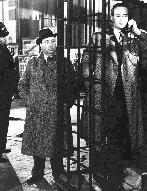
Missed It By That Much: "Robin and Marian"

Missed It By That Much
A series of analyses of treasured film that are not classics,
though they could have been if only a few elements were changed.


"Robin and Marian" (Columbia/Tri-Star) 1976
Director: Richard Lester
Screenplay: James Goldman

On paper, it looks perfect. The author of "The Lion In Winter" jumping a few years ahead in the story to tell of the end of Richard the Lionheart's bloody Crusades, and the return of Robin Hood and the loyal Little John to Sherwood Forest, where they find a lot has changed. Directing would be Richard Lester, who had returned to A-list prominence with his extraordinary staging of "The Three Musketeers"/"The Four Musketeers." He was becoming the "go-to" guy for period dramas, finding ways to bring a mature light-heartedness to any dreary point in history (or more appropriately, he would ignore Hollywood sound-stage pretense and show historical periods a bit more accurately--for example, his fly-filled Rome in the otherwise schtick-filled "A Funny Thing Happened On the Way to the Forum"). In the years since, his successes had been spotty: "Juggernaut," his all-star take on the disaster film, sank at the box-office (never mind--watch it!), as did his dream-project "Royal Flash" bringing his "Musketeers" adaptor George MacDonald Fraser's character to the big screen.
But "Robin and Marian" had that Goldman script (unfortunately, Goldman's other produced screenplay "They Might Be Giants," although good for naming rock bands, also failed at the box-office despite the star-power of a post-"Patton" George C. Scott and Joanne Woodward) and a dream-cast. Goldman wanted Nicol Williamson as Robin and maybe Sean Connery as Little John. Lester got them, but reversed the roles, which Goldman had to admit, worked. Robert Shaw would re-unite with his "From Russia With Love" co-star (and golfing partner) as the Sheriff of Nottingham. Richard Harris would play King Richard, Denholm Elliott and Ronnie Barker (of "The Two Ronnies") would be Merry Men. Ian Holm would appear as the weasley King John. But, with the role of Maid Marian, they hit the mother-lode: after nearly a decade off the screen, producer Ray Stark coaxed Audrey Hepburn to play the older, wiser lost love of Robin Hood.

Filming was done in Spain (Lester's old haunt from "Musketeers" and "A Funny Thing Happened On the Way to the Forum") and completed quickly--Lester's a "one-take" kind of director which always appealed to Connery.

Then things started to go wrong.

The script by Goldman is charming, but often relies, as did "The Lion in Winter" on piquant anachronisms--the kind of "Isn't that funny? They talk like we do!" approach to historical drama that can be a bit cloying. "You never wrote!" complains Maid Marian at one point in the script about Robin Hood's many years away. "I don't know how!" says Robin in perplexed reply.

But there are some nice things--the over-all theme of living past your prime or need, combined with Robin's nostalgia for the old days and his childish belief that he can make things right again on all fronts. There are some nice little cliche-bashings. I remember a couple of cut-away shots of Nicol Williamson's Little John looking pained at Robin and Marian expressing affection for each other, and thinking, "Oh Lord, they're going to make Little John gay!" which I thought was a pretty cheap way to bring in relevance to the story. But it proves to be a clever gambit. Later in the film when Marian goes to John and begs him to keep Robin out of battle, she makes the same assumption. "You've always been jealous of me! But you had him all those years!" Williamson beautifully underplays this scene "Yer Rob's lady," he mumbles. "What?" she cries. "If ye'd been mine, I'd never've left." and Williamson chucks the apple he was eating into the night where it arcs and disappears. Nice set-up. Nice turn. As is the ending, recreating the myth of Robin firing one last arrow through the window, telling John to bury Marian and he where it lands. In Lester's last shot, it never falls to earth.

The charm of the script no doubt appealed to Hepburn--she has a speech at the end that most actresses would kill for, though, practically. it slows the film to a crawl at a critical time. There are publicity pictures of Lester and Connery showing her around the set, but Hepburn, given Lester's directorial approach of "You act, I'll shoot" might have been a bit put off by his quick approach and lack of hand-holding.

She made complaints about some of the gristlier aspects to Lester's cut, particularly to his opening the film with a shot of ripe fruit, and ending it, with the fruit rotting in the sun. This is a brilliant way to express an aspect of the story--that Robin, and Marian too, have overstayed their usefulness. And the film is gritty. The staging of an opening scene in a burned-out desert fortress feels more like everybody's waiting for Godot rather than King Richard. And Lester keeps his own anachronisms well-chosen, for example Robin Hood's morning routine--waking up in the forest, stretching, brushing his teeth with a fir branch, and reaching for a good ball-scratch until he sees Marian waking up--Connery's hopping attempt to be nonchalant is priceless.

And the violence is rough stuff. People die very badly in the film despite the chain-mail and armor, and the wounds they suffer are played up. Lester seemed determined to counter-act any chirpiness in the film by bringing it down to Earth. Maybe this upset Hepburn.

But for whatever reason, producer Ray Stark chose to take control. Initially, Lester employed Michel Legrand, his composer for the "Musketeers" films, to write a period-appropriate score, which was met with much approval, though it wasn't tuneful or romantic in any way. Stark, hearing the score, and not having control over much else, replaced it with a quickly put-together score by John Barry, who'd worked with Lester before and whose James Bond scores for Connery were well-known. He also won an Oscar for the music for Goldman's "The Lion in Winter." Barry's a wonderful composer, but the main-stay of his score is a bucolic love theme that frequently bounces over the scenes and makes them too sweet for a film about the passing of youth and the end of days. It's sounds like it would be more appropriate for a film about otters frolicing than "Robin and Marian." Perhaps Stark thought would be enough to soothe the blue-haired ladies going to see Audrey Hepburn's first film in a decade. Given her rather cute performance, maybe it would have been a good idea to re-cast her, too. Perhaps she took the role as a chance to get another Oscar (she won in 1954 for "Roman Holiday"--Katherine Hepburn won for her starring role in "The Lion in Winter"). She didn't get it. Nor did the blue-hairs show up. The film was not a major hit at the box office.

I've never heard the Legrand score, but considering the amazing job that he did scoring "The Three Musketeers" for Lester, the two might have done something very interesting for this film. But we'll never know. "Robin and Marian" is locked in a bizarre nether-world where it's at once too sweet, but also stark and unsentimental. Lester could make misconcieved films, but his approach to counter-point Goldman's sentimentality in a world of hardship was a good one. One would have liked to have seen that version of the film.

Sunday, August 26, 2007

The "Now I've Seen Everything" Dep't. - Alfred Hitchcock II

Alfred Hitchcock: Immigrant Worker of Suspense

The first years of Alfred Hitchcock's work in America show the patterns and themes that he'd explored in his German and British periods and would obsess his future films. But an interesting transition occurred between "The Paradine Case" and "Rope." First of all, Hitchcock began working with color film with the same eye to detail that he brought to the shadows of black-and-white. Second, with "Rope," he began working as his own producer. Such was his success in his first years in America, that soon he left the Selznicks and the Wangers behind, assuming more control over his projects (although he still had to answer to the banks and studios). But there was also a change in the subject matter: while there was still the requisite threat of murder, intrigue and deception (as well as wrong men, false imprisonment and threatening mothers), "The Paradine Case" was the last Hitchcock film to feature "shame" as a major theme. From then on, the world of Hitchcock was filled with more sociopaths and genuine evil that knew no shame, and frequently relished their crimes. The concern with reputation and "what others will think" became irrelevent. From now on, it was a fight for survival. Whether this was Hitchcock's conscious choice, or a result of his work during the war (he worked on documentaries dealing with the German work-camps, as can be seen "Of Marginal Interest"), or the imposed morality of his producers or the Breen Code is hard to say.

WARNING! SPOILERS ABOUND IN THESE CAPSULE SUMMARIES!! WHATEVER YOU DO, IF YOU HAVEN'T SEEN THESE HITCHCOCK FILMS, THEN DO NOT READ ANY FURTHER (By all means, go to the attic OR the basement, take a shower OR a ride on a carousel, wait in a corn-field OR the schoolyard, visit Mt. Rushmore, the Statue of Liberty, the Bates Motel, OR a beach on the French Riviera, or for that matter, just sit in your room and watch your neighbors but for the love of an omnipotent uncaring God...) I REPEAT, DO NOT READ ANY FURTHER!!! DAMMITT!!!

(Thank you and have a nice day)


Alfred Hitchcock's "The Paradine Case" (1947) Adapted by wife Alma, but with a script credited to producer David O. Selznick, "The Paradine Case" was a British court drama, with very few British actors, save for Charles Laughton as a prejudicial judge. Selznick hired his then-prodigy Alida Valli for the role of a woman accused of murdering her blind husband. She goes through the indignities of searches and imprisonment, which must have appealed to Hitchcock, as well as the scorn of Society--seems she was having an affair with her groom played by a not-at-all British Louis Jordan, who looked like he'd never spent any time in a barn. Convinced of her innocence, her barrister (played by the also-not-veddy-British, but very stalwart Gregory Peck) struggles hard to win her freedom and preserve her reputation, though he also has fallen under her spell, threatening his marriage, his wife being the object of lust for Laughton's judge, who happens to be presiding over the case. You think that's a tangled web? How about the behind-the-scenes stories of the casting! Jourdan was hired to fulfill a contract obligation, Valli for her...relationship with the Producer, and Peck for box-office potential. Anything but story-logic. Peck, whom Hitchcock had troubles directing in "Spellbound," tried hard to give the young actor more gravitas, dying his hair gray, and shooting him from below, but at this point in his career, Peck was quite incapable of expressing humiliation, which undercut the entire point of the film. Hitchcock also had to contend with Selznick's customary second-guessing and last-minute re-writes. If Hitchcock had any doubts about producing his own films, the unpleasant circumstances of "The Paradine Case" would have dispelled them.
Hitchcock appears at 36 minutes in leaving Cumberland Station carrying a cello.


Alfred Hitchcock's "Notorious" (1946) Another of those bench-mark Hitchcock films. Working from a Ben Hecht script, Hitchcock fashioned a nearly perfect spy story involving a love triangle, a woman's degradation, Nazi spies, and a rather fortuitous "MacGuffin." Ingrid Bergman plays Alicia Huberman, daughter of a convicted Nazi agent, drowning her sorrows with a mixed cocktail of fast-living and slow-gin. Lindsey Lohan of the War Years. She is recruited, somewhat improbably, by the government to spy on some of her father's old cronies, fussily plotting in Latin America. Being patriotic, wanting to clear the family name (and falling in love with her "liaison"--in both senses of the term--named Devlin, though Cary Grant pronounces it "Devil-in'") she readily agrees, and before long she has ingratiated herself into their midst, and into the heart of one of them, Alex Sebastian, played with great sympathy by Claude Rains. Soon, Sebastian asks to marry her. Her superiors are overjoyed, Devlin is jealous and torn by duty, and Alicia, seeing Devlin's seeming ambivalence, goes along with it.

For Hitchcock, the story boiled down to "How can a spy organization claim the moral high ground when prostituting someone for information?" In the process of saving her family's reputation, Alicia must destroy her own in the eyes of her lover and their bosses--who seemingly think so little of her that it hardly causes a stir. And Devlin watches the woman he loves marry another man or compromise the mission.

Bergman is great throughout: depressed as a society floozy, radiantly in love with Devlin, confused and haunted in Latin America. Grant plays Devlin with a facial passivity, never cracking a smile throughout, an operative who keeps his emotions in check. Claude Rains is the smitten Nazi, whose devotion to Alicia makes him a sympathetic villain (he has the trademark Hitchcock overbearing mother, as well), and Louis Calhern is the spy boss with all the charm of a corporate snake-oil salesman.

Much is made of the "MacGuffin" in this one, written a year before Hiroshima. It's described in the script as "some sort of metal ore," a compromise when someone advised Hitchcock not to say the word "uranium." Even that caused enough of a stir that Hitchcock was investigated and tailed for three months.

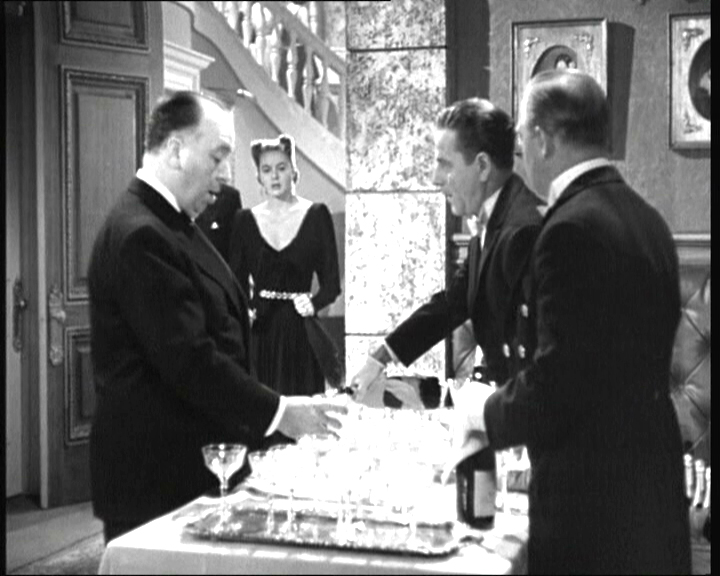
Hitchcock appears at the Sebastian party drinking champagne and quickly departing at 01:04:39.


Alfred Hitchcock's "Spellbound" (1945) Hitchcock always has a little bit of a problem translating psychology to the screen--curable psychology anyway, and "Spellbound," though it tries very hard to legitimize Freud's treatment of mental illness through dream analysis, makes it look more like a stunt. Especially in a "Dali-esque" dream sequence (because Salvador Dali really designed it!) that when it's explained causes a bit of eye-rolling. Ingrid Bergman plays a psychologist at an insane asylum, where the staff is awaiting the arrival of the new administrator, Dr. Edwardes. When he shows up they are surprised to find him a youngish man (Gregory Peck), who is given to odd reactions when Ingrid makes suggestive marks in a table-cloth, or at other seemingly innocent times. Soon, this wrong man is suspected of killing the real Dr. Edwardes, and it takes the power of dream analysis, and the love of Ingrid Bergman to make everything right again. It's melodramatically crafted (with a script by Ben Hecht and Angus McPhail), but in pushing the love story, they might have taken it too far. Franz Waxman's score, though unconventional in places, evokes hearts and flowers a bit too hard (as does a rather silly impresionistic shot of doors opening) and combined with the very literal dream-work can produce a fit of giggles. Add to that some unconvincing process work in the skiing scenes. They also might be hitting it a little too close to have a shrink straight out of Vienna doing a little analysis on Dr. Edwardes. Unfortunately, Gregory Peck is a bit unseasoned to pull off the complexities of what are asked of him, mostly looking rather vague, while Ingrid Bergman fares a bit better, though one has to wonder about her ability to be impartial, given the way she gets involved with her patient here. The stand-out performance, though, is by Leo G. Carroll in the role of the retiring administrator. There is some nice work in this, and one should remark particularly of a Hitchcock surprise--using huge models to keep the foreground and background in focus simultaneously--he also employed this in "Dial 'M' for Murder."
Hitchcock emerges from an elevator carrying a violin case at 43 minutes into the film.


Alfred Hitchcock's "Lifeboat" (1944) Hitchcock first arrived in America to make a movie about the Titanic, but it was scuttled for "Rebecca." This might be classified as a sequel of sorts. Six torpedo-attack survivors of various nationalities and backgrounds must maintain a kind of survival in a lifeboat in the middle of the ocean awaiting a rescue that may never come. Think "Stagecoach" on a raft, rather than out West, or "Gilligan's Island" without the island...or cocoanut jokes. The floaters are made up of a fashion writer, a millionaire, an Army nurse, and an English woman carrying her dead child...the crew-survivors are a black steward, the radio operator, a leftist, and an injured sailor. John Hodiak is the ostensible working-class hero, the imperious Talulah Bankhead is the high society reporter who must adjust to a more primitive lifestyle. The others, including William Bendix and Hume Cronyn, are the shark-fodder in various stages of will-to-live. And then, as the Nazis is Walter Slezak. Nazi? Who said anything about Nazi's?** Well, this was made during war-time, and Hitchcock was really making a movie about the dynamic of "can't eveybody just get along?" Well, Ingrid, if everyone got along--there wouldn't be a mooo-vie...In Hitchcock's microcosm of diversity (sketched out by John Steinbeck, and scripted by Jo Swerling, who wrote "It's a Wonderful Life" and "Guys and Dolls"), its the drama that results that matters. Contrived? Yes. But there's plenty of Hitchcock in this one, despite having no place to move the camera. And even a lifeboat leaves plenty of room for people to display the best and worst of their natures.
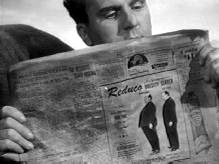
In what is probably his most ingenious cameo, Hitchcock shows his newly trimmed form in the "before" and "after" pictures in a "Reduc-o Obesity Slayer" advertisement in a conveniently brought-along newspaper at 25 minutes into the film.


Alfred Hitchcock's "Shadow of a Doubt" (1943) Though he sometimes denied it, Hitchcock cited "Shadow of a Doubt" as his own favorite film, partly because of his collaboration with playwright Thornton Wilder (and wife Alma and Robert Audrey, as it turns out), but also because of the immaculate way this combined study of home-town life and a serial killer in the family works so seamlessly.

The Newton family is tinged with a touch of the macabre, but only because their lives and family are so "normal." If they only knew the truth. Charley hates her normal life in Sant Rosa. She wants adventure, and mystery and romance. She wants something to happen! Better watch what you wish for, kid: Her namesake, Uncle Charlie, is coming to town. And it's not for nostalgia, although Uncle Charlie is all about nostalgia. No, Charlie the elder is coming for a visit because he's on the run from a couple of detectives tracking the "Merry Widow" Murderer. And before you can say "black smoke from a train over-shadowing everything good in town," he's starting to arouse suspicion, especially in his adoring niece.

It's hard to know where to start--"Shadow of a Doubt" is, like "Strangers on a Train," "Rear Window," "Vertigo," "Psycho" and YOUR favorite Hitchcock film, the director at his peak. The presentation, they way the film is shot (one of my favorites is a medium close-up of Uncle Charlie nestled in bed, the headboard of which seems to be forming angel's wings...or are they devil's?), how Hitchcock turns the warm, inviting town of Santa Rosa into a threatening hell in the latter half, the way his camera crawls up to Joseph Cotten's face as he starts a tirade about modern times and the idle rich, and when the niece (off-camera) protests, his face swings into the camera and envelopes it (Joseph Cotten was never better than this movie--exploiting his slightly louge manner as a kind of pathology, and young Teresa Wright, who would have a long Hollywood career matches him). The family is full of Wilder-Hitchcock eccentrics that to reveal much would spoil the fun, but watch for a very young Hume Cronyn, who was a frequent Hitchcock collaborator (he adapted "Under Capricorn" for Hitchcock) in a key role. It's filled to bursting with good ideas that warrant repeated viewings.
***
Hitchcock plays cards on the train to Santa Rosa at 17:00 into the film. He must have known the picture was going to be good--this is his "gin rummy" hand.


Alfred Hitchcock's "Saboteur" (1942) "Saboteur" is, like "The Thirty Nine Steps," one of those Hitchcock "Wrong Man on the Run" stories that reached its zenith with "North By Northwest." In fact, "Saboteur" might as well be the blue-print for the Cary Grant film. Robert Cummings (who would show up again in "Dial 'M' for Murder") plays a minutions worker who is accused of sabotage and goes on the run to prove his innocence. Dorothy Parker worked on the screen-play and her wit can be seen when Cummings and the inevitable blonde accomplice (Priscilla Lane, imposed on Hitchcock by Universal--she gets top billing) hide out in a train-car of circus freaks. But what "Saboteur" is most famous for is its over-the-top finale. Where "North By Northwest" used Mt. Rushmore, "Saboteur" stages its final confrontation atop the Statue of Liberty, when Robert Cummings must help the man who can prove his innocence (a young Norman Lloyd, who would go on to produce "Alfred Hitchcock Presents") from falling from the Torch. Staged in near-silence, without music score, it is one of the most nail-biting sequences any director has put to film. In a movie that deals with the theme of patriotism in time of war, it's a giddily hysterical sequence that still manages to thrill. The effects, for its time, are spectacular as well.
Hitchcock stands outside a drug store 60:00 into the film.


Alfred Hitchcock's "Mr. and Mrs. Smith" (1941) Hitchcock's next film is an anomaly--a comedy with Carole Lombard (who coerced him into directing) and Robert Montgomery. He's a partner at a prominent New York law-firm. She's...incorrigibly cute in a cloying kind of way. When they have a spat they don't go to bed mad. They lock themselves in their apartment--he doesn't go back to work until they're back blowing kisses at each other. During a reconciliatory breakfast, this brilliant lawyer makes the mistake of saying he probably wouldn't get married again if something happened to her. Then, convenienetly, it's discovered that their marriage wasn't legally binding. Hilarity ensues.

Well, not much. There is a protracted scene that produces well-earned chuckles when the two, now dating separately, end up at the same night club and simultaneously spy on each other and pretend they're having a FAB-ulous time. But that's about it. Hitchcock would flirt with cutesiness later in his career, but he would never again commit himself to a project where the only jeopardy is getting stuck on a World's Fair thrill ride in a down-pour (the 1939 New York World's Fair is only tantalizingly seen). The only "wrong man" here is Robert Montgomery (Elizabeth's Dad) who is so twee in this, he could be auditioning for "Bewitched."
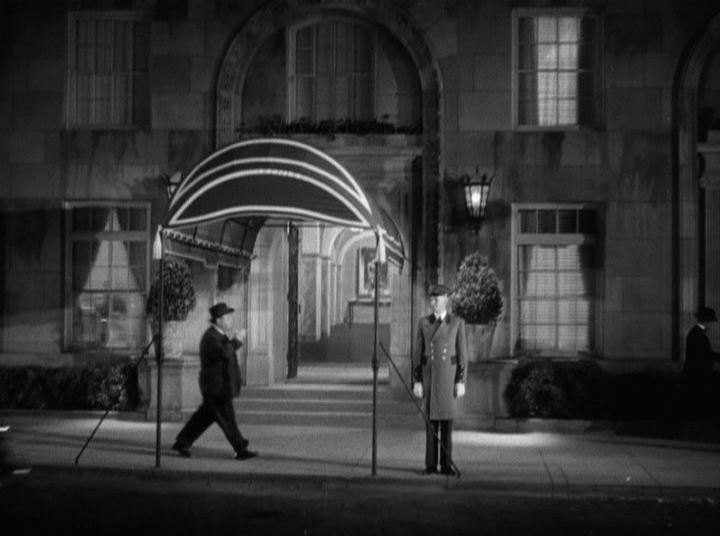
Hitchcock walks in front of the entrance to their apartment building at 41:00 into the film. He's moving pretty fast--perhaps he's trying to make a getaway.


Alfred Hitchcock's "Suspicion" (1941) Hitchcock and Fontaine again, after "Rebecca," and with some qualities to the earlier film, but pushed further. This time Cary Grant is the husband for the tremulously suspicious wife Fontaine plays, but instead of having a shady past, she thinks he's a murderer, and that he wants to murder her! Fortunately, she has a good soul-mate in the director, who angles everything in that direction.**** In the most famous shot of "Suspicion," Grant walks up from the kitchen to deliver a glass of milk to his by-now paranoid bride. She's sure he's poisoning her, so Hitchcock stages the walk up the circular stairwell dramatically, with a spider web of shadows splayed against the walls, and the glass of milk ominously glowing--Hitchcock put a light bulb in it, and wired it up to beam from the glass. Nigel Bruce (Basil Rathbone's "Dr. Watson") plays friend and confidante, and all the performances are top-notch. Grant and Fontaine make a great screen couple, even if a very dysfunctional one.
Hitchcock mails a letter at 45:00 into the film.


Alfred Hitchcock's "Foreign Correspondent" (1940) Hitchcock's second film in America, and once again, you wouldn't know it. A lot of it takes place in Holland, so of course, you have inclement weather and a windmill figuring prominently in the plot. Reporter Joel McCrea (with ultra-American name of Johnny Jones) is in Europe following the efforts of a Dutch diplomat carrying an Allied treaty. When the diplomat is kidnapped by Nazi Agents, McCrea shucks off his objectivity and pursues the kidnappers..and the story.

According to Wikipedia, a huge slew of writers participated in the screenplay.***** But despite that, Hitchcock couldn't secure his choice for the lead, Gary Cooper, as he wouldn't stoop so low as to make "a thriller." There are the requisite betrayals and double-crosses. At one point, Joel McCrea goes out the upper-floor window of his hotel to escape his captors and over to the adjoining room, just as Cary Grant would in "North By Northwest" 20 years later. And there are the Hitchcockian set-pieces: a murder in the driving rain, as we follow the killer's path through a path of jostling umbrellas; a windmill that reveals its secrets by turning against the wind; and a rather mind-blowing shot of a plane crash-diving into the ocean from the cockpit's perspective, complete with water flooding the chamber violently.

And it ends with a plea for America to get into the fight, as McCrea reports his story in a darkened broadcast booth in London as the bombs begin to fall.


"Okay, we'll tell 'em then. I can't read the rest of the speech I had, 'cause the lights have gone out, so I'll just have to speak from the cuff. All that noise you hear isn't static - it's death, and its coming to London. Yes, they're coming here now. You can hear the bombs falling on the streets and on the homes. Don't tune me out, hang on a while - this is a big story, and you're part of it, it's too late to do anything here now except stand in the dark and let them come... as if the lights were out everywhere, except in America. But keep those lights burning, cover them with steel, ring them with guns, build a canopy of battleships and bombing planes around them. Hello, America, hang on to your lights: they're the only lights left in this world!"

At our point in history, it is easy to look at "Foreign Correspondent" with the knowledge of the London Blitz. But for the audiences at its premiere those events hadn't happened yet. The film opened at the time The Battle of Britain was happening in the skies. Three weeks later, German bombs started to fall on London as depicted in the film.

Apparently, Joseph Goebbels admired it as a great piece of propaganda.

And Gary Cooper would later tell Hithcock it was a mistake not to have starred in this movie.
Hitchcock walks in front of Joel McCrea reading a newspaper at 11:00 into the film.


Alfred Hitchcock's "Rebecca" (1940) Hitchcock's first film in America, under contract to Über-producer David O. Selznick.****** Hitchcock wanted to film this himself, but couldn't afford the screen-rights, and originally, he was supposed to make a film about the Titanic for Selznick, but when that fell through, or the plans sunk, Selznick suggested the Daphne DuMaurier story, a sort of modern take on a Brontë novel, instead (she also wrote the original story for Hitchcock's "Jamaica Inn" and "The Birds"). Despite being his first film in America, the film is as British as British can be--the story takes place in England, the three leads are British, but because Hitchcock had no access to real locations, "Rebecca" has a remote, fairy-tale quality to it--almost Disney-esque. Joan Fontaine is the unsophisticated girl who happens to fall under the charms of the rather frosty Maxim DeWinter (played with a certain lack of commitment by Laurence Olivier). Following their hasty marriage, he brings her back to the Manderley Estate, where if she isn't her own worst enemy, the staff, especially the creepily engaged Mrs. Danvers, is. Danvers (Judith Anderson) makes no secret of her preference for the deceased former Mrs. DeWinter (the "Rebecca" of the title--Fontaine's character, significantly, isn't named at all) and it becomes a psychological battle of wills between the idealized past and the haunted present. Hitchcock's first film in America won the Best Picture Oscar for 1941. The award went to Selznick. The award for Best Directing that year went to John Ford for "The Grapes of Wrath," his third Oscar of the five he would win in total.

Alfred Hitchcock never won an Oscar for Best Directing.

Hitchcock is waiting while George Sanders makes a phone-call towards the end of the film.

* There is a spectacular shot in "Notorious," during the part sequence, that travels from the second floor balcony and slowly swoops down to an all-important key in Ingrid Bergman's hand. It's an amazing shot filled with suspense of its own accord. Well, Cary Grant kept that key as a good-luck charm for most of his life, but when he heard that Ingrid Bergman had developed cancer, he sent it to her for luck. At Hitchcock's AFI tribute, Bergman, knowing she was dying, gave the key to the frail Alfred Hitchcock, who would only live another year, himself. They held onto each other close, and whispered in each other's ear. It is the most genuine, emotional moment seen in those false-sentiment AFI events.

** This Nazi happens to be one of the crew-members of the U-boat that sank the freighter everyone came from.

*** Hitchcock's graddaughter took a college course studying his films and turned in a paper on "Shadow of a Doubt," with the help and advice of her grandfather. When she only got a C+, he replied, "Sorry, sweetheart, it was the best I could do!"

*** Hitchcock was on loan to RKO, and when one of the executives saw "Suspicion," he was so alarmed that he took out every shot that implicated Grant. The film ran 55 minutes long.
Cooler heads prevailed.

**** Their list: Robert Benchley (who appears in the film), Charles Bennett, Harold Clurman, Joan Harrison, Ben Hecht, James Hilton, John Howard Lawson, John Lee Mahin, Richard Maibaum and Budd Schulberg. That's quite a list! But Walter Wanger had been trying to make a movie like this since 1936. A lot of writers had a lot of opportunities over the years.

***** Also according to Wikipedia, Selznick's meddling influence informed itself into a couple of Hitchcock's films. Roger O. Thornhill, the protagonist on "North By Northwest," at one point mentions that the "O" stands for "nothing." Supposedly, the "O" in David O. Selznick didn't either, Selznick picking the "O" for how it sounded. And Thorwald's attire in "Rear Window?" Modeled after Selznick.

And that's where I stop. I've only seen a couple films from his British period (The excellent "The 39 Steps," and that only recently, and the original version of "The Man Who Knew Too Much" with Peter Lorre). But, with some minimal searching, the Internet has a few complete Hithcock's from the period available to stream (And this is, "Alfred Hitchcock II", after all) I would also direct your attention to the Hitchcock version of Wikipedia, still in its infancy, but from there you can find a web-site called the "1000 Pictures Project" reducing every Hitchcock film to 1000 individual frames. Once I found that, I found it incalculably useful for illustrations throughout the text (I believe they follow a mathematical pattern: divide the film's length by 1,000, a grab a frame at every interval of that amount. It would explain why some critical shots are not included. But, hey, if you've got a complaint, you try it!). I also spent some enjoyable time re-acquainting myself with "Hitchcock/Truffaut," Francois Truffaut's near-definitive book-length interview with Hitchcock. Want to hear the original tapes of those sessions? Go here. You'll find that the book (translated from English to French and then back to English) doesn't follow the conversation too exactly.

Is Hitchcock important to Film, or as he put it, The Cin-e-ma? Of course he is. The man, with every film, designed a new way to present the world, a new way to communicate it, to turn it into art. He managed to expand the vocabulary of visual presentation, of film itself, into a whole 'nother realm, and one would think that that expansion stopped dead with Hitchcock, given how often his tricks and framings are used by current directors. Often imitated. Never topped. One is hard-pressed to think of anyone since who has furthered that work. The fact that Hitchcock worked in the thriller realm should not negate his importance, though it almost certainly kept him from winning an Oscar for directing...ever (he won the Irving Thalberg Award in 1968). Big deal. He was a name unto himself in Hollywood and throughout the world. Though he may not have had great success at the end, he never stopped being a household word, or being a significant draw for his movies. And that's a result of consistently being innovative in ways of connecting with his audience.

And after all, Ingrid, it's only a moo-vie.

The other aspect about Hitchcock to remember is that he was relentlessly entertaining...just fun.

It would spoil things to take Hitchcock too seriously.

Peter Bogdanovich tells the story of interviewing Hitchcock, and after a few drinks, they take the elevator down to have dinner. At the 18th floor, more people come in to go to the dining room, and Hitchcock begins talking, "...Oh, it was horrible! There he was, lying in a pool of his own blood! Blood coming from his ears...from his nose...Blood everywhere!" Bogdanovich has no idea where this is coming from, but assumes that's because he's a little drunk, he must have missed something. At the 15th floor, more people come in. Hitch continues: " Blood everywhere! He was such a sorry mess, and caked on the walls, it was absolutely horrible, I thought 'I need to go call a doctor, but was there time?'" The elevator is now at the bottom floor to the dining room and the bell rings. "And I said to him, 'What happened? How did this happen?'" The door opens. No one moves. Everyone is waiting to hear the answer. "Excuse me," says Hitchcock and grabs Bogdanovich and exits the car first. Eventually, the elevator car empties...but Bogdanovich turns to Hitchcock, whispering, "Well, what did he say?" Hitchcock waves him off, "Oh, nothing...that was just my elevator story."

Friday, August 24, 2007

Movie Review - "Sunshine"

"...They went at night."

"Sunshine" is Danny Boyle's homage to "2001"* while serving up an environmental metaphor in a sci-fi setting, a dissertation on the uses of faith, while also landing in the "Incredible Mess" subcategory of films.

It goes like this: Our sun is dying. Seven years ago, the spaceship "Icarus I" headed out for the sun to drop a payload the "mass" of Manhattan Island to re-ignite it and stop the new Ice Age developing on Earth. The ship disappeared mysteriously, and so, "Icarus II" was launched, same mission, same payload. You'd think with the luck they had with the first one, they wouldn't name the second ship the same thing. Plus, if you're going to the sun, "Icarus" might not be the most inspiring legend to name your ship after.**

Be that as it may, the ship is as "green" as can be, with its own eco-system/garden (overseen by Michelle Yeoh) providing oxygen for the ship. But it wouldn't be much of a space drama if things went smoothly, and before you can radio "Houston, we've got a problem," people get hot under the helmet-collar and things start to come apart faster than an "O" ring on a chilly day. The ship's shrink may be getting a bit too much sun. The "payload expert" (Cillian Murphy) and systems engineer (Chris Evans) are not getting along in what the pilot (Rose Byrne) calls "an excess of manhood breaking out in the com-center," and a slight miscalculation by the navigator creates a series of unfortunate events, and turns him suicidal.

Geez, folks, go outside. Get some sun.

Danny Boyle can be counted on to breathe new oxygen into any genre, like "Trainspotting" for the "kitchen-sink" film, "28 Days Later" for the "zombie" movie, but "Sunshine" has so many echoes of Kubrick's "2001" right down to color schemes, ship designs, POV shots, "Icarus's" somewhat fussy computer behavior, freeze-frames in vague situations and close-up eye shots that "A Space Odyssey" is never too far from his frame (Murphy even has a slight resemblance to Keir Dullea). The dynamic of the crew is right out of Scott's "Alien," and the denoument is subject to interpretation (after the "multiple endings" debacle of "28 Days Later"). One also suspects that to secure a rating, or due to some preview-audience's expressed discomfort, some make-up effects have been toned down to near-imperceptibility. But, by and large, its a fascinating excercise in a genre that, if it asks too much of a leap of faith from its audience, can become laughable. "Sunshine" is far from that. It's always a little bit exhilarating to see a sci-film that obeys the laws of orbital mechanics, knows the dangers of space-travel (where math can be fatal), and doesn't have one ray-gun.

Best to see it on a big screen, it's full of little details that won't translate on video.

"Sunshine" is a Matinee for a rainy day. Bring some sun-block.

* in fact, it's a bit scary how many little ties to "2001" there are. Why, you'll even see a black monolith or three in this film.

** In his acceptance of the D.W. Griffith Award from the Director's Guild in 1999 Kubrick evoked the Icarus story to talk about D.W. Griffith's rise and fall in the film business. "I always felt the message of the 'Icarus' story wasn't "Don't fly too high," but, rather, "Do a better job on the wax and feathers!" You can see that speech here.

Wednesday, August 22, 2007

Movie Review - "The Simpsons Movie"

"That's why we should hate kids!" Moe from TSM

Although for a good portion of its 18 seasons I've missed seeing new versions of "The Simpsons," for the most part, I've kept up with the incredible turns their lives have taken. When I do, I am usually shocked by the breadth and depth of the humor and the pot-shots it takes at culture...any culture. Plus, they have a true comedian's gift for choosing the perfect terms for maximum effect, as opposed to the sloppiness of wannabe's like "Family Guy."

My favorite line from "The Simpsons" came from an episode where Homer, after having a pencil removed from his frontal lobe (he had shoved it up his nose at some point), becomes much smarter, but finds life with increased intelligence in his hometown of Springfield horrible. "You've got to help me, Doc!" he implores at the end, "I'm a Spaulding Gray in a Rick Dees world!"

Well...I think it's hilarious.

So, what could a "Simpsons" movie add after 18 bloody years on Fox? A lot of reflexive humor dealing with the auditorium experience as opposed to "the box," a bit more risque behavior, some yellow toe-dipping into CGI, a bit more experimentation with delayed comic timing that you can't do with a 24 minute time-clock limitation. But it's more of the same, basically. I have a notebook full of funny lines that I could parrot back, but it'd just undercut them when they show up, as "The Simpsons" depends on shock, surprise, and good comic ideas you've never heard before. I laughed all the way through its preview trailer, but, for once, it didn't even scratch the surface of the laughs contained in the full film. And another good sign--the theater workers kept sneaking in on breaks to watch it.

"The Simpsons." More powerful than a nicotine fix.

But, if you don't like "The Simpsons," you won't laugh much at this movie. I howled throughout, and another few people laughed occassionally in the smallish crowd, and the kids in the audience "haw-hawed" at the physical humor while the rest of it barely brushed their scalps. In a big theater, it'd be interesting to see how many people actually laugh...just to see if people are pre-disposed to laugh. A lot of the folks in the audience seemed...restrained. Their loss. I giggled like a goon.

One thing that upset--"Music by Hans Zimmer?" Doesn't he get enough work? What about the brilliant Alf Clausen, the musical genius behind "The Simpsons" for two decades?! "D'OH!"
"The Simpsons Movie" is a cheap matinee. "Ha Ha!"
------------------------------------------------------------------------
News Update:

Odd little things from the week, probably better placed after the review for "The Simpsons."

--It's the dog-days of August, which means kids are getting bored with Summer, and really, really anxious (apparently) to go back to school (or to The Slammer). So hi-jinks ensue in the month of August. It's the time of year when you get phone-calls to ask if you've got "Prince Albert in a can," or your mail-box gets cherry-bombed, like mine was in Normandy Park a few years ago (In fact, now that I think of it, that would make a great screen-play--for that time of year when kids get restless and prank-ish...what would you call it, "A.D.D.-Days of Summer?"). I drove to work the other day and passed by the reader board for the "Trinity" Church, which read "Jesus Loves Worship." Driving back at night, the other side read "I love tits." Evidently some devil-inspired young'un changed that side more to his liking. Drove by it again yesterday afternoon--the other side now said "Jesus Forgives." So does the Pastor, I guess.

--I had another story which I thought was funny, but after writing it out I realized that folks might deduce the people involved, it could get back to them, and hurt them in some way. I liked it because it was done without guile and with a total lack of "hyper-sensitivity." When I wrote it out I concluded "I wish the world was like this."

But it's not.

If you see me, ask me about it some time.

--I hit a deer with my car the other night. Now, if you know me, you know I'm really damned vigilant about watching out for deer and other wildlife while driving on the Rock. But this deer was too stupid to live, drunk on sour black-berries or something. I was driving 35 in a 40 zone, and the thing walked onto the road when I was practically on top of it--a deer suicide, apparently. I had just enough time to yank the wheel to the left and avoid hitting its head with my passenger head-light. At worst I gave it a round-house to the jaw--absolutely no damage to the car, so I couldn't have hit it hard. But it's probably missing a tooth or two. I went back to check on it to see if it was still there, and it had evidently high-tailed it--fleeing the scene of an accident.

I hate hitting deer. Hate it.


--For the last few weeks I notice I'm getting a lot of "hits" from folks who are tracking back from a picture of Leif Garrett I used to illustrate Mark Hamill's hair in "Star Wars" away back in this post. Now, the thing is, I didn't even post the picture. I just linked directly to it, and for some reason all roads from that picture lead to me...or that post. I'd better go and fix a couple of mistakes I found in it.

Tuesday, August 21, 2007

Feelin' Good

Starting a marathon of freelance, with tutorials to edit and crunch (by Thursday), sweetening three animations for some old friends (who've payed me very well...and just gave me carte-blanche on it--SWEET!) and I'm working split-shifts recording foley for a film in the evening. On top of that, I'm watching a lot of television in my capacity of being an Emmy voter (I have to watch an hour of "Two and a Half Men" tonight...oog!). This may entail some late nights. Especially considering I'm working 'til 10:30 pm, then have a 2 hour commute home (One bright spot is that the imminent terror attack of the ferries won't happen around midnight. Sheesh!) K.'s working in town for three days (with dog in tow, so no "sitter" traffic). It's just me and my work.

But there is a bright spot to all this...I'm working, for one...fine enjoyable work.

But today I had a physical that I'd been planning for a couple of months. My Bad cholesterol is High, My Good Cholesterol is Low, My Sugar level is higher than the Norm (but nowhere near diabetes level), my tri-glycerides are low. I'm a little overweight. This is all shitty news.

But my blood pressure is lower than the consumer confidence index. Lower than Bush's approval rating. Lower than a metaphor for something really low. For some reason, that has nothing to do with heredity, I have ice-water in my veins. And when Dr. Smith took out his little pocket calculator and fed my shitty statistics into his little Cornonary Calculator, I came up with a 10% chance.

10%. "Putting you on cholesterol medicine would reduce your chances another 3% (snaps the thing shut) Why bother?"

Yes! So I'll eat less chocolate chip cookies. More fruit on my healthy-healthy cereal in the morning. More stir fry, even less fast-food (to approximately none). Chips are already out. More wood-chopping. Longer dog walks. More visits to the gym.

Like my blood, life is a little sweeter.

(Sorry to gloat)
--------------------------------------------------------------------------
Song in me head: Still Nino Rota's score for "La Strada"
_-_-_-_-_-_-_-_-_-_-_-_-_-_-_-_-_-_-_-_-_-_-_-_-_-_-_-_-_-_-_-_-_-_-_-_-
Coming up: Some tips for talking on talk shows, a new feature (finally, maybe), more poetry of spam, maybe a joke, but expect more Hitchcock on Sunday--get your "Hitchcock Blonde" vote in

Saturday, August 18, 2007

Movie Review - "Stardust"

"Getting killed by pirates...heart eaten by a witch...meet Victoria--I can't seem to decide which is worse!"

Matthew Vaughn's film of "Stardust" is so far removed from his last film, "Layer Cake," that it would take a Babylon Candle to bridge the two (Don't know what a "Babylon Candle" is? Then you'll have to see the film. You should anyway). "Layer Cake" was a whooping, swooping kitchen-sink-and-porsches story of drug-dealing in contemporary London. And while some of the stylistic touches are the same for "Stardust," the story couldn't be more different. For instead of modern-day Britain, he is spinning his camera through Neil Gaiman's Faerie-Land.

Gaiman's reach is all things mythical, from the twee to the atrocious--across the stars, underground, beyond the pale and underneath your fingernails. He borrows from all sources, and puts them through his own personal salad-shooter and spits them out with his own dressing. In his work you'll find echoes of Shakespeare, Marlowe and Milton, G.K. Chesterton and Jorge Luis Borges and the Brothers Grimm, Greek mythology and Roman gods, History and Urban Legend, The Arabian Nights and the Book of the Dead, The Bible and the DC/Marvel Multiverses. I've been reading Gaiman with delight (no pun intended) for years, starting with his "Sandman" saga, which dragged on for maybe a dozen more issues than necessary because he had so many stories he wanted to get to, but I also love his "Violent Cases," and much of his book-work. It is with some trepidation that one watches his forays into film--Jon Peters owns the film-rights to "Sandman," for instance, and Gaiman wrote the English translation for "Princess Mononoke," and worked on "Mirrormask," and there's talk of filming "Good Omens," the book he co-wrote with Terry Pratchett. That's scary talk. For what it's done to the works of Alan Moore, Hollywood looks like a gold-plated abortion clinic, and one wonders if they could do any justice to Gaiman's work. Even to attempt to film his "Signal to Noise" would be to destroy it.

"Stardust" makes the transition fairly well, though it eliminates the faeries and sprites that populate Gaiman's world like smoke, dust and flotsam do in Ridley Scott's (they also serve as little "Rosencrantzes" and "Guildensterns"). They throw in a sock-o finale, and the film has none of the delicacy of Charles Vess' illustrations from the graphic novel that Gaiman expanded to book-length. In fact, it has the sensibility several refinements up from Monty Python-design. But it does retain Gaiman's special form of "myth-busting," the wink-and-a-nod to the "real" world that suffused "The Princess Bride," but without the Borcht Belt cinched around its waist.

What's interesting is how Paramount is selling it...or not selling it, as the case may be. Looking at the poster, you'd think it was one of the endless string of pre-teen or teen fantasy novels adaptations that are filling the Previews, or as reverent as "Chronicles of Narnia," when nothing could be further from the truth, (but there are enough spinning helicopter shots of big landscapes to reassure the Suits that it has a "Lord of the Rings" quality). It's frequently hilarious in surprising and snarky ways, especially in the casting. Michelle Pfeiffer may not be the best at holding an accent, but her comic timing, and willingness to play against her looks is delightful. Robert DeNiro makes an entrance and you worry that he's been put in the wrong movie, but then he comes through with flying colors. Peter O'Toole does wonders with his limited screen-time as the Lion-King of a family of blue-bloods, and Rupert Everett shows up long enough to tweak his image hilariously. It's a fun, fine, un-gooey fairy tale that charms and delights. It's not doing well at the theaters, so do yourself a favor and go. Don't wait for Paramount to get their act together to convince you.

"Stardust" is a matinee

Friday, August 17, 2007

Believe It or Not: Do-It-Yourself Genetics

I was in the back of a car heading for an interview with a couple of merchants I was going to be writing an ad for. In the front seats were the Sales Manager, and one of the salesmen, both there to close with the client. As I sat back in the car looking at notes and trying out phrases, the two guys in the front started a conversation about family. The Sales Manager had four kids: three girls and a boy. The salesman had two girls, and mentioned the were going to try and have another baby, hopefully a boy.

The Manager stopped for a moment. Then he plunged ahead. "You know I've got three girls, but when we decided to have another kid, we really wanted a boy. So I wondered if there was any way to tilt the odds a little. Well, there was a guy I knew who had a couple of daughters and then he had a son and I asked him and the guy said...swear to God...'high and to the right.'"

"...what?"

"High...and to the right. Well, I tried that, and, well, you've met my son."

"High and to the right? That's crazy!"

"I'm just sayin'.....it worked for this guy and it worked for me. No guarantee."

High and to the right. I've always remembered that story, not only because it sounds so crazy, but I also like the phrase because it sounds so "baseball." It always reminds me of that scene in "Play It Again, Sam" where after making love Woody Allen and Diane Keaton discuss what just happened:

"What were you thinking of when we were doing it?"

"I was thinking about baseball. It calms me down and helps me prolong the moment."

"Yeah, I was wondering why you kept yelling, "Slide!"

Anyway, the salesman and his wife did have another kid.


Boy.

I'm just sayin'....
-------------------------------------------------------------------------
So, it's been quiet on the Rock. Besides the baby eagle learning to fly, nothing much of consequence has happened. The past three days we've taken Smokey to what Walaka calls "Two Cliffs" Beach, which has a seemingly endless expanse of sand. It's very flat and Smokey can run and run to his heart's content. Once he's in the water it takes a while for the water to become so deep he has to swim, and he likes that. He's becoming more used to not having his feet touch bottom and less inclined to want to jump into our arms to get out of the water. That cuts down on the bruises, cuts and scrapes for us.

Next week is going to be very busy. K's working three days next week, and for me the freelance has piled up so that I'm working every day next week on something: Video sweetening at the Agents, foley recording at the Animals, animation sweetening and training audio at home. That's good. It almost feels like a full schedule.
------------------------------------------------------------------
Tales from the Red Envelope:

Actually, the Red Envelope's been on-hold while K's been away...and she just opted out of "The Prestige," so we await the next installment, I've been paying a visit to the Socialized Book Vendor. You know, that terribly inefficient bureaucracy where nobody owns anything...the library? Anyway, I picked up a couple of DVD's: one being an early formulative Hitchcock, "The 39 Steps," and the other being that classic film I talked about having never seen here:


"La Srada" (Frederico Fellini, 1954) Before his imagination took surrealistic flight, Fellini was still grounded in the Italian neo-realist school, and his "La Strada" takes place in the still existent ruins from the second World War--the villages and hovels where roving bands of merchants and entertainers try to eke out a living on the road. Strongman Zampano (Anthony Quinn), who breaks chains for a living returns to the family where his first assistant (now deceased) was acquired. Next in line is dim, but sweet Gelsomina (played by Mrs. Fellini, Giulietta Masina), and she hops on board Zampano's makeshift motorcycle/carnival tent/camper-trailer ("It's American!") and learns the tricks of the trade, which she takes to quickly. Eventually, they hook up with a larger circus, where they meet The Fool (Richard Basehart), who is sweet to her, but pushes all of Zampano's buttons, making the frustrated performer ever more enraged. Quinn is terrific, a bull with steam constantly coming out of his nose, Basehart shows his lighter irresponsible side rather than the stalwart authority figure he became used to playing, and Masina's performance is one of such force of personality that you can only call it "Chaplinesque," so much of it is tied to wordless expression and acting with the face. It's a melancholy circus Fellini liked to paint, supported by Nino Rota's ebullient/lyrical score but in the end shows how some chains can never be broken. Like any good fable or morality play, it saddens but doesn't disappoint.

(A week after watching "La Strada," Nino Rota's score still capers in my head.)

Wednesday, August 15, 2007

Have You Heard the One About....

Here's another one of those jokes I've known for years and years and never been able to get out of my head. I think I've always liked it for the simple set-up, and the build-up of information to the punch-line (no pun intended). It also has that element of giving you more information as it goes along while increasing the mystery to the surprise. I have no idea what the source of it was:


During the occupation of France, four people shared a train compartment: a German officer, a French officer, a pretty French girl, and a dowager. When the train entered a tunnel, everything in the compartment went black. Suddenly, there was the sound of a kiss, followed by a loud SLAP!

When the train emerged from the tunnel, the German officer was massaging a painful-looking bright red hand-mark on his face.

The dowager thinks: "Good for that girl! That terrible German got just what he deserved!"

The German thinks: "Gott in Himmel. That French swine kisses the girl and I get slapped for it!"

The girl thinks: "Strange. Why would the German kiss the old woman rather than me?"

The Frenchman thinks: "Viva La France! I kiss my hand, slap the German and no one's the wiser!"
------------------------------------------------------------------
True-Life Update: "Baby Huey" is now flying quite well, but is extraordinarily vocal, no doubt yelling the eagle equivalent of "Hey, ma, lookit what I'm doing! Look! Lookit!! Ma, Lookit!! Lookit!!"

K. Update: Today, "Baby Huey" flew right over the cabin, it's wing movements are very slow and when it made it to the opposite tree, "it clamped on for dear life." Then it turned and flew back to the nest.
------------------------------------------------------------------

Of Marginal Importance is a video Mark Evanier had mentioned on his blog that just cracked me up all the way through it's eight minutes--it's a sales presentation for LaChoy products produced in the 60's by The Muppets. I miss Jim Henson. He was far more anarchic than the Corporate Muppets are today. Also to the side is a nifty series of Hitchcock quotes, which will continue until the next Hitchcock installment (which will be a week from Sunday--Hitchcock, man, he's killing me!).


Monday, August 13, 2007

Feeling Clannish

Behold Clan Wilson.

Four generations of it. The latest edition is less than a couple weeks; The eldest, 87. There are grandparents, children, grandchildren, great-grandchildren, cousins, brothers-and sisters-in-law and a fiancee or two, and a couple of friends of both sexes. They stem from the Wilson family tree, specifically, my father and his twin sisters, only one of whom, MaryBeth, is still around to enjoy the growth, the depth, the extent of it. There's an older Wilson brother's family not represented here, and neither my wife or my brother is here (though his wife and daughter are), but this was the scene Sunday at the "Wilson Twin" Reunion and Holey Board Tournament that lasted all day. Uncle George was in the restaurant game, and so the food was offered and consumed in copious amounts that never seemed to end. My father's side of the family is a hilarious band of ragamuffins, seriously unpretentious, who let fly with a great deal of honesty, humor and affection. We all rag on each other and laugh a lot.

And we play Holey Board, which is a tradition. Basically you throw elephantine washers at an astro-turfed encrusted wooden board with three holes in it (you can see it there on the lawn--I believe that was "Court 3" in the competition, there were eight in all). Everyone participates, ice is broken, and damn, if even the most disinterested in the outcome start getting a lit-tle competitive. Me and Cousin Lisa were one team. Final outcome: Won-2; Lost-2.

Sister-in-law Jane and niece Annie were able to come this year, and they fit right in. I think they might have been a little non-plussed to see what this side of my brother's family was like. I know when I first attended one of these soirees my Sister and I and my wife were welcomed with open arms, though we hadn't seen many of them in years. But it was an amazing feeling, walking into a room filled with people you could look at and know they had your DNA--the same eyes, jaw-lines, wolfish grins (and same pattern of baldness)--it was a feeling of belonging. I was told stories of my father when he was much younger and of his sense of the world, and his sense of humor (which I've talked about here). Aunt MaryBeth and her sister Catherine, were twin models who introduced my Mom to my Dad--actually they nagged my mother into going out with their brother. It didn't go all that well. Dad took her to see "Fantasia" at the movies, and when he asked her what she thought of it, she groused "Well, I've seen it be-FORE...," she being not the most encouraging of dates. Oh. The twins hounded my dad when he got home--"Well, did you kiss her?" "No," he said quietly. "But I'm going to marry her." True story.

Either my brother or I have Dad's old Navy cap from WWII, where taped inside were pictures of Mary and the twins as a reminder of love back home. As a family, the Wilson kids were really close, and everyone had a hand in the family I was born into. So, of course, I go to these reunions. My father died thirty years ago (is it really so long ago?), but he lives in the faces of my aunt and cousins. How can I miss him, when they live so close in proximity and familiarity. Our roots are deep.

Thanks to Mary A.Q.D. for getting the photo to me so fast!

----------------------------------------------------------------
Next day Update: Got home last night about 9:00pm--ferry traffic to the Rock was fine, no prob, but coming back looked hellacious. Niece Kayla stayed overnight to get up early and drove right on a boat. She chose well.

After writing the above I went out to star-gaze. It's Perseid time in our neck of the Universe. Stood out for about 20 minutes in the light breeze and the almost total dark the Rock provides. Managed to see 3 meteors: a couple of short blasts that basically disintegrated, and then a nice long trail--it's like skipping stones, sometimes they sink before you get a good jumper. But it did bring back that same thought that I always get looking at the stars, and which Berkley Breathed cartooned so well last week.


--------------------------------------------------------------
True-Life Adventures Update: The eagle, "Baby Huey" has left the nest. I repeat, "Baby Huey" has left the nest (Sure it only jumped to the next tree over, but, c'mon, how long has it taken you to fly?)

Sunday, August 12, 2007

The "Now I've Seen Everything" Dept.- Alfred Hitchcock III

Alfred Hitchcock: A Period of Grace

You cannot broach the subject of Alfred Hitchcock and his films without the touchy subject of the women in his films. A clerk noticed I'd bought a Hitchcock DVD and remarked "Oh, my mother won't watch these with me--she thinks he's too dark and mean to women." Well, as the line goes, he's not all that easy on men, either! One can certainly look at the films of Hitchcock and see him as a misogynist, using women as victims, if that's what you're looking for. But it's not that simple, tempting as it is. So many of his female characters are strong, lively, and capable of handling what life, or the director, dishes out. Hitchcock was an incurable romantic,* forever pining, forever falling in love or lust, then his Catholic upbringing would rear its ugly crown-of-thorns ringed head, making him feel guilty about it, and desiring it all the more because of its forbidden nature. He would see a woman and see a glimmer of the perfect woman in his mind, and then manipulate his power to complete the picture. It's no wonder he was attracted to "Vertigo," it must have seemed like "second-nature" to him. There were many women he was particularly fond of--Ingrid Bergman, Carole Lombard, Vera Miles, but towering above them all was Grace Kelly. She must have seemed like a god-send to him: blonde, cool, stylish, but secretly randy as hell. Hitch did three films in a row with her and they're three of his best, in different ways, and each one is like a valentine to Grace. Hitchcock's camera plays over her face, moves in for enveloping close-ups, gives her flirting, outrageous behavior and the best clothes. It's clear how enchanted he was with her, and how disappointed he was when she left films to become Her Serene Highness of Monaco**--he kept trying to coax her back, most notably with "Marnie." And when he couldn't, he tried to mold 'Tippi' Hedren into her likeness. But he couldn't bring back Grace. And in the face of that frustration, maybe his love became bitterness and antipathy. Unrequited love can do that, and it might be why his later films are "mean to women." Certainly the Hedren films are. Certainly they are indicative of the frustration of pursuing the unattainable.

WARNING! SPOILERS ABOUND IN THESE CAPSULE SUMMARIES!! WHATEVER YOU DO, IF YOU HAVEN'T SEEN THESE HITCHCOCK FILMS, THEN DO NOT READ ANY FURTHER (By all means, go to the attic OR the basement, take a shower OR a ride on a carousel, wait in a corn-field OR the schoolyard, visit Mt. Rushmore, the Statue of Liberty, the Bates Motel, OR the beach on the French Riviera, or for that matter, just sit in your room and watch your neighbors, but for the love of an omnipotent uncaring God...) I REPEAT, DO NOT READ ANY FURTHER!!!

(Thank you and have a nice day)


Alfred Hitchcock's "To Catch a Thief" (1955) It takes one to catch one. And as cat-burglar John Robie ("The Cat") sees it, we all have a touch of larceny in our souls, as dark as the green of night (or that's how it appears with Hitchcock's Technicolor experiments--the colors pop in this picture). Someone is snatching diamonds on the French Riviera and the local police and Robie's old resistance pals think he's come out of sunny retirement. He hasn't. And he knows he's never going to get any peace until said copy-cat-burglar is caged. So soon he's pursuing his own shadow, while also being pursued by one Frances Stevens, a spoiled-rich, very forward heiress on holiday ("To Catch a Thief," get it?) She thinks he's guilty, too, and like the Mark Rutland character in "Marnie," that only excites her more. The dialog is laced with double and single entendre's, (at a picnic: "Would you like a breast or a leg?" Grant double-take--there are lots of them: "You make the choice...") especially in a mutual seduction scene that features Technicolor fireworks in the background. It's a trifle, a bon-bon, a well-written (by "Rear Window" scribe John Michael Hayes) jolly-good time, and it must have been nice to go to a tony vacation spot as a location with friends and crew after two suceesful films of nothing but studio work. Kelly is never sexier than when, after giving Robie the cold shoulder during dinner, plants a smoldering kiss on his face for dessert.*** That's pure Hitchcock, enjoying himself. Certainly better than anything we've got back-home in Portland, Oregon ("Nearly everything is...")


Alfred Hitchcock's "Rear Window" (1954) A continuation of the filmmaker's obsession with making films in an enclosed space (like "Lifeboat," "Rope," and that same year's "Dial 'M' for Murder"), "Rear Window" takes place on a single set--but what a set it is. A complete New York brownstone with courtyard that allows the laid-up L.B. Jeffries, a confirmed bachelor and thrill-seeking photographer, to spice up his boring recuperation **** with some not-so-innocent spying on his neighbors. It's a hot summer week, and he's also sweating and feeling helpless because his gorgeous fashion-designer girlfriend finally has him trapped in his apartment, so she can press the subject of marriage. It's a brilliant stroke of the screenplay that all those windows open up on various stages of love stories, from a honeymooning couple to a dancer warding off unwanted advances to the childless couple throwing all their attention to their dog to the composer trying to write a love song, to "Miss Lonelyhearts" unlucky in love and life. Then there's the Thorwalds upstairs--she's an invalid, and he's a brusque angry man at the end of his rope. Then when Mrs. Thorwald goes missing one day and Stewart's character begins to suspect the worst. The police are skeptical so, soon, it's not enough to spy on Thorwald, you have to gather evidence, too. And that's when things get interesting.

It's a perfect screenplay (by John Michael Hayes), especially for Hitchcock--everything clicks and resonates with the characters, and our identification with them is complete: we're just as much voyeurs as Jeffries is...and just as helpless when bad things happen to good people (Hitchcock always liked to tell the story of Mrs. Joseph Cotton at the premiere grabbing her husband during a particularly scary scene and telling him "DO something! DO something!"). Stewart and Kelly are marvelous (as is Raymond Burr's scary but oddly sympathetic knife salesman), and Thelma Ritter, who has all but been forgotten, shows again why she was the perfect sounding board/comic relief/greek chorus of films. All the themes and techniques that Hitchcock has been experimenting with over the last couple of decades comes together in this story. With all the single-set experience already under his considerable belt, Hitchcock's direction is seamless and full of clever touches that always maximize the situation and is never restricted by it. And the entire movie seems to adhere to the Look/See/React strategy of movie-making that Hitchcock excels at. Despite the one location and a protagonist (you can't really call him a "hero") who is restricted in his movements, it is the perfect Hitchcock film...and one of the most thrilling.

Hitchcock can be seen winding the clock in the composer's room at 30 minutes into the film. That composer, by the way, is Ross Bagdasarian, who, as David Seville, would create hits with "Alvin and the Chipmunks."


Kelly, as seen through Hitchcock's lens in "Rear Window."
He gives her one of the best entrances in movies, though it's shot at times like she's an approaching murderer


Alfred Hitchcock's "Dial 'M' for Murder" (1954) One of Hitchcock's most popular films, he decided to direct it when another project fell through. Still, it seeems like a perfect pairing. Frederick Knott's play was an international hit, a macabre tale of deceit, blackmail, murder and double-cross that buttoned up everything in a nice, neat audience-satisfying package. Hitchcock made no attempt to "open up" the play--everything basically happens in one room (there are some cutaways to the lead's "alibi"). And something else is peculiar, too. Hitchcock shoots everything from a fairly low angle. The reason is simple and clever. "Dial 'M' for Murder" was shot in 3-D, and the low angles allow furniture, lamps, telephones to loom into the picture to give it depth. But the highlight effect must have been Grace Kelly's hand reaching out to the audience as she's being strangled by an unseen assailant. I wouldn't be surprised if people grabbed for it in sympathy given the 3-D imagery. Ray Milland is another of Hitchcock's sophisticated bastards, although the illicit affair between Kelly and Robert Cummings (from Hitchcock's "Saboteur") doesn't make them more sympathetic. And mention should be made of British actor John Williams (not the composer) recreating his Tony Award winning role. He would appear again in "To Catch a Thief" and many times on "Alfred Hitchcock presents..." A journey-man actor who could pull off drama and comedy, Hitchcock used him when he wanted his policemen to be non-threatening. The source is one of Hitchcock's least cinematic projects, all talky exposition and not much action, but Hitchcock, through clever camera placement, keeps it interesting.


Alfred Hitchcock's "I Confess" (1953) It's probably the best idea for a suspense gimmick that a Catholic boy could come up with: a priest hears confession about a murder, but when suspicion for the crime falls on him, he cannot break the Seal of Confession and reveal the truth, even though it may cost him his life. A good idea, based soundly on priestly vows, but audiences didn't buy it. If he was going to his death, why doesn't he just SAY something? What good will his vows do him if he's dead? And the murderer will go free to kill others! They didn't buy it back in '53, and given the recent clergy scandals, it especially rings hollow now. I'm a recovering Catholic, so I understood the theory, but what I never bought was Father Logan's sudden conversion to the priest-hood, and old flame Anne Baxter's stalker behavior towards him. Baxter's always been a "moony-goony" kind of actress, but her situation here is frustrating...especially considering the object of her affection is Montgomery Clift. I mean, c'mon, lady, get a clue!

I mock, but Clift is great in this movie. Enigmatic and haunted, he makes you think his Father Logan would make a great martyr, and that lends some credence to the concept. And Hitchcock's direction is never less than assured and squeezes the last bit of suspense out of every situation, though I'm sure dealing with Clift's uber-method might have been frustrating for him.*****

Hitch can be seen crossing a hill above a long length of stairs just after the opening credits. During filming of "The Exorcist" the stairway in Georgetown outside little Reagan's window (and serves a useful purpose late in the story) was nicknamed "The Hitchcock Steps."


Alfred Hitchcock's "Strangers on a Train" (1951) The best film Hitchcock made that people are unfamiliar with. First off, it's an adapatation of a Patricia Highsmith novel (she of the "Ripley" series) and her dark take on life and people's motivations must have appealed to Hitchcock a great deal. Raymond Chandler is credited with the screenplay, but he didn't do much of it, per Hitchcock. Two men "meet cute" on a train and through an extended conversation it is assumed that the two are going to switch murders--remove an obstacle in the other's life. "Criss-Cross," says the sociopathic Bruno Anthony (Robert Walker, revealing a savage wit previously unseen in his previous work--sadly, he died after making this movie--his son RW, jr., who is the spittin' image of him, played "Charlie X" on the original "Star Trek"), who murders the trampy wife who won't grant tennis player Guy Haines a divorce, and then sets out to stalk him to make sure he doesn't renege on the "bargain. The Antony character is so strong that only a slightly hysterical climax can be enough to snap the tension he creates and Hitchcock provides a spectacular one. Mention should be made of the wonderful Marion Lorne (she played dotty "Aunt Clara" on "Bewitched") as Bruno's mother ("She's as crazy as her son," said Hitchcock [1]) and also Kasey Rogers who played the targeted wife and also ended up on "Bewitched" playing Larry Tate's wife. She is far better than the studio-insisted Ruth Roman, who belongs to the "Loretta Young School of Acting" all eyebrow-arching and reflecting tension by using her REM skills. Then, in her first of many appearances in her dad's work, Patricia Hitchcock, who's terrific playing the cheerily morbid little sister--not unlike the daughter that appeared in "Shadow of a Doubt."

Hitchcock can be seen 9 minutes into the film, getting on the train as “Guy Haines” exits. In another of his musical cameos, he’s carrying a double bass fiddle.


Alfred Hitchcock's "Stage Fright"(1950) One would think this movie was a slam-dunk for Hitchcock. He had just come off the disappointing “Under Capricorn” and dove back into the suspense/mystery genre with a setting of back-stage intrigue. ****** But one can see why he was interested. The movie starts with Richard Todd running from the British police, and saved by wanna-be actress Jane Wyman. Todd tells her of a murder plot, and how he’s trying to protect the woman he suspects of being the killer (Marlene Dietrich). To help her friend discover the truth Wyman goes undercover, using her actress skills to secure a job as a maid to Dietrich. And as they say, the plot thickens.

"Congeals" might be a better word. Hitchcock got a lot of flack for this movie for using one character’s recollection of events as a smokescreen—in other words, an unreliable narrator. But Hitchcock had his own problems with the film, the first being Jane Wyman. Wyman became disinterested in keeping her maid disguise consistent when she saw how unglamorous she looked, next to Dietrich. So she took it upon herself to change her wardrobe and appearance, quite destroying any credibility she had in the film. Hitchcock also felt the film broke as he put it: “the cardinal rule. The more successful the villain, the more successful the picture, and in this picture the villain was a flop!” [2]

Hitchcock can be seen 38 minutes into the film looking at a passing Jane Wyman—no doubt wondering if that really is the dress he asked for in wardrobe.


Alfred Hitchcock's “Under Capricorn (1949) The movie that inspired the line “Ingrid, it’s only a movie!” “Under Capricorn” was an uncharacteristic film for Hitchcock (after this, he'd never again make another "period" picture), but he secured the rights to entice Ingrid Bergman—then Hollywood’s hottest star—to headline it. It’s an overheated story of love triangles and betrayal ala “Wuthering Heights," although set among the penal colonies of Australia.
Joseph Cotten (a lifelong Hitchcock friend and star of "Shadow of a Doubt"--we'll get there!) is a former convict, now wealthy, and married to alcoholic Ingrid Bergman. Her cousin, the governor's nephew, comes to visit from England, and finds things very strange. The housekeeper, for instance, is in love with her master, and is psychologically torturing her weak mistress, shades of "Rebecca." It's the oddest blend of psycho-drama and bodice-ripping romance, and The Hollywood Reporter groused you "had to wait a hundred and five minutes for the first thrill of the picture." [3]

Things were thrilling on the set, however. Hitch decided he wanted to do a lot of those long-take scenes he'd tried with "Rope," which threw Bergman into tizzies (She told Truffaut she had "harrowing memories of the way large pieces of the decor would vanish into thin air" in some shots.)[4] It would be Hitchcock's last film with Bergman, and the last period picture he ever attempted. "Besides," he reminisced, "there wasn't enough humor in the film. If I were to make another picture in Australia today, I'd have a policeman hop into the pocket of a kangaroo and yell, "Follow that car!" [5]

Hitchcock can be seen, in period dress, at 3:00 and 14:00 minutes in the film.


Alfred Hitchcock's "Rope" (1948) Hitchcock is a master of montage, so what would ever possess him to make a film that has the conceit of being one continuous shot, that plays out in real time (from 7:30 pm to 9:15 pm)?******* The challenge of it, I suppose (This was also Hitchcock's first movie as an independent producer). There was another challenge, as well--it was also his first film in color. "Rope" is basically a stage play recorded to film. Based on the circumstances of the Leopold and Loeb "thrill-kill" case, its entitled sociopaths stuff their victim in a chest and turn it into a centerpiece for a high society party. The logistics for this experiment were daunting. The set had to be malleable enough for a camera to be able to negotiate doorways and around furniture. Invisible crew-members worked out of sight (it was ever thus) to maintain the illusion of reality. An elaborate backdrop invisibly changed from a late afternoon skyline to night. Even clouds of spun glass were made to move in the distance.

Playing the killers are two competent B-movie actors, John Dall, best known for "Gun-Crazy" and "Spartacus," and Farley Granger, a callow actor of youthful earnestness--he would return as the hapless object of affection of the "Strangers on a Train." Headlining is James Stewart, in his first film role for Hitchcock. As with his other "Hitch" roles, his seemingly amoral college professor/mentor-to-the-murderers in "Rope" is complex and, when realizing his role in things, becomes extraordinarily agitated. The performances are fine (though Granger has a couple of scenes "off the rails"), the material is competent, but the stunt of the "continuous" shot distracts from the film. There is really no good story-telling reason to do it, which is unusual for Hitchcock. But he did learn how to use those continuous shots and where they could be used judiciously, and it would stand him in good stead on "Dial 'M' for Murder," "Rear Window," "Psycho," and throughout his career.


* The love of his life and his silent partner/colloborator was the formidable Alma Reville, his wife and frequent continuity person, she had an equal say in his craft. More often than not, it was Alma who would write critical memos on specific subjects dealing with his films, finding ways to solve problems cinematically. Know that cutaway to the shower in the pull-back from Janet Leigh half on the floor after the "Psycho" shower murder? Alma spotted an imperceptible sign of life from Leigh --a blink, a twitch of the eye--when no one else did. She was that good, and indispensible to his art.

** Alfred and Alma did not attend wedding to Prince Rainier though they were invited.


*** That kiss inspires a line that was made to roll off the tongue of Cary Grant: "Not only did I enjoy that kiss, but I was awed by the efficiency behind it." (There's also a great line poking fun at Hitchcock's star and friend: "You're just not American enough to carry it off.")


**** Very early on, Hitchcock tells the complete story of how Jeffries has a broken leg in a single pan across a sleeping Jimmy Stewart, down his cast, across the table to a broken camera, and up to several shots of mayhem, including a race-car crash with a tire coming straight toward the camera. No words needed or necessary.


***** The DVD tells the anecdote of a scene where Clift walks out of a court-house, and Hitch wanted him to look up at a steeple. Clift looked at him and said..."But I wouldn't look up there..." to which the director replied, "But I shot it. You HAVE to look up to it to make it MATCH."


****** In the Hitchcock/Truffaut book-length interview, Hitchcock explains that he did the movie because when the book came out, critics said it would make a good Hitchcock film. "And I, like an idiot, believed them!" he says [6]. But it might have been also something he purchased for his daughter, Pat, who was just graduating from RADA. What better role for his daughter than as a neophyte actress taking on a role in real life? (Truffaut even mentions that Wyman looks a bit like Patricia). But what studio would give the director's daughter a starring role over Marlene Dietrich, Richard Todd and Michael Wilding? Hitch's daughter does play in "Stage Fright" and made her supporting debut in her father's next film "Strangers of a Train."


******* It's not one shot, of course, but every "take" was supposed to last one roll of film--approximately 10 minutes, though careful examination shows there are a couple of cleverly disguised edits in it.


[1] HitchcockTruffaut ©1967 by Truffaut, published by Simon and Shuster, SBN 671-20346-0, p. 146

[2] ibid., p.141

[3] ibid., pp. 135-136

[4] ibid., p. 138

[5] ibid., p. 138

[6] ibid., p. 139

Friday, August 10, 2007

Happy Birthday, SteveB!

.....uh...yesterday....

Happy Birthday+1/365th to SteveB, frequent frequenter of these posts.*

Steve and I met in Junior High School (which has now been leveled and turned into a decent-sized urban park--with water project), where, along with Johnson, DeMeritt, Offenbacker, and Handa, we would haunt the library (a habit we continued in High School). This turned into poker games, hanging's-out and road trips, interrupted by a long protracted service with our Naval Forces, which he served in good stead ending up working with the Clinton and Bush (the lesser) Administrations. Surprisingly, they actually let him leave the Service during Bush's term, where he may be one of the youngest retirees on record.

Steve was the first of us to get married (to Sally), have kids (two splendid ones!--with Sally), and live a life approaching normalcy--again, with Sally. I think it's Sally that was the missing ingredient for the rest of us divorcees.

Steve studied art in college and still dabbles in mixed-media to this day, and has developed an unerring eye for profitable kitsch.

He introduced me to the songs of Randy Newman, for which I will always be indebted.

Happy Birthday, Steve! You will always be older than me, but I'm gaining on you.

* He HATES it, when I use multi-colored fonts!

Wednesday, August 08, 2007

Movie Review - "The Bourne Ultimatum"

Bourne ...Again?

I read "The Bourne Identity" decades ago, back when there was still a "Carlos, the Jackal" wandering the Earth, discriminately causing focussed havoc and then disapperaring. No one had seen him. He had never been photographed, and his reputation as an international terrorist (back in the day, when it had an odd, ghoulish glamour to it) was known world-wide. I bought the book for the "Carlos" angle, and dove into it eagerly.

I hated it. One of the dullest "thrillers" I've ever read, it seemed like it would never end. I wanted to have amnesia just to forget it after finally making it to the last page. It was made into a Richard Chamberlain mini-series which I never saw, and then into a film back in 2002. At the time of its premiere, there was no feeling that it would amount to anything, after all, it starred Matt Damon as Bourne, and his last couple of movies tanked quickly. There'd been a ton of re-shoots and the opening delayed for six months. All bad signs.

So, when I finally caught up with it, I was surprised to find it a good, credible thriller. How? Tony Gilroy's screenplay threw out the book, and kept the "amnesiac assassin" part. Doug Liman's direction kept the thing moving, the fights were spectacular, and even the tired concepts like a car chase through Paris were done with a great deal of panache. It also had a great supporting cast with Famka Potente, Brian Cox, Chris Cooper, Julia Stiles and Clive Owen. Paul Greengrass followed up with an equally spectacular version of "The Bourne Supremacy" and he's the man in charge of "Ultimatum."

As an exercise in montage, it's absolutely amazing. I rarely saw a shot held for more than five seconds. Greengrass has such a command of what he's shooting and is such a whiz supervising the cut, that you get just enough information to propel you forward--no more, no less--but you never lose a sense of where things are, and the danger the protagonists appear to be in (as opposed to, say, Michael Bay who cuts just as much but never with the discipline of story-telling that Greengrass does). Case in point: there's a long, protracted fight (of course--one of several) in a Tangier apartment. At one point, it heads into the kitchen most of it done in an overhead shot, presumably to hide the stunt-doubles. Now I was watching pretty closely, but, as is inevitable in the kitchen, a knife becomes involved, but I never saw it. I only HEARD it.

Just enough information to advance the plot. It is fascinating to watch.

But despite that, one has to confess that "The Bourne Ultimatum" has little to differentiate it from "The Bourne Supremacy," or "The Bourne Identity", other than there are key plot-points, like "The Story Begins" or "A friend is killed." This one picks up immediately where "Supremacy" ends. Some personal details are cleared up, but it's basically "run to Moscow/London/Tangier/New York and avoid detection/fight/chase." All cleverly done, mind you...but it's barely different from what we've seen before. There is a resolution of sorts, which distinguishes this entry, but that's about it. And, amusingly, the whole thing wraps up with a circular story-telling logic that puts us right back to square one.

"It's over when we've won!" bromides David Strathairn's anti-terrorism "deep cover" head*

With all the room for a sequel that this movie provides, I guess we haven't won yet.
"The Bourne Ultimatum" is the cheapest matinee you can find.

Now, to be perfectly silly, here is the chance that the Producers had to have a hit song by changing the title to "Bourne 3." My lyrics for the Main Title song are as follows (to the tune of "Born Free")

Bourne "3"
As "3" as a trio
With fights of such brio,
Bourne "3," just like "1" and "2"

Bourne "3"
The Bourne Ul-ti-ma-tum
Not hard to cre-ate 'em
Just change the cars and locales

Bourne "3"
'cuz trilogies make dough!
The box-sets are in the store
in time for number "4!"

Bourne "3"
The last one that I'll see
It just don't intrigue me
Un-less it's freeeee!

* It's another great cast with Joan Allen and Julia Stiles returning--Greengrass makes maximum use of Stiles' lack of expressiveness--Scott Glenn, and Albert Finney, and a seemingly endless supply of stunt actors who look convincing carrying a gun.

Tuesday, August 07, 2007

Festivus...

August is the time of year when there are all sorts of festivals of sorts. The harvest is starting soon, there are early growers to be sold, and we prepare for everything to go to seed. The fleet's in, so that must mean it's time for Seafair, something I haven't participated in for nearly a decade: No torchlight parade, no "Miss Seafair" contest (oh damn, sorry, it's now the "Seafair Scholarship Program for Women," complete with evening gown competition), no hydroplaning (unless it rains while I'm driving), which still is the dumbest sport known to man--NASCAR with flooded engines--the winner is usually the boat that 1) doesn't go "dead" in the water, and 2) usually wins by a wide margin because every other boat is under-performing. * Maybe I'm just showing myself to be an old kvetcher, but I haven't enjoyed the concept for quite awhile ("Why, in my day they had PISTON engines!! They didn't call 'em 'Thunder-boats' for nuthin'!!" "That's great, grandpa, throw me another beer!") Really, it was just a good excuse to go down to Genesee and drink--the tradition continues, 250 people were arrested Sunday during the races. Well, at least the city fathers distracted the sailors for another year, which has always been the intention. Oh, that's the Scholarship Recipient below (does eveybody who gets a scholarship have to wear a taiara?)

On "The Rock," we had the Loganberry Festival, and the "Island Fair," and coming up on the 11th, the Coupeville Arts and Crafts Fair (what CAN you do with all those mussel-shells?), and the Highland Games up at the Loganberry Farm. There'll be the "Heavy Stone" Toss, and the "Light Hammer" throw, and the "Caber" Toss, plus dancing and fall-de-rall.

But this weekend, I'm looking forward to the "Wilson Family Reunion," where my Dad's side of the family whoops it up, cooks a great deal (Uncle George is a fine restauranteur, cook and kitchen chief), and plays completely meaningless games with a footballer's fervor. It is always fun and hilarious. My sister-in-law's in town, and she and my niece (and sister) will all attend. Should make for an interesting Monday post.
-----------------------------------------------------------------------
I missed "The League of the Underemployed" Company Picnic, but I was determined not to miss "Breakfast with the Bloggers" last Friday where Walaka and Otis and John-bai and O and Jon and K (his K) got together for a loud boisterous breakfast. I'd never met Jon (or K), though we have corresponded blog-wise, and even though I feel like I know her, I'd never REALLY met Olaiya, so it was fun to get together and eat, and joke and gab and one-up-punmanship with each other. A splendid time was had by all. Smokey even made an appearance and although he eats vegetarian on occassion, he was content to wait in the car. Then we went out to Lake Forest Park to play some fast frisbee, and met Walaka over at his place for an extended conversation while Otis was out gal-ivanting. Smoke' did a bit more frisbee toss out in the parking lot, then we went home--he slept well that night.
------------------------------------------------------------------------
Here's a quick wildlife update: Saturday morning I woke up to find a migration of grey birds...on my lawn...on foot. Not sure what was going on, but two dozen of these plain little fowl were walking like they had a purpose. Very strange.

My neighbor robin in the rafters has hatched its eggs. There are peeping little birds every time one of the adults approaches, hoping for some regurgitated bird-food. Yummy!

Meanwhile at the eagles' nest: Their child "Baby Huey"--who looks huge--has not left the nest yet. It seems content to scream at Mom and Dad whenever it is hungry. It'll fly one day. Or they'll kick him out.
------------------------------------------------------------------------
Tales from the Red Envelope:

Just enough inspiration to be enjoyable. If there wasn't, this would be a stiff "Lord of the Rings" wannabe with children, rather than Orcs. It's a breezy summation of C.S. Lewis' first classic for kids, and though it was sold as a Christian film to gather the flocks who flocked to "The Passion of the Christ," it comes across as less than inspirational. Some fine special effects, it ultimately comes down to a battle movie, which seems odd. Tilda Swinton makes a great evil Queen, and Liam Neeson voices the Lion of the title with the same gravitas he used with Qui-Gon Jinn In "Episode I." That's not necessarily a good thing.
Ultimately, "Narnia" is a good bench-mark for determining how advanced CGI effects are. At this point, it would seem that we're good on polar bears, centaurs, wolves and lions. Not so much with beavers. But as there are seven books in all in Lewis' series, I suppose there's time to get it right.

The Wild Parrots of Telegraph Hill (Judy Irving, 2003)
A documentary not so much about the birds themselves, but how people, particularly one man, relate to them. I suppose it has to be this way because the parrots can't speak for themselves and relate their own stories, so they need an advocate. That the filmmaker entered into a romantic relationship with the guy is, I guess, inevitable. I don't know many documentarians who don't keep up contact with their subjects if they're at all accessible.

As for the parrots, they are now just a fact of Nature, whatever their origins. Their continued existence depends on the charity of the Telegraph Hill residents. If there's a parrot-poop problem, it's for sure that some of them will want them gassed (as with the migrating geese in Seattle), or will just decimate the population as happened with the "abandoned bunny" colony in Redmond, which was bulldozed to make way for REI headquarters. Living on "The Rock" has taught me that, no matter how we romanticize the critters and anthropomorphize them, "Nature is red in tooth and claw" still, and it extends even to us, as these species survive merely on our whim. As upbeat as the movie tries to be about this lovely little miracle, it cannot ignore the predators among us.

The movie where people noticed Clive Owen. Hodges made the original "Get Carter" and a bad version of Crichton's "The Terminal Man" and the Dino DeLaurentiis "Flash Gordon." But these things can be forgiven when something like this rolls around. Jack Manfred is a writer, who hasn't written and is seeking inspiration. A former card-sharp, he takes a job as a croupier at a local casino, and finds himself changed. And for a man whose mantra is "I don't gamble," he hasn't realized that he does anyway, just as sure as breathing. Owen carries the movie, eyes at half-mast, watching his gamblers the way a lizard looks at ants, betraying everyone and everything but his emotions. He's a genuine cypher, and so incapable of expressing anything that when something turns in his life its always a bit of a shock. In the end, the dealer has to realize that he is just as capable of being played. And that revelation can come as quickly as the turning of a card.

* Nothing could be sadder than Heat 2b--the ones where the guys who lost in the first "Heat" chase each other's rooster-tails to see who's the biggest loser (see previous "'dead' in the water" passage).

Friday, August 03, 2007

Movie Review - "Harry Potter and the Order of the Phoenix"

"It's so unfair!"
"Yeah, well, there's a lot o' that goin' around"

It's the fifth year at Hogwarts Academy, or what seems like, more and more, the fifth chapter in the Trials of Harry Potter, and by now, the series is on cruise control. The last breath of fresh air came in Alfonso Cuaron's breezy take on the third book ("Prisoner of Azkaban"), but when Mike Newell's fourth movie seemed to have absolutely no sense of personal style, I guess they decided to go to the second string and hired television director David Yates for this one (and the next). One can see why. At this point the series is just marking time, and though all together they've made a magillion dollars, they also feature half the alumni of RADA, so hiring a less-than-name director can save some expenses somewhere.

I mean, look at this cast--Brendan Gleeson, Maggie Smith, Robbie Coltrane, Emma Thompson, Alan Rickman, Jason Isaacs, Julie Walters, Robert Hardy, Fiona Shaw, Richard Griffiths, Michael Gambon, Richard Thewliss, Gary Oldman, Ralph Fiennes, then they throw in Helena Bonham Carter as fourth billing in a role that's strictly a cameo (she has less screen time than Darth Maul did!) and Imelda Staunton, who steals every scene she's in, as a sweetly smiling Wizard's fascist. Carter's chaotic Bellatrix is frightening, and reminded me of her truly-unhinged Ophelia in the Franco Zeffirelli "Hamlet." And the kids (Radcliffe and Watson and Grint "oh, my!") are now old pros, all the kinks and amateurishness disappeared from their performances, and replaced with subtleties that bring smiles of admiration. Radcliffe, in particular, has never been better and shoulders a lot of dramatic weight.

And Yates does a pretty good job of maneuvering through the diversions and red herrings that slow up the pace getting to the final confrontations. One particularly spectacular wizarding demonstration and fatal outcome are sloppily shot and edited, and the emotional impact lessened because of it. Maybe instead of messing around with a fairly useless trial scene, they could have spent a bit more care at the climax.

Rowling has seven lessons for Harry to learn before everything is "spelled" out, and the nice thing about her convoluted little stories is that while you're concentrating on the new advancements of plot, those little helpful life lessons are buried to subliminally help kids through their journey out of childhood. Nice trick, that.

One may wonder at why I give the movie such a low rating and its because (at least, in the "Junior Achievement" theater I watched it at), the picture was dark and muddy, and the sound mix was poor enough to make a quarter of the dialog unintelligible. Probably better to see it at home.

"Harry Potter and the Order of the Phoenix" is a rental.

Thursday, August 02, 2007

Movie Review - "Sicko"

A Modest Proposal

Michael Moore has another documentary. This one's about America's out-of-whack medical system. He front-loads it with anecdotes from real people (when they survive) probably in an effort to make the criticisms less about him than his subject.

Good effort.

But everyone has their HMO/insurance/hospital horror story. The best thing is that Moore shows the alternative: superior, cheaper health care available in Canada, Britain, France, and even, in its most dramatic episode, in a back-water like Cuba.

"What's wrong with us?" he asks. The difference appears to be that Canada/Britain/France don't put up with the Royal Screwing Americans do, or maybe Americans, heads stuck proudly up our asses, just don't know what they're missing...or don't want to know...or are so mis-informed to know. the propaganda (remember that word--it'll be important later) put out by advertisers, the drug manufacturers, the hospitals and insurance thieves is that "socialized medicine" is bad medicine. The line is they'll go broke if they level the playing field, that research (funded largely by the government) will degrade--even if it doesn't involve stem-cells, that the bureaucracy will make the system unwieldy and inefficient, despite the fact that Medicare has operating costs of 10%, and is far more efficient than going through the gauntlet of forms that is required now. And if you try to subvert the system by going to Canada, France, india (saw a great report on cheaper better operations there on "60 Minutes"), or worse, Cuba (Moore was just subpoenaed by the White House, just so they can show that they give subpoenas as well as receive them), you're treated like a criminal. Yet, ironically, we see a scene where a 9-11 rescue worker with pulmonary problems can get an inhaler prescription for a nickel. In the US, the exact thing costs her $120.00. You see her flee the apothecaria in tears ..and no doubt, shame. And she's the criminal?

In Britain, where we imagine horror stories of bad teeth, iron-bed wards and exams with tongue depressors, they have wait times of 20 minutes. Last wait time I had? Two weeks. I got better before the appointment. Isn't medicine wonderful? No wonder quack self-help books become best sellers.

Even Margaret Thatcher loved their "socialized" medicine. And you know what a "red" she was.

Yes, of course, but it's Michael Moore, and you know how slanted his documentaries are. Like the commercials extolling wonders drugs right before the interminable health warnings aren't slanted. As if documentaries don't have a point of view. "Duh." That argument only makes sense if you think "Triumph of the Will" was pretty even-handed. Even Frederick Wiseman's unblinking, narration-less, scriptless docs still needed to have the camera pointed, and the film edited. Every time something is left out and something is included an editorial decision is made, and a bias is created.

Really, the folks who complain about about Moore's politics have their own snake-oil to sell. But to complain that a documentary is biased is...if not deliberately retarded, its certainly ignorant. Of course, they're biased. That's what documentaries are unless they done by a commitee. "The Wild Parrots of Telegraph Hill" had a POV fer cryin' out loud!*

No, what really bugs people about Moore is his style. He holds up the self-important to ridicule. His methods are the Theater of the Absurd's in a dark, Swiftian manner. And when you live in a bubble (or a beltway) built of your own ego, being made to look absurd feels like an attack. Most of these vampires are afraid to see their own reflections. This hurts their comfort.

There is a common thread running through all of Moore's films and that is the inherent weakness of the American people. The brilliant deconstruction of America's dependence on guns by Parker and Stone in "Bowling for Columbine" makes a direct corollary to our fears., just as "Farenheit 911" proposes the same for the real power behind the Bush Administration. "Sicko" points to the corrupt HMO/insurance/pharmaceutical Axis of Evil and says that fear of losing what advantages we have keeps us from acting to better the system. Fears exacerbated by the PR and lobbying firms employed by that Axis. And we're just ignorant of how things work...and work well in other countries...for nothing. Governments are corporations are subject to the same fears (Why did Nike drop Michael Vick?) and only by appling soles firmly to asphalt will any change be made ** The 9-11 conspirators were foiled soon after the WTC disaster by a band of brave Americans who did what needed to be done. Politicos and People In Authoritah enough to wield fear praise their bravery but secretly fear it. If fear is good enough for us, its good enough for them.

Time to light the torches and gather ye pitchforks.

And retire in Canada...or France...or Spain. Anywhere but here.


"Sicko" is a rental.
(Hey, my insurance is as high as a mortgage payment, I've gotta economize somewhere!)

* An acquaintance once told me that "Spielberg is so manipulative." I asked them who their favorite director was and then pointed out a particularly manipulative moment in one of their films. "Well, they're better at it than Spielberg." "OR you're pre-disposed not to notice." They took offense at that. But, really, there's no defense of that attitude. Let's just abandon that argument, folks, because it's worthless. Whenever a writer puts pen to paper it's manipulation. The director, by his very definition, is manipulating. And the editor, the costume deigner...anyone who bends light is capable of bending reality and minds. Film IS manipulation. Always has been...since its inception more than 100 years ago.

** This is how good a filmmaker Moore is: In a sequence showing french citizens taking to the streets protesting for benefits, there is a brief shot of a policeman looking hopeless and demoralized in the face of the demonstration. Cut to a protest of cops demanding benefits. That's the nice thing about protest. Anyone can do it.

----------------------------------------------------------------------
Bumper sticker: "ABCDEFGHIJKLMNOPQRSTUV XYZ"

Song in me Head: "I Guess That's Why They Call it the Blues" (Elton John)/"Le Festin" (Camille from "Ratatouille")

Wednesday, August 01, 2007

Happy Birthday, K.

Wife-Companion

Running Mate

Comrade in Arms

Fellow Traveler

CFO

Leader of the Pack

Den Mother

Inspiration

Muse

My Buddy


"Once you get past ten, birthdays get a lot less fun."