Wednesday, October 11, 2006

Personal Heroes-Welles
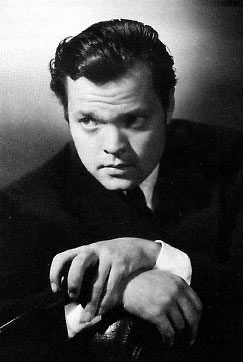
This is Orson Welles

" I discovered at the age of six that everything was a phony, worked with mirrors. Since then, I've always wanted to be a magician."

I had a lot to say about Orson Welles. I wrote a long dissertation about genius and discipline. About magic and illusion. But a lot of what I had to say was said in “Anytime Movies II”—I just said it differently.

Suffice it to say that every new Welles film opened up the world to a new, more wondrous interpretation. But…there are damned few Welles films. We will never see his unexpurgated version of “
The Magnificent Ambersons.” Nor his modern dress version of “Don Quixote." ** Nor his suspense film "The Deep" (taken from the same source novel as Philip Noyce’sDead Calm”) which starred Laurence Harvey, Jeanne Moreau and Welles. There are tantalizing glimpses of his London documentary in the DVD of “F for Fake.” Then there’s the film he was working on when he died “The Other Side of the Wind”—Peter Bogdanovich is trying to get it finished for cable. But it won’t be the same. Every so often, bits and pieces of these projects appear to tantalize and disappoint. I guess the way I feel about Welles is like the diner who is promised a sumptuous meal but gets a maddeningly small portion.—there’s never enough. It’s frustrating.

Like this story.

I was going on vacation once when I was working at
KIRO radio, and it was a much-needed vacation. A couple of days before it would begin one of the sales-sharks approached me. “Are you really going on vacation?” she asked. “What!” I said, suspecting a trap. “Are you going somewhere?” “Why do you ask?” “Well, I was wondering...if you wanted to record Orson Welles…” I would! Would I! Apparently, Welles was booked to appear with the Seattle Symphony to read
Ogden Nash’s “Carnival of the Animals” to the Saint-Saëns piece. He was going to phone in a promotional commercial, and I’d have the chance to record him. Well, being that I idolized Welles, it didn’t matter if he was in the studio or I was recording him down the phone-line…it was Orson Welles! And, as a bonus, they’d give me a ticket to the concert. Yes!! Any nebulous plans I had for traveling someplace to relax went away—I was going to have a chance to record….Orson Welles! I made sure that I would be home all day and available at a moment’s notice to head down to the studio when the call came in that he was ready.

"The enemy of art is the absence of limitations."

That call came on Tuesday. Great! I’d get to record Orson (I was calling him “Orson”) AND have the bulk of my vacation. I went down to Broadcast House and met the Symphony folks there—extraordinarily nice people who I subsequently had a long relationship doing ads promoting the Symphony (through them, I got some free passes to performances like the one where I saw the perfect version of the “New World Symphony” my favorite piece of “classical” music. Welles was supposed to call at a designated time, and I showed up early—so excited was I to record my hero.

We had a speaker-phone arrangement in the studio, so there was no way to record the conversation when it was off. The way it’d work was we’d set up the call, put Orson on the speaker-phone and through that, then and only then, record him. Remember that. It’ll be important later.

The appointed time came and Orson hadn’t called. We checked with the switchboard and no, if Orson Welles had called, they’d know it—plus, he had the direct line to the studio. But he hadn’t called. An hour and a half later, the symphony rep called the number she had* and talked to someone at his house who said that Orson was “out” and he was supposed to be back two hours ago, and no, she didn’t know when he’d be back.

Okay, it wasn’t going to happen that day. We’d regroup, set up another time and get it done then. The Symphony ad wasn’t supposed to start airing until that Saturday, so we had time.

"The director is simply the audience. So the terrible burden of the director is to take the place of that yawning vacuum, to be the audience and to select from what happens during the day which movement shall be a disaster and which a gala night. His job is to preside over accidents."

Well, let me telescope this story and just say that we had a scheduled time almost every day that week, and I trudged down to the studio to record each time, and, each time, the same scenario played out, including the phone call to Orson’s house and the excuses—and the apologies. Still, I thought it was worth it if I could get him on tape and the Symphony folks, though wearying of it all, still were enthusiastic about the prospect.

As was I.

Friday was our “make or break” day. We had to record something—anything--to air over the weekend to promote the concert. All the usual suspects joined in the studio for the appointed time. True to form, the time passed with no phone call. He was supposed to call us. We’d been assured he’d be home. Nothing was going to interfere. An hour went by, a phone call was made, and we were assured he’d be home by 3pm. Okay, we said, we’ll call him at 3.

By this time, I was skeptical, so I started writing an alternative in case we couldn’t record Orson. I dashed it off and it was approved by the Symphony crew on the spot. 3pm rolled around. We all looked at each other—give him ten minutes, then call. As I remember, nobody spoke. We just sort of watched the clock. 3:05. This was going to be our last shot at recording Orson. 3:06. I checked the equipment to make sure everything was working, because after all, (3:07), it’d be really embarrassing to finally get him after al this time, and then (3:08) have something fall apart on us. Everything was fine. Tape was ready to roll. 3:09. We called. The Symphony rep dialed Orson’s number and we waited. She and I exchanged glances every time the phone buzzed down the line. I couldn’t hear anything, and I wouldn’t until the speaker-phone was engaged.

Then her eyes widened. A huge smile spread across her face. “Mr. Welles…” she started. But that’s all she said. The smile disappeared and turned into an expression of shock. I couldn’t hear any of it, but she blinked a couple of times and made the impression she was going to start to speak, but she never got the chance. After about 30 seconds, her mouth closed, never managing to say another word.


“What happened?”

“He yelled at me!”

“Wha…?!”

“He said to stop calling and bothering him”

“But…was it really him?”

“He called me a pest!”

“Yeah, that was Orson, all right,” I said. That was a particularly memorable word he used in the out-takes from a commercial session that had been floating around studios around the country (and which you can hear below)**

Damn! Orson in a tirade and because of that damned speaker-phone, I didn’t get to hear it, let alone record it.

Well, I set about to get my alternative recorded, and the symphony folks went back to headquarters to lick their wounds and wait for my phone-call to play the advertisement down the line.

Ultimately, I was told that Orson stewed about the “pests” and in the evening, figured out that it wasn’t a French interviewer who had been hounding him, but it was actually the Symphony, and he called and profusely apologized—it was a huge misunderstanding, please forgive him.

Yeah, yeah. But it was too late to record the commercial. I made the best I could of a nice weekend to try to turn it into a vacation, and returned to work Monday morning, having learned a lesson to never do anything like that again. At least, there was still the concert to look forward to.

A little while later. A phone call. “Orson’s not coming!” “Oh? What’s the matter?” “Doctor’s orders. He’s too ill to travel. We have to go with a substitute.” That would turn out to be Seattle actor John Gilbert, who did a superb job (if feeling somewhat out of his depth standing in for Orson Welles). And the program was great—witty and energetic and expertly played. A wonderful show.

But it wasn’t Orson Welles. But then again, it was all too much like Orson Welles. The potential for great things. The magic. And the frustration when things fall short. The disappontment. The lost chances. That is also Orson Welles. So much was out of his control. But quite a bit of it was.
***

"I think I made essentially a mistake in staying in movies, because I--but it's a mistake I can't regret, because it's like saying ''I shouldn't have stayed married to that woman, but I did because I love her.'' I would have been more successful if I'd left movies immediately, stayed in the theater, gone into politics, written, anything. I have--I have wasted the greater part of my life looking for money and trying to get along, trying to make my work from this terribly expensive paint-box, which is a movie. And I've spent too much energy on things that have nothing to do with making a movie. It's about two percent moviemaking and ninety-eight percent hustling. It's no way to spend a life." ORSON WELLES: [1982]

MARINA AT HOLLYWOOD’S MEMORIAL

Producers, deal-makers, lured by his death
to this hired hall, where were you all
when he needed you? Easy to call him your “Poet of Film”
now he is dead. While he lived, you locked arms
against him and called him a “failed genius.”

How sadly he told me, “They think I’m too old,
but what about George Bernard Shaw, Picasso
or Monte Verdi, seventy-five when he wrote his last opera?
For a man of his time, he was older than God,
but nobody told him, ‘You’re history, baby.’”

Now hear this about your “self-indulgent genius!”
How often he worked from dawn to dawn,
rewriting scripts, cigar stub clamped between his teeth,
the floor around him papered with ideas!
New ways to win you drove him through the days.

When I raged at the lack of justice, he observed,
“I don’t believe in justice but in luck. You never know
what kind you’ll get; that’s why you can’t give up.
I learned that from my father who died broke but happy.
If you lose today, you could still win big tomorrow.”

The films of your “failed genius” are hailed in every land
except his own, where his foreign work is damned
as “technically flawed” (in other words, not made in Hollywood).
Listen! Genius is not a wisdom tooth a man can lose
but the handprint one man makes on the wall of time!

Chris Feder Welles

"If you want a happy ending, that depends, of course, on where you stop your story."

Orson Welles....here, at his best.


"The movie director must always remain a slightly ambiguous figure, after all, because so much of what he signs his name to came from elsewhere, so many of his best things are merely accidents over which he presides. Or the good fortune he recieves. Or the grace."

"This is Orson Welles" p. 259 Orson Welles and Peter Bogdanovich; ©1998 Da Capo Press

Wellesnet - an Orson Welles blog
Orson Welles at IMDB
Orson Welles at Wikipedia
The Estate of Orson Welles - a tribute site
Orson Welles: a Man and his Genius - another tribute site
An interesting article about Welles
An article on "The War of the Worlds" broadcast
A rather definitive site on "The Mercury Theater"
Welles FBI Files
**The infamous Orson Welles "outtakes"

*I made a note of the number and wrote it down into my phone-ledger. I found that ledger the other day, and inside it was Orson Welles' home phone number.

** Well, now, here's a curious thing: a segment of Welles' "Don Quichotte" (backed by a bizarre version of The Doors' "The End") but you can see where Welles was going with taking the Don's visions into the modern era. This is a haunting piece of film, soundtrack or no.

***Post-script: Reading this, you'd think I had the opinion that Orson Welles was a failure. Far from it. If anything, Welles can only be said to have not lived up to his potential, which seemed limitless. As it stands, he is merely more human, more approachable. For all his foibles and falterings, his accomplishments, as they stand (and we are privy to so few of them!), are (to be annoyingly alliterative) formidable. We should all be such "failures."

Coming up: another "Anytime" Movie, and a personal hero who is...well, not to put too fine a point on it...ALIVE!

Saturday, October 07, 2006

This Makes Me Very Sad-The Passing of Buck O'Neil

http://seattletimes.nwsource.com/html/sports/2003293090_buck07.html
http://seattlepi.nwsource.com/baseball/287923_buck07.html
http://msn.foxsports.com/mlb/story/6038012
http://msn.foxsports.com/mlb/story/6038904


John Jordan "Buck" O'Neil died last night. He was 94-- a long full life of incident and quietly breaking boundaries. He played and managed in the Negro Leagues, becoming synonymous with the Kansas City Monarchs and in 1962 became the first black coach of a major league baseball team. He spent his entire life in baseball. He saw Babe Ruth play. He's given tips to Ichiro Suzuki.

I was working on a PBS "Be More" ad that featured O'Neil, when a fellow I worked with a lot in the old days, Rick Stanton, walked in, and we started talking about what had been going on in the years since we last talked. "So, you wanna hear my Buck O'Neil story?" he said. Rick used to play ball and had aspirations to go to "The Show." He had fun and became one of the cleverest copywriters I'd ever met. Well, he was on a visit to the Negro Leagues Hall of Fame in Kansas City with an acquaintance, and that person said, "Hey, you want to meet Buck O'Neil?" Lunch was arranged, and a meeting place was set up. Buck was waiting for them on a park bench, and they had a long happy lunch and at the end of it, Buck asked what they were doing the rest of their visit. The trip to NL Hall of Fame was mentioned and O'Neil, who was instrumental in getting it set up, said he'd come with. "You're kidding, right?" Rick said. "No," O'Neil said. "It'll keep me out of my wife's hair." So Rick and Buck and friend spent a glorious day story-telling and touring the facility. Rick said it was one of the best days of his life, and when Rick ran into Buck here in town a few years later, Buck still remembered him...in detail. Buck O'Neil was a kind, sweet generous man.

This year, because they were acknowledging the Negro Leagues for the first time, it was expected that O'Neil would be elected to the Major League Hall of Fame in Cooperstown, but he wasn't. The HoF crowed that they'd elected the first woman to the Hall, but she was a white woman who had owned a Negro League Team. Buck missed the cut. Fans around the country were outraged. A local team made a cross country trip to Kansas City on bicycles this summer with a petition to put Buck in. He met with them, though he was ill, and was overjoyed with the sentiment. He was also hired on to a ball club this summer and and given a time at bat, making him, officially, the oldest man to ever play the major leagues. The idea was to walk him, but Buck was swinging at pitches. Habit, I guess. Competitiveness. Guts. Or he wouldn't have it any other way. He was 94.

Now, he's dead and it would have been nice to have him inducted into the Hall while he was alive, but no, that couldn't happen. But O'Neil, who celebrated life and never expressed bitterness at the slights in his life, took it, like everything, in stride. "Just keep lovin' ol' Buck," he said.

Easily done, skipper. Easily done.

http://www.bestofbuck.com/800/bio.htm

Friday, October 06, 2006

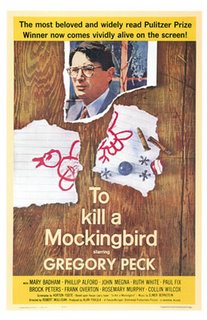
"Anytime Movies" IX: To Kill a Mockingbird

What is it about this film that puts it on so many favorites lists. Horton Foote’s masterful telescoping of Harper Lee’s frail, powerful novel? The fact that, as movie adaptations go, this is certainly one of the best? That it has an impeccably picked cast, directed to feel absolutely real, including three of the best child-performances in all of movies, by one of the best directors of actors, Robert Mulligan? The beautiful, fragile score by Elmer Bernstein, certainly contributes.

I remember seeing “
To Kill A Mockingbird” when I was seven years old, and not “getting it” much. I remember being annoyed with my Mom for trying to cover my eyes during the “scary” parts—although Robert Duvall as “Boo” Radley did genuinely creep me out back then (in fact, he still does, a bit). I didn’t “get” the dog-shooting (“He won’t kill a mockingbird, but he’ll sure-as-shootin' kill a dog!”) But I remember that it was a scary movie for a kid. In the film, the night was so dark, and any light cast spooky elongated shadows and trees moved and leaves rustled. The World seemed restless and alive when it should have been still and asleep. It was a world that, under the pretense of peace and calm, seethed with menace and dread just under the surface.

And that’s the key, I think. There seemed to be, in the movie, at least, a sense that the tremulous world was lurching and struggling to change—that the very earth was metamorphosing and demanding it, while the people entwined in that world, moved along, oblivious to the change, holding onto a complacent life that would inevitably end. At the same time, “Mockingbird” has the feel of nostalgia—the palpable sense that life flows through our fingers like sand, and that we’re always in danger of losing that life we hold precious.

But you don’t think of these things when you’re a child. Summers are endless. Life is eternal. If born into a nurturing, protecting household (and that is key) there is the illusion that the world is benign and all things are possible…under heaven.

Heaven is a concept easily grasped by a child. If you’ve been “good” in your life, as a reward after death, you go to a “good” place to spend Eternity. In the years of growth, a child struggles to understand its world and to assert itself in an environment it has no control over. In a world too complex to understand, the concept of Heaven is a comfort to a child. It’s simple. It’s uncomplicated. It’s black and white. Like Good and Bad.

Like integrity.


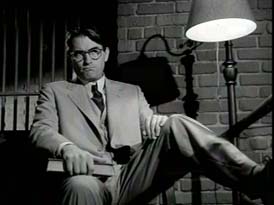
Atticus Finch (Gregory Peck) awaits a lynch-mob, that to his initial dismay and then wonder is shamed and turned away by his own children

The children in “To Kill a Mockingbird” learn the world isn’t nearly as simple as they thought. That the Radley “kid” may not be the evil thing they whisper about in the dark before they go to sleep. That other peoples’ lives may not resemble their own. That their father is many things—but he is also fallible. Jem breaks down when Tom Robinson is convicted of raping a white woman, but I would doubt that he’s crying for Robinson. He’s crying for his father’s failure—a disappointment as palpable as his father being not willing to play football for the Methodists. Jem and Scout are too young to understand the idea of integrity. No, that's not quite accurate. They’re too young to understand the pressures of a world where integrity might be compromised. And they’re too young to understand that their father’s belief in right and good could actually cause them harm. But it is that integrity that makes their father dependable, despite the tragedies of the summer. It is that integrity in a fragile, changing world that will sustain and endure and remain a constant as sure as the north star in the void. And that echoes long in our minds at the end of the film with its last line of narration: “He would be in Jem’s room all night. An he would be there when Jem waked up in the morning.”

When the American Film Institute held a vote for the cinema’s best hero, the honor did not go to the Sergent Yorks or the Skywalkers or the Bonds or any of the roles played by Eastwood, Willis or Schwarzenegger. It went to a character of gentle heroics who in the course of the movie only fires one shot, who does not raise a hand in anger, and with jaw set and quiet voice does what he knows to be right. It was a shock that Atticus Finch would be voted the greatest movie hero, but it was the best choice possible, and legitimized the idea of holding such a silly poll in the first place.

Stephen Frankfurt's evocative title sequence.
Music by Elmer Bernstein


Anytime Movies are movies I can watch anytime, anywhere. If I see a second of it, I can identify it. If it shows up on television, my attention is focused on it until the conclusion. Sometimes it's the direction, sometimes it's the writing, sometimes it's the acting, sometimes it's just the idea behind it, but these are the movies I can watch again and again and never tire of them. There are ten. This is Number 9.

2. Citizen Kane
3. Once Upon a Time in the West
4. -Only Angels Have Wings
5. The Searchers
6. Mr. Smith Goes to Washington
7. Chinatown
8. American Graffiti
9. To Kill a Mockingbird
10. Goldfinger


Wednesday, October 04, 2006

Personal Heroes-Kubrick

Stanley Kubrick

You sit at the board and suddenly your heart leaps. Your hand trembles to pick up the piece and move it. But what chess teaches you is that you must sit there calmly and think about whether it's really a good idea and whether there are other, better ideas.


"I would not think of quarreling with your interpretation nor offering any other, as I have found it always the best policy to allow the film to speak for itself."


He worked and honed and crafted and planned and plotted each of these stories for years, like elaborate chess-games against any contingency. By the time they reached his audience, he was so many moves ahead, the audience was frequently out of reach. Or out of touch. And it would take years for them to catch up. “People say it’s too bad he made so few films,” Martin Scorsese has said of him. “But there's so much, it’s enough. It’s enough.”

We’ll catch up with each of these little mysteries. Our only common thread to their ultimate meaning—he chose everything deliberately…specifically. There are no red herrings in his films. Everything has a purpose. They’re meant to be there. But you have to make leaps. Like knowing that Kubrick thought his version of "The Shining" was, essentially, a hopeful story. Any movie that proposed an after-life had to be.

Kubrick stayed out of the press, and the vacuum that created was usually filled with speculation about him. That he was phobic. That he was obsessive, certainly, and probably insane. Certainly he was misogynistic, if you look at his films.

But look at the man. Everything in Kubrick's life revolved around work and family. He couldn't make "Lolita" in America, so he moved to Britain, and remained there, impressed with the British crews, and distrustful of the Hollywood "scene." Everything he could do in Hollywood, he could do there...and on his terms. He wouldn't fly, preferring in his last trips to America, to sail. He said that he distrusted the airlines, but probably he preferred the time it took him to travel the ocean. With "2001," it allowed him to stall..and to edit. He set himself and his family in a perfect world where he didn't need to travel much, where all the tools of his trade were within arm's reach. It must have seemed idyllic. And misogynistic? His family was nothing, but women, whom he apparently doted on and adored. One of the stories his family tells of how he tried to convince one of his daughters not to leave home for the U.S. "But, everything you need is right here!" he would say. But the daughter moved anyway.

And he disliked doing interviews because the press always asked "those" questions. The ones that sound like you have to write a dissertation, or you won't pass the exam.

He was always getting tapes from his sister in New York with football games and tv shows from the States. He was quietly talking to his team of professionals (lawyers, accountants) with the thought of moving to Vancouver B.C. On the editing of "Eyes Wide Shut," which he'd been planning to film for decades, he pushed himself to working 18 hours or more a day, and he was found slumped, dead, during a night, working.

Kubrick's family took great pains to be available to the press and to use the Internet to dispel the stories that had accumulated over the years. His step-daughter Katherine used to respond regularly to questions on alt.movies.kubrick, and the picture one gets of her father was someone who would worry problems until he had the right answer, or at least the best answer for the moment. That he was a hopeless animal-lover, surrounding himself with spoiled dogs and cats. And rather than being reclusive, he just needed a good-enough excuse to leave home, like a play a friend was in, or a good party. He preferred to entertain at home.

He could drive people nuts with long phone-calls, and persistent questions over a wide range of topics. Persnickety questions. Too-much-detailed questions. And when you signed a contract to work for Kubrick, he expected you to be on-call at any time. You were his, mind, body and soul. In the field of movie-making, he demanded loyalty where most expect back-stabbing and that can be crazy-making. People came out of working on Kubrick movies, changed. More disciplined. Tougher. Kubrick's crews were spare. He spent less in a day than any other major film director, and with that he bought the luxury of time. Time to experiment, to try it again. And again. Most shoots try to get something in "the can" as quickly as possible. But for him, to do a hundred takes of a scene wasn't a failure, it was a luxury...to work on it, to experiment, 'til you got what you wanted: something fresh, something unusual, something useful. Kubrick wouldn't "settle."

You checkmate. You don't "draw."

Well, he did once. Here is Kubrick's acceptance speech for the D.W. Griffith Lifetime Achievement award from the Director's Guild of America. It shows an uncomfortable Kubrick graciously, but very stiffly, giving his speech. According to his wife, he hated doing it. He was always blowing lines, and messing up. Then, he wouldn't be satisfied with his delivery. Finally, he just gave up--the man who thought nothing of a hundred takes with a proper actor--finally conceded that that was the best he could do, given the talent he was working with. He probably felt like he was tipping over his king.


After his death, his family made a documentary in tribute and celebration--the first few minutes of which play like an Overture and is a brilliant encapsulation of the many facets of Stanley Kubrick, warts and all. Here are the first few minutes of "Stanley Kubrick: A Life in Pictures"

One more video--about the time "A Life In Pictures" was released, Charlie Rose had Kubrick's widow, Christiane, and her brother, who made the film, along with Martin Scorsese to talk about Kubrick for an entire hour. Here's that quite special show:


Stanley Kubrick taught me that there was more to a film than cameras and actors. He taught me that somebody was telling a story, and how that person used the camera, and the things forever framed by it, were as much a part of telling the story, as the words in the script. He taught me about the "language" of film. And once you learn that, every theater becomes a classroom. And you never stop learning. And that is truly a gift that keeps on giving. Of all the heroes in this series, he was the one I always wanted to thank the most.

“The most terrifying thing about the universe is not that it is hostile but that it is indifferent; but if we can come to terms with this indifference and accept the challenges of life within the boundaries of death--however mutable man may be able to make them--our existence as a species can have genuine meaning and fulfillment. However vast the darkness, we must supply our own light.”
Stanley Kubrick


There's a man lives in London town,
Makes movies, he's world-renowned.
Yes, he's really got the fame,
Stanley Kubrick is his name.
He does it all, he does it all,
Stanley does it all...
He's a man who looks ahead
To make you think he raised the dead
And he cuts all his flicks,
He's a genius with his tricks.
He does it all, he does it all.
I'm tellin' y'all, Stanley does it all.

Scatman Crothers (who'd never heard of Kubrick when he was cast in "The Shining")


Archivio Kubrick - Italian site that's quite comprehensive
Christiane Kubrick’s web-site - art site of Mrs. Kubrick

Tuesday, October 03, 2006

Happy Birthday, Walter!

Monday, October 02, 2006

Why I Look Like Hell

Busy weekend. Katheryn and Smokey were out of town, visiting--from reports, he's out in the wilderness becoming an honest-to-dog cattle-dog. He'd better not herd my shoes when he gets back, is all I ask. Nephew Evan von Trapp was in town on his way to Baton Rouge for some work. We met up with his sister (my niece) and my sister (my sister) for some downtown dining and catching up. Then, while Annie headed for the hills, we met up again on Friday (after sister and neph did some late-season) kayaking for in-car dining at the local Burgermaster. Good eats and good times. Saturday, I spent doing a bunch of relaxing (I approached the weekend feeling exhausted) and computer-wrangling, trying to back up a bunch of free-lance, and do some phone-calling and recruiting for another gig, and also do some last-minute editing, second-guessing and re-linking.* He took off on Sunday, and for some reason I didn't get his messages trying to get hold of me. Well, we'll compare notes later. He's road-tripping, meeting his dad in Austin, and from there, onto Louisiana. Good to see him and do family stuff. It's wierd when you've got family and you meet up and they're carrying computers over their shoulders, though. A bit like if everyone was carrying a slide-projector to show you their last trip. My, how things have changed....

And that was just one of the many subjects passed over when walaka and I got together with Farmer Scott for his birthday-brunch. Lotta talk. Lotta trampin'. It was good to get together and hang out, which we did most of the day it was so enjoyable. But don't take my word for it. Wal' talks about it over here. The first time I'd been to the new digs and massage center, which is very nice...though for some reason it's missing a bannister....and has a sunlight-bathing cat. Unfortunately, some 50-year old dormant metagene having to do with responsibility kicked in and we went off in our different directions. I cooked, I cleaned, I looked for screws (what did we do with the ones for the door-hinge we were going to replace?), I built a fire, I futzed (my specialty), and did more hard-drive scrubbing. The result? Bed at 4 am. FOUR AY-EM. Then, up at 7:30....(no, let's be accurate here) crawl like a snivelling, shambling mockery of a man at 7:30 to make my way to the 1'sn'0's Ranch. Good thing I mis-timed the hot-water heater cycle and got a cold shower this morning! Ooorg. Sleep. Tonight. Cook a pizza for Katheryn when she gets home, then sleep. sleeeeeep.
Zzz
zzz
zz zz
zz
z.

* As a result, there are new links for things I've already done...like a video for "Mr. Smith Goes to Washington." (YAY!) and I added another Chuck Jones cartoon (couldn't resist, maybe I'll add a couple more....), and I did a little clean-up on a couple essays here and there. Aesthetics, mostly.
This week: It sure piles up, as my father used to say: Another day, Another hero, and another hole in the "Anytime Movies" list filled.

Sunday, October 01, 2006

Happy Birthday, Scott!

All Hail the Hydrangea King

Friday, September 29, 2006

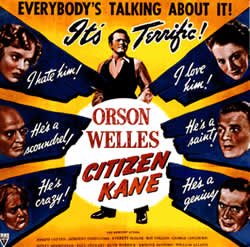
"Anytime Movies" II: Citizen Kane

So obvious a choice.

Yet “Citizen Kane” (or RKO 281) has been fielding off re-appraisals and critical backlash since the day of its premiere. Is it really "the greatest American film ever made?"

Yes.


So far….

Part of the argument against it is that it can’t be since it was the product of a 26 year old who had never made a film before. But
Orson Welles was a 26 year old who grew up pampered and precocious—who read Shakespeare at an age when other kids are reading Seuss. As a teen he made his way in the world by his brio and his considerable talents and his nerve to try just about anything. He was an artistic sociopath who staged alternative Shakespeare productions and avant-garde radio plays for years before be given, as Kane puts it, “the candy store”—a carte blanche contract with a film studio to make any film of his choice, any way he wanted with final cut and a stipulation that said no one could alter it in any way in perpetuity (This is the reason why Turner Broadcasting in its rush to colorize movies could never put so much as a pink pixel to “Citizen Kane.” Some contract!). With it, he gathered his seasoned Mercury Theater actors (some of whom would go onto major Hollywood careers), one of the most innovative and painterly cinematographers, Gregg Toland, young, daring editor Robert Wise, the arrogant and brilliant composer Bernard Herrmann, and the amazing technical crew at RKO who produced such amazing feats as “King Kong” and the Astaire-Rogers musicals and turned them loose on Herman Mankiewicz’s long-in-the-planning screenplay that he believed could never be produced.

Out of all that talent at the top of its game, Welles produced the best American movie ever made, and as a reward he was never allowed that freedom again. Ever.

No good movie goes unpunished.

His next film, “
The Magnificent Ambersons” was a more mature and accomplished–looking film, but RKO chopped it up. re-shot the ending into a certain incomprehensibility and threw it on the bottom of a cheesey double bill. Welles’ Falstaff movie “The Chimes at Midnight” was the project closest to his heart, and might be better if not for the logistical and technical hurdles Welles had to jump in order to make it.

But “Kane” is the grail—the stuff of legend, and has been looked on ever since with avarice by would-be auteurs with more guts than talent, and therein lies the danger. That reputation could make "Kane" as cold and lifeless as one of the statues in Xanadu’s basement. It’s actually more like one of Susan Alexander Kane’s puzzles—intricate and maybe unsolvable without a lot of effort. There’s one shot where Welles shows his hand. It occurs after Susan has left him, accompanied by the screeching cockatiel superimposed on the screen (“I wanted to wake the audience up at that point,” Welles joked. Really, Orson? Right there?) and right after he trashes her room—destroying the acquisitions of her life—and Kane picks up the snow-globe that will fall from his hand at his death. “Rosebud,” he murmurs (both times) and then walks as in a daze out of her room, into the hall, and past the servants. He then crosses through a mirrored hallway that reflects an endless line of Kanes that recede and disappear. After Kane (and his many reflections) has passed, the camera then pushes into the mirror and out of the reverie of the butler (“Sentimental fella, aren’t you?” “Mmm. Yes and no.”)


That shot is the exit from the worlds of memory through which we have seen many reflections of Kane—the house of mirrors that makes up the bulk of “Citizen Kane,” the movie. It is also our last image of Kane, himself, in the film. He’s talked about through to the end, of course, but that splintered mirror-shot is our final impression of him (Kane—and Welles—are not even seen in the End Credits review of actors). At that point it becomes clear (as crystal) that the entire film is like that hall of mirrors that reflected back the aspects of Kane important to each narrator—a process that began with the newsreel that quickly jumped through the highlights of Kane’s life as a public figure and set up the film’s surface mystery—what is the meaning of Kane’s last word (and so serves as a stand-in for “who was Kane, really?”).

In the course of the various reflections there are all sorts of legerdemain—little tricks and in-jokes—that Welles, who was an amateur magician, clearly loved pulling off even if an audience didn’t immediately “get” them. One of my favorites is the craning shot through the model of the “El Rancho” nightclub where Susan Alexander performs and drinks herself into a stupor every night. The night of Thompson’s first visit it’s storming outside and flashes of lightning hide the camera’s passage through the roof sign and through the glass transom into the nightclub inside. When, half the movie later, we again travel through that transom it’s broken—presumably by our first trip through it. In the film’s original framing (unfortunately not in the DVD presentation) there is the slightest nudge of the camera to the right in the rather severe shot of Mrs. Kane signing little Charles away to the banker, and we see, just on the edge of the frame, that significant snow-globe that keeps popping up in dramatic moments. In the newsreel there is a shot of a newspaper of the entire Kane family. Later in the film, we actually see that shot being taken. Another is the way Kane’s hectoring “Sing-Siiiiing!” to “Boss” Jim Gettys is cut off by a shutting door, but continues by a braying car-horn out on the street. These are little filigrees to the grand architecture of lighting, framing and editing tricks that Welles and his crew pull off.*

But that central question “who was Kane?” is purposely never answered, not by a word, not by an object, and not by a person. In the end, the film says that it can’t solve the problem, that it can only present it, and leave us with the acknowledgement of its complexity.

So what are we left with as the remnants of Kane and his life fly up from the furnace of Xanadu? An answer to the mystery of "Rosebud," but not an answer to the man. For Kane was many things, but as Kane himself passed judgment on himself, he was never great. Given gifts that many of us will never ever have, he ultimately squandered them. Insular, wasteful, in his house of mirrors, he is left alone to contemplate himself.

We all have our gifts. What do we do with them? “Citizen Kane” is like that glass globe that we can peer inside and see the illusion of life…and consider our own lives. And in the end we are left with its final image to contemplate, and one may consider that Kane was a master illusionist himself, pretending greatness where there was none, and utilizing the very same tools used by those other illusionists—magicians and very young film directors--to create those illusions.

Those tools being smoke…and mirrors.

* Orson Welles is unique in the group of directors of movies that I’ve seen in that every time I exit from a new film of his, I come out looking at the world with new eyes…or with a new perception of the old world--one that seems filled with possibilities.


Anytime Movies are movies I can watch anytime, anywhere. If I see a second of it, I can identify it. If it shows up on television, my attention is focused on it until the conclusion. Sometimes it’s the direction, sometimes it’s the writing, some times it’s the acting, sometimes it’s just the idea behind it, but these are the movies I can watch again and again and never tire of them. There are ten. This is Number 2.

2. Citizen Kane
3. Once Upon a Time in the West
4. -Only Angels Have Wings
5. The Searchers
6. Mr. Smith Goes to Washington
7. Chinatown
8. American Graffiti

10. Goldfinger

Wednesday, September 27, 2006

SuperThunderStingCar!

For anyone growing up the the "Super-Marionette" shows of Gerry Anderson, this should be a treat. Anybody else seeing it will think it's just bizarre. It features Peter Cook and Dudley Moore.
(For the record, I was a "Supercar" fan)


Tuesday, September 26, 2006

Personal Heroes-Schulz

Good ol’ Charles Schulz

He was nicknamed “Sparky.” He taught me how to read. He taught me what was funny. He probably had more than a hand in making me appreciate suffering and melancholy.

And he always made me laugh. He still does. One of the great joys in snatching up the new publications of “
The Complete Peanuts” is to see the early, humbly ground-breaking work of Charles M. “Sparky” Schulz—his gentle skewering of life and ideas in Eisenhower-era America-a kind of combination of "The Man in the Gray Flannel Suit" and “The Button-Down Mind” dressed in shorts and penny-loafers. The consistent chagrin of Charlie Brown at another talent unachieved. The constant harpiness of Lucy that constantly expanded into inventive new areas of abuse. Linus, the intellectual, who, although he always had a fact or a scripture quote at the ready, still depended on a security blanket. Schroeder-an obsessive compulsive deifying Beethoven to the point he can play classical pieces on a toy piano. Schulz’s kids were doomed to only be seen from two angles only: straight-on or profile--like a “wanted” poster. They walked six inches above the ground at all times. Linus’ little cult of “The Great Pumpkin” that turned religion and the pageantry of Christmas on its ear. The complete neuroses of these little losers that, of course, turns the dog to flights of fancy. You’d escape, too, if your lemonade stand had been replaced by a “psychiatric booth.” (“5¢ The Doctor is In”)

It became the norm (I was going to say fashionable, but that takes some effort) to simply dismiss Schulz and his work. You couldn’t ignore him, he was everywhere—
TV specials, greeting cards, Macy’s Parade balloons, hawking Dolly Madison sugar snacks and Met-Life Insurance. Al Capp once wheezed that Schulz was the only man in history who made a fortune selling “clean” postcards. Schulz’s scribbles made him a multi-millionaire with a big skating rink as his own private Xanadu. It’s easy to look at all that and discount the work he was doing. Anything that popular, so universally received, couldn’t be of any REAL value, could it? And sure, he could play it safe. But the basic concepts of “Peanuts” (he hated that name—it was the idea of a publisher) are bizarre. We just grew used to them. And then we took them for granted.

The fact that Schulz, day after day, faced his white cardboard and created a strip six days a week with an expanded Sunday strip by himself with no assistants for nearly 50 years is an amazing achievement (something that is endlessly written about in the links below). That he could still go to that well-spring of creativity and come up with fresh concepts with the exquisitely-timed four panels of his strip makes him that much more inspiring than his contemporaries.
Trudeau couldn’t do it. Breathed, Watterson, Larson—they all quit, fearing the dreaded “staleness” that Schulz—humble Charlie Schulz—nimbly avoided for nearly half a century. And his ambitions were rather small: a good quality gag, a fine ink line.

The strip was so much a part of the man and the man the strip, that he only retired, very reluctantly, when he feared he was dying. And when the nation heard that he was hanging it up, it was like somebody pulled a football out from under them. Suddenly, the book collections that stopped being printed every year like clockwork, reappeared. There was a crush for interviews. Tributes were made. At the end of it, Schulz saw just how relevant he was. That must have meant something very special for him in his last days. Or he might have seen it as another “Peanuts” irony, hung his head against a brick-wall and said “Augh!” For me, there is something awe-inspiring and just a little sacred that on the eve of the publication of his very last original strip, Schulz died in his sleep. When his creation ended, so did he. And it outlasted him just a little bit. From a lifetime documenting the frustrations and heart aches of failure, he got that one exactly right. But then, Schulz’s timing was always perfect.

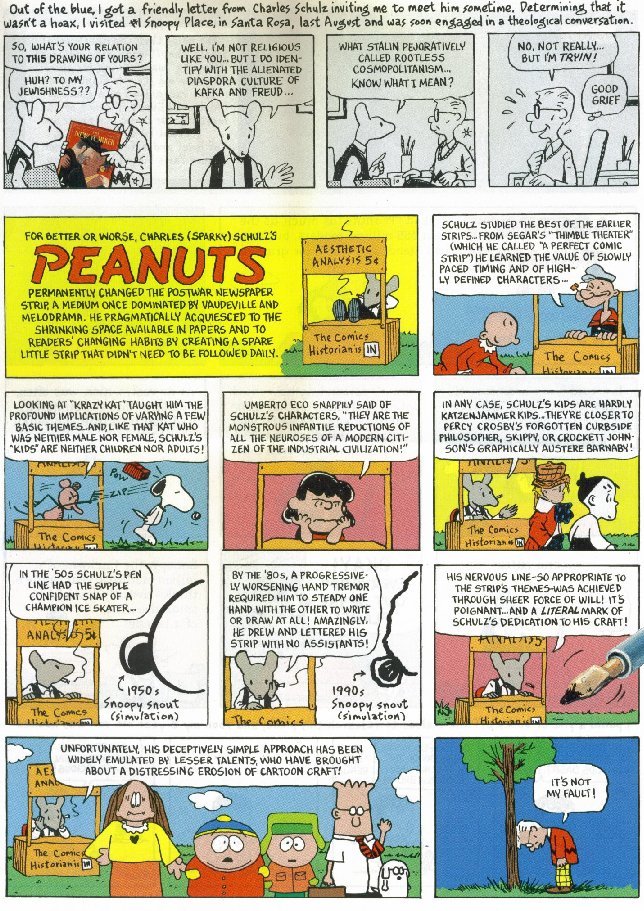
Among the links below are some of those last tributes, and I’ve included
Art Spiegelman’s rather cold (and admiring) analysis of the man and his work. Plus, there’s my favorite strip of his…at least today’s.


Bill ("Calvin and Hobbes") Watterson's tribute

Time Magazine weighs in

Fresh Air's Terry Gross interviews Schulz

Mark Evanier on the continuation of "Peanuts" post-Schulz

Bill Waterson (again) reviewing a Schulz biography

John Updike reviewing "The Book" in The New Yorker

An interesting "Slate" slide-show that ties in the Schulz psychology with the work--a bit cruelly

The Boyhood Charles Schulz

"Of all the Charlie Browns in the world, he's the Charlie Browniest"