Thursday, August 17, 2006

Another Blog (wasted) with Tom Lehrer

"Writer's Block" Week continues, with another of humorist/satirist/math teacher/fugitive-from-the-limelight Tom Lehrer's work for "The Electric Company." This explains the many transformative powers of "Silent E." As Lehrer says in "The Vatican Rag:" "Time to transubstantiate!"


For those not wanting to stay silent, here's another wonderful karaoke version of a Lehrer song--that ode to the Boy Scouts "Be Prepared."

And another quote-this time about why he stopped writing his satirical songs: "I can just pick up the paper and get ten topics, but how do you write a song about it? It's easier to be funny when you're not bitter and angry; If I were to write a song about Newt Gingrich, I can't imagine [it] being funny." [I'm]often reminded of the old Punch cartoon showing a dying patient forlornly asking the doctor at his bedside, 'Doctor, is there any hope?', to which the doctor replies 'No, why?'" These days, Lehrer says he feels like "a resident of Pompeii who has been asked for some humorous comments on lava." He's also said "Once Henry Kissinger wins the Nobel Prize for Peace, satire becomes obsolete." Thanks to Jeremy Mazner for the quotes taken from his fine essay on Tom Lehrer, which you can persuse at this fine site.

Tuesday, August 15, 2006

A Blog (wasted) with Tom Lehrer I

Tom Lehrer is a math teacher at MIT and UC Santa Cruz and has garnered considerable fame (and a few hits in the mouth) for his song-writing talents. He put out a few records on his own label and became something of a cult--meaning of interest to neanderthals, degenerates and shut-ins with a low threshold of amusement. Best used as background music for opium dens, Mr. Lehrer's music displays a considerable lack of respect for the English language that rivals Sullivan, Sondheim and Ashman. For instance, take his lyrics for "We'll All Go Together When We Go" (please):

When you attend a funeral,
It is sad to think that sooner or'l
Later those you love will do the same for you.
And you may have thought it tragic,
Not to mention other adjec-
Tives, to think of all the weeping they will do.
(But don't you worry.)
No more ashes, no more sackcloth,
And an arm band made of black cloth
Will some day nevermore adorn a sleeve.
For if the bomb that drops on you
Gets your friends and neighbors too,
There'll be nobody left behind to grieve.
And we will all go together when we go.
What a comforting fact that is to know.
Universal bereavement,
An inspiring achievement,
Yes, we will all go together when we go.
We will all go together when we go.
All suffused with an incandescent glow.
No one will have the endurance
To collect on his insurance,
Lloyd's of London will be loaded when they go.
Oh we will all fry together when we fry.
We'll be French fried potatoes by and by.
There will be no more misery
When the world is our rotisserie,
Yes, we will all fry together when we fry.
Down by the old maelstrom,
There'll be a storm before the calm.
And we will all bake together when we bake.
There'll be nobody present at the wake.
With complete participation
In that grand incineration,
Nearly three billion hunks of well-done steak.
Oh we will all char together when we char.
And let there be no moaning of the bar.
Just sing out a Te Deum
When you see that I.C.B.M.,
And the party will be come-as-you-are.
Oh, we will all burn together when we burn.
There'll be no need to stand and wait your turn.
When it's time for the fallout
And Saint Peter calls us all out,
We'll just drop our agendas and adjourn.
You will all go directly to your respective Valhallas.
Go directly, do not pass Go, do not collect two hundred dollahs.
And we will all go together when we go.
Every Hottentot and every Eskimo.
When the air becomes uranious,
We will all go simultaneous.
Yes, we all will go together
When we all go together,
Yes we all will go together when we go.


Lehrer has also written such gems as "The Masochism Tango," "The Vatican Rag," "National Brotherhood Week," and (my favorite) "Poisoning Pigeons in the Park." Given such wholesome fare, of course, he was asked to write songs for "The Electric Company," 'way back in the 70's (when you could still get Morgan Freeman for less than a mil'). Asked about his work for "The Electric Company" he says: "They told me it would help kids read. I have yet to see any evidence that it worked." His sarcasm is a major influence on my writing style (using the term loosely). As the man rarely writes anything these days, this is some of his most recent work, this one exploring the "S-N" combination.


Saturday, August 12, 2006

The Night We Won the Emmy

Dave, Ella, Mike, Yojimbo and Tom-The Audio Sweetening Team of Science

Mike wanted to throw up with every page turned in the program.

Since the category we were nominated for was the second-to-the-last one of the evening there were many opportunities to urp up the fine salmon dinner we had just had. Why do they serve a dinner at one of the most nervous-making things to sit through? Whose idea was that? It made for a long evening at the L.A. Hilton. It was the 1995-1996 Daytime Emmy Awards, and we were nominated for sound editing for "Bill Nye the Science Guy."

We knew we were going to lose.

All the signs were there.

First, we were hicks from podunk Seattle. As far as the television industry knew, we were still importing wives from Boston for our lumberjacks, spotted owl or no. We were not established in said industry, and we were affiliated with a studio not known for its TV work. It was, in fact, our first nomination. It was, in fact, our first television series. We knew deep down in our bones that we didn't deserve to be there. Confidence was "low." In fact, hiding under the table would have been appropriate.

Why were we even there if we thought the evening would end in defeat and humiliation? Hey, when you get nominated for an Emmy Award, you go. You have to see the elephant. You never know when a chance like that will come again. So, you go. You hope for the best, but expect the worst.

Don't get me wrong. I thought the sound for "Bill Nye" was good work. Even better, it was genuinely funny work. It was a struggle to crank out the dense sound mix that we did each week, and I had it in my head to try and present an original sound-scape for every episode--one that reflected the subject matter being discussed, something probably too subtle for the 12 year old target audience, but it was what I wanted to do. I thought by putting water sounds, rain sounds and splashes in a show about "The Water Cycle" would enhance the learning points of the show. And, after the pilot, I also wanted the show to have an anarchic "clubhouse" atmosphere, like the shows of my childhood idols, Soupy Sales* and J.P. Patches. So, to that end, there would be sonic "in-jokes" for regular viewers. I wanted to take the science seriously, but the host and his world...not so much.

By the time of The Night of the Sweat-Stained Tuxedo's, I had supervised 65 half-hour shows over a little under two years. The work was of generally high quality, but I'd watched my marriage come apart in the interim and I was battling depression.

I had also quit the show. After 65 episodes, I'd begun to think I was repeating myself and not bringing anything fresh to the show, and had moved out to Microsoft to create content for computers. I felt I'd left the audio in the more-than-capable hands of the ASToS. I would listen to their stuff and think that it was the best part of the job, having long grown tired of my contributions. Handing over the reigns was part of my duties that second year. I thought we'd done some terrific work the first season, but there wasn't a spark of interest in any awards. Probably nobody noticed. So I wasn't expecting anything for the second. I had done my best and moved on.

Then an early morning phone call came from Producer Hamilton McCullough. The show'd been nominated...for writing, editing and sound editing.

When they say it's an honor just to be nominated, it's never more true than when you're first told. You're pleased, you're proud.

And then the doubts creep in. "We couldn't win, could we?" evolves over a couple of months into "We couldn't win if we tripped over the statues in an L.A. back-alley."
There were other portents. We were up against "Flipper," a nationally syndicated show (with a very young Jessica Alba) produced out of Florida--at the time a popular spot for post-production (Disney had a unit out there and had been trying to convince the Nye producers to go there)--and as if that weren't enough, the weekend of the awards saw the premiere of "Flipper-The Movie" with Paul Hogan.

God was laughing at us.

That night, it seemed like the weight of the world was increasing exponentially during the awards ceremony. We were all there, sitting in the back of the Hilton auditorium. Ella had cut short a vacation in Vegas with her husband to be there. The men had rented tux's--you do that for the Emmy's.

As the evening dragged on, the writers for the show won "Best Writing for a Series." Then, the editors lost--a crime because the editors played an extremely creative role in shaping each Nye show.

That tore it: we would lose. What could you expect? We were losers. We should be happy they served us dinner and we had a nice bottle of wine. Plus, Katheryn and I were staying at a exceedingly plush five-star hotel downtown. We arrived at the ceremony in a limo. We figured "if we're going to do this once, let's live it up."

After all, we were going to lose. Dinner came and went. I grew more stoic and resigned to my fate. I had notes for an acceptance speech in my inside jacket pocket that I dashed off in three minutes. Wouldn't need 'em.

Our category was next and none other than The Science Guy himself would present it. He'd been by the table a couple of times to pump us up, even though we knew that, in a common phrase used on the set, we were "going to have our smokes crushed."

I took a deep breath and held it, a tight smile on my face. I looked across the table at Tom, ready to give him a sympathetic, supportive word when the inevitable happened.

"And the winner is..."Disney presents...Bill Nye, the Science Guy!"

I was looking at Tom, empathy at the ready, when his face exploded in shock. That's the only way I've been able to describe it. A split second from dejected to ecstatic. Klieg lights whirled to out tables, blinding us. Tom practically jumped around the table and started to sprint towards the stage. I sat disbelieving for a second. All I could do was follow. I started running, too.

I became aware of a looming presence blocking my path: it was Hamilton McCullough-always calm, always cool, always supportive. "Congratulations! You deserve it!" I grabbed his outstretched hand, babbled a thanks, and continued my serpentine run in the dark between tables to the stage. I don't remember being handed the award. I did have the presence of mind to open my wallet and slip Bill a ten. "Oh! Very funny!" he said. I walked over to the podium, and Bill and I did a quick search for the winning card. "You'll want this," he said.

People were still applauding. I started to talk with a warning that there was a lot to say, when I looked over at my colleagues beaming in the kliegs clutching their statues. I had to do it. "Ladies and Gentlemen, the Audio Sweetening Team of Science!" and I introduced each of them by name as the applause renewed. All those hours, all those nights working, putting sound effects in one at a time, all that effort to get everything done in five days to meet deadlines. I thanked everyone on the show, especially the creators, Jim, Erren and Bill, and I particularly thanked the editors for how they shaped the show. I remember being very proud of everybody. And very grateful.

Pictures. Lots of pictures were taken. We were over the moon. We marched, like an army, back to the place where Katheryn and I were staying and invaded the bar, which became full to bursting. But being a five-star hotel, seeing all the people and all the hardware, the manager improvised and within moments opened up a veranda for us and served us out there. It was a big, well-oiled, loud, laughing party. And why not? For us, the audio editors, for that one evening, we had been told by our peers that we were doing the best work in the country.** And no one could take that away from us.

At one point, I slipped away and found a phone booth. I called my mother. She was 79 and beginning to get a little frail. She had yet to be diagnosed with Alzheimer's, but all the signs were there if we'd chosen to recognize them. I was calling late. I knew she'd be in bed, but I had to tell her the news. It took awhile for her to pick up. "Hi, Mom! I won an Emmy!" She sounded a little muddled "Is that you?" "Yeah, Mom! I won an Emmy!" "Where are you?" "I'm in Los Angeles! I won an Emmy!" "You're in Los Angeles? When did you go?" "Friday. Just for the weekend. I won an Emmy!" "Well, that's nice." she chuckled. "You have a good time, and you come back safe." "Um, okay. See you when I get back." "Bye-bye, honey."

Click.
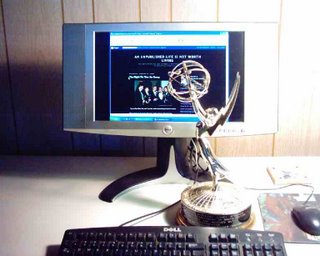
I wasn't disappointed she wasn't excited about it as I was. I mean, c'mon, you can't expect a 79 year old to go from unconscious to excited in 30 seconds (You could throw a rod or something!). But, if I was looking for additional approval that night, I didn't get it. Nor, I realized, did I need it. At some point in your life, as Mike Myers put it, you have to cash in your own chips. It's your life. You might as well enjoy it. But part of the job is to generate your own joy. And appreciate it when it happens. That's something else I got that night. And it's more than worth its weight in gold.

Or gold-plating.

*God bless the Internet. For all its faults and apocrypha, I can, at long last, show you what Soupy Sales was like back "in the day." Throughout production of "Bill Nye, the Science Guy" all I could do was inadequately describe the anarchy of his show, which was usually met with uncomprehending looks.

**It was just the beginning. "Bill Nye, the Science Guy" became an Emmy magnet. For the next four years, they would win in many different categories...including editing...and for sound editing every year, culminating, the last year, with the coup de grace -- Best Children's Series.

Next week: It's "Writer's Block" week. I take a break from publishing (but not writing, ironically--isn't this how "Moonlighting" got in trouble?) and offer up some audio-video from a favorite singer-songwriter. The quality-quotient can only rise.

"Anytime Movies" Part X: Goldfinger

I’m an unrepentant James Bond fan.

Yes, the movies are sexist and exploitive--frozen in the hardened amber of 60’s attitudes and prejudices.

They’re filled with mink-lined sadism, clueless Brit' snobbery and snarky humor only drunken Frat boys laugh at.

I love it. And “
Goldfinger” (1964) is the epitome of it all.

Call it a “guilty pleasure” if you must and place it at the end of this list, but homage must be paid and credit given.

There may be better films in the series (that would be its predecessor, the slightly more sober “
From Russia With Love”- and I have warm spots in my heart for OHMSS, the nasty/silly “Diamonds Are Forever,” and “The Living Daylights.”) Certainly there are more elaborate and flashy ones, where you walk out talking about the sets (and not much else).

But “Goldfinger” has it all, managing to take a
middling Fleming thriller (even though Anthony Burgess listed it in his “99 Novels: The Best in English Since 1939 ” as a representative of the Bond series) and improve on it—a rarity in the films. The screenplay (by series veteran Richard Maibaum and utility closer Paul Dehn) is an efficient series of traps and foreshadows-dropping gold nuggets of information that pay off later in the story: Bond’s improvised electrocution of an assailant in a seemingly-unrelated pre-titles sequence sets us up with information for another situation later, as does a casual conversation about discharging firearms in a pressurized airplane cabin (since disproved by the “Mythbusters”) Maibaum and Dehn toss out a group of characters early (and fittingly) to streamline the Big Set-Piece-Goldfinger’s raid on Ft. Knox, and go Fleming one better—instead of the unworkable book idea of physically stealing the gold, the screenwriters just devise a way to irradiate it, making it unexploitable, crashing the U.S. economy while increasing the worth of the villain’s holdings. Neat. They also update the book’s nasty “Perils of Pauline” sequence with a circular saw by strapping Bond to a slab of gold being bisected by the recently-developed laser beam.

Maibaum excelled at plot and structure, but it was Dehn, a radicalized gay writer who had worked as a propaganda instructor at the OSS "Camp X" during WWII, who tossed in the more cheeky touches. There’s a cool re-appraisal of Bond as a hero in this film. He’s basically kicked between situations out of his control, something which irked star
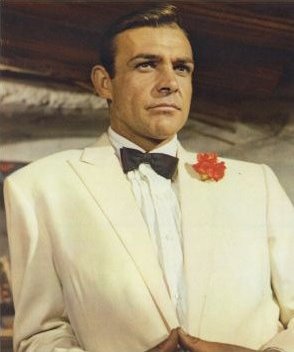
Sean Connery who saw Bond as an active investigator. Connery was also miffed at some Bond set-ups—the seagull disguise at the very beginning of the film, although he did embrace Bond stripping off a wet-suit to reveal a white linen tuxedo jacket, which he wears to a seedy South-of-the-Border bar (The “cluelessly-overdressed Bond” joke would be done to death in the films until Timothy Dalton put an end to it --although Pierce Brosnan still had his Bond pathologically straighten his tie, even underwater).

His third time out Connery is finally casual with Bond, while tossing in odd little bits of business to suggest that Bond is inches away from being clobbered on a regular basis. The villains are memorable, and the women have defined personalities (for once) with
Shirley Eaton’s “golden girl” displaying as much aggressive sexuality as Bond (Eaton, and Gert Frobe, as Goldfinger, had their vocal parts dubbed by other actors). Of course, there's also the "homer," the lethal bowler hat, the hi-tech exoticism of the laser beam. And then, there’s the car.

John Barry’s score is the blaring frosting on the cake: repeating chimes announcing the presence of the villain, or anything having to do with gold; sinuous strings compounding like snakes creep during the laser beam sequence and Goldfinger’s signature theme blats out in brass clusters. And although other artists’ Bond songs have topped the charts, no one’s topped its theme song (with lyrics by Leslie Bricusse and Anthony Newley) for brio and outrageousness. No one has ever “belted” a song like Shirley Bassey does this.

It also has my two favorite lines from any Bond film. The first, adapted from Fleming:

This is gold, Mr. Bond. All my life I’ve been in love with its color, its brilliance, its divine heaviness.

And from Maibaum and Dehn, a line so good, it’s amazing no thriller had used it yet:

Bond: Do you expect me to talk?

Goldfinger: No, Mr. Bond, I expect you to DIE!


They’ve just finished filming the latest James Bond film—which is based on Fleming’s first Bond novel “Casino Royale” but due to rights issues has been out of the grasp of the longtime Bond producers. The new Bond is an odd choice—Daniel Craig, who suggests (when he’s “on”) a British Steve McQueen. He has been bad in some films (“Lara Croft: Tomb Raider” and “Road to Perdition”) where he barely registers, but he CAN be the thing your eyes gravitate to, as in Spielberg’s “Munich” or the British TV version of “Copenhagen” (Craig played Heisenberg), or his signature film “Layer Cake.” He may be a bit different, but he can’t be THAT different. After all, every film has ended with “James Bond will Return.” It’s a bit like saying “Meet the new Bond. Same as the old Bond.”

"Anytime Movies" are movies I can watch anytime, anywhere. If I see a second of it, I can identify it. If it shows up on television, my attention is focused on it until the conclusion. Sometimes it’s the direction, sometimes it’s the writing, sometimes it’s the acting, sometimes it’s just the idea behind it, but these are the movies I can watch again and again and never tire of them. There are ten. This is Number 10.

V: The Searchers

X: Goldfinger


Wednesday, August 09, 2006

Commercial Politik

If I feel physically as if the top of my head were taken off, I know that is poetry.

That's my favorite quote by Emily Dickinson* (more, even, than "Hope is a Thing without feathers.") because I know whereof she speaks.

There've only been a few instances--and it's usually been while writing--where I came up with a solution to a problem that arrived, unannounced and unexpected, and was so ingenious (So ingenious that it couldn't have come from me!) that it sent happy sparks through my head. In my chosen profession, I've had lots of occasions where I've thrown an odd sound effect into an empty silent space and made it come alive, and more, made it seem like that sound was always there to begin with--that it "belonged" there. It's a low-level joy that has always made me laugh, giggle, chortle and made each instance turn a creative corner that it could never retreat from (but then, that's the goal of sound editing: to do the job so convincingly that it is indistinguishable from reality; it's a con, a magic trick, and one of the easiest subterfuges that one can foist on an audience, as they're a willing contributor to the deceit).

But there have been damned few instances of Dickinson's "top of my head coming off."

Irina caused one of those moments to happen

But not in the way you’re thinking. Yeah, she was pretty. A 20-something blonde Russian woman in a stylish leather jacket. She was a Russian translator at the University of Washington, and that afternoon at the studio she was going to be reading some Russian for a commercial for the short-lived Goodwill Games then being held in Seattle. She had a thin, husky voice that, with the accent, was quite intoxicating. Plus, I had an interest in Russia. ** I found her fascinating. While I was setting up her microphone, I asked her how she pronounced her name. "Irina," she said, expertly rolling the "R's." "Irina," I repeated…sort of. I can't roll my "R's” to save my life, but I've gotten by with a slovenly-pronounced "dr" sound that can simulate it, like a ventriloquist's trick. So, I actually said "Idrina." Her left eyebrow arched in surprise. "Werry good," she said in all seriousness.

Score!

The session went well. I remember it as being the highlight of a not-too-good day. Irina was coolly professional, and when complimented on her performance, would answer back with a knowing smile. The time came to edit the commercial together (this was back in the analog days of physically cutting recording tape) and the producer left to conduct some business, leaving me with Irina, who wanted to watch me hack away at the 1/4" tape that contained her “takes.” We talked. I asked her how she felt about being in the States while her country was embroiled in protests (Gorbachev was in power and was having some trouble keeping control). She said she was still in contact with her family and that it wasn't too good there with the stores not being able to keep much in stock. She mentioned that her mother still lived "in town," which was how she referred to Moscow. Some "town." We kept a running conversation going about a variety of subjects and I found her absolutely charming.

After watching me work for quite a few minutes, at some point, she started asking me about the process I was engaged in: cutting the good takes out and splicing them together with tape (no, really, that's how we did it back then!). I explained that I saw the process not so much as taking away the bad takes, as much as just taking the best of the best and trying to make some perfect version of the commercial in my head. That interested her. "So, you're something of an artist, then..."

I laughed. She hit a sore spot for me at that point in my career. I was getting skeptical of the whole commercial process. I saw myself as constructing lies to bilk people out of their money, or convince them to vote for some charlatan just because I could make them sound like they could put two words together coherently. I saw myself as doing the Devil’s Work, certainly nothing very constructive to Society as a whole, and was getting down on myself for being a part of it. 'An artist? No!" I scoffed. "I make commercials. The only way I could be thought of as an artist is if you consider propaganda an art."

Her head tilted, and she went quiet--the first time in the afternoon she had. She was thinking…a lot. I became very aware of the silence in the room. I looked over at her. Her brow was deeply furrowed. "Maybe..." she began slowly. Then she stopped. "You know, in my country, we have what we call the 'Socialist Realist School of Art.' It's usually posters of muscular men in their coveralls, standing tall before a tractor against a blood-red sky, or gleaming wrenches gripped in fists. It's all very stylized, but it's meant to inspire the workers to work harder because they're all engaged in building the goal of the Worker's Utopia, which the art is supposed to represent."

She paused.

"Maybe you're working in the Capitalist Realist School of Art."

Boom!

The top of my head was taken off.

I sat there staring at her, my mouth open.

"Did I say something wrong?"

"No! NO! That's PER-fect! You're exactly right! That's exactly what this is." I explained to her that most commercials present a need that only the product being offered can fulfill, or an idealized version of American life and how it could be obtained if only (if only) the consumer purchased their products. Billboards hawking cigarettes show active attractive young people engaged in activities that would usually make them cough up a lung. Folks in McDonald's ads are slim, attractive and wealthy enough not to eat at McDonald's, which can make them obese and give them bad skin. Detergents whiten whiter, soften softer and God forbid, we should mention phosphates because it would probably poison the cute little animated teddy bear giggling insanely over the product. Slathering on under-arm goo will make you popular. Commercials (and its Satanic relative, Public Relations) have precious little to do with reality, but they present an idealized view of life that specific consumerism will achieve. The Capitalist Realist School of Art. Say it with me now.

The Capitalist Realist School of Art

Hallelujah, and Great Day in the Mornin'!

Of course. It was so obvious it made my head spin. But it took someone with a totally different life-experience to point it out to me.

I've carried that message to this day, and I tell anyone who cares to hear the lesson Irina taught me that summer day. The lesson that took the top of my head off. I'd never seen it so clear. What was the line Brando's Col. Kurtz says in "Apocalypse Now?" "Like a diamond bullet fired right in my brain."

The Capitalist Realist School of Art

There it is, comrades. Look to the Future that is being presented to you. See what we're all marching towards. Notice the manipulation. Think about the irony that some of these messages contain within them, and the obvious art direction being used to impose the Vision. Look at advertisements and see that Utopia that we are working to achieve. That Better Life that the alternate universe of the advertisement beckons us towards where groceries glisten with painted-on freshness. Where our clothes are all color coordinated and bright as we splash at the water-park with our lit cigarettes. Every ice-cube in a glass of vodka spells out “sex.”*** Our cars are not just our transportation, but our Freedom. And they define us. And diamonds are forever, and more accurately display your feelings than you can. I’m sure you can find examples of your own. It’s also a place where an inarticulate President having trouble communicating his message, can depend on the carefully prepared staging and backdrops behind him to summarize his stammerings into easily digestible nuggets...just in case you lose track. Or nod off. March on, comrades.

The Capitalist Realist School of Art.

I saw Irina one more time. She was coming in to revise the commercial she had done, but I wasn't the engineer on the session, as I was working on something else. But I did see her in the lobby, and when she saw me, she jumped from the couch and ran over to me. "Jhim!" she said, and gave me a big hug. We talked animatedly for awhile, and then she had to go. "You're not my engineer today?" "Wish I was, but not today." A slight pout. "Next time, though..."

But that was the last time I saw her.

Thanks, Irina, for taking the top of my head off. It was like poetry.

*I have an imposing biography of Dickinson packed away in one of the boxes in storage. One of these days I'll strip off the packing tape and start chunking into it during those many ferry-waiting opportunities.

** That is if your definition of "interest" runs along the lines of "something you have a vague notice of while not caring enough to do one whit of research, or in the case of a country, have absolutely no desire traveling to, i.e. 'He had an interest in Russia, but only in that he had read some Chekhov short stories.'"

*** This was pointed out in a book from the late ‘50’s entitled “The Hidden Persuaders,” where some liquor ads had the word “Sex” air-brushed into the ice-cubes—an art-directed hit at our sub-conscious to “tell” us that “liquor” = “sex.” If you want one, you must want the other.

Monday, August 07, 2006

Weekend Wrap-up

Farmer Scott and The Chief came out to the Island post-delivery, and after a few minutes of Smokey "getting bad" on 'em, and a few more minutes watching the reflected sunset off the Saratoga Passage, we made our way to Toby's Tavern, home of "The Best Fish n Chips in the World." I haven't seen these guys in too long awhile--not since The Big Move--so it was good to hang out and jaw, if only for a little while. A movie night was the traditional thing to do, in lieu of a poker game, but so many movies have come and gone and too many of The Chief's visits to Seattle as well, we were starting to lose the sense of "getting together." Since we've been doing that since High School (30-mmph-mmph years ago), that's too much tradition and water-under-the-bridge to lose. Relationships take face-time, and blogs are no substitute.
------------------------------------------------------------------------------
After much banging and hammering, the wall came tumbling down, and we've been able to access the water-heater. Merely a touch of the red "candy-like" reset button, and we've got hot water again. No more boiling water on the stove-top to do dishes or take baths. With a punch of a button we're back in the...well, not exactly the 21st century, but certainly the 20th. Hot water. What a luxury.
------------------------------------------------------------------------------
Applied for a couple more part-time jobs on-line. We'll see if anything comes of them. One, I'd only be working Sundays. Hmmm. My sister-in-law Jane is coming out Tuesday to spend time with her daughter up on Mt. Rainier, and hang with the fam.' She and my Seester will be coming out this weekend to hang with the eagles and bunnies...and finches...the quail...and the rare occassion of a deer or buck crossing our lawn. Katheryn mentioned that one day last week while Smokey was swimming in The Passage, a sea-lion took some interest in him...kept bobbing up and checking him out. Smoke' never saw him, but once the lion realized it was another species entirely, gave it up and went back to fishing. I wonder what his reaction would be? Would he think it was another dog?
-----------------------------------------------------------------------------
This week I've got a solid day's worth of editing for one of the freelance gigs in addition to the usual work, and even more freelance on Friday. Busy, busy. On top of that, I'm watching Ken Burns' documentary on Thomas Jefferson as an adjunct to reading "Undaunted Courage." Clay Jenkinson's featured in the Jefferson show. I had a great time reading his book, "Message on the Wind" and I try to catch him every time he comes to town--the next chance being in November at the Tukwila Rotary and the Library. Maybe that can become something for The group Blog. Or not. Seems the things always show up on the BCC Community Channel or the Seattle Channel for a repeating cycle of...forever. Still, always entertaining shows he puts on.

-----------------------------------------------------------------------------

A belated birthday to one of my all-time heroes (that's another series of things to write about). Writer, voice-actor, radio show creator, maker of some of the finest commercials ever created. I've seen him speak on a number of occasions and he's never ceased to be fresh, funny and full of himself. You're an inspiration to me.

Happy 80th Birthday, Stan Freberg!


Next week: Really! This week my brain will explode (Promise!), if all goes well there will be a post that's its own award, and an Anytime Movie goes for the gold.

Saturday, August 05, 2006

"Anytime Movies" Part V: The Searchers

It’s a film that chills me right down to my bones and makes me cry every single time. It throws itself into the deepest pits of despair and within moments, prat-falls into low comedy. It’s a western…about race relations, and in the house of mirrors of a “genre” piece deflects the self-righteous tone of a sermon. It stares into the soul of people at their worst, and exults in their best.

It is arguably
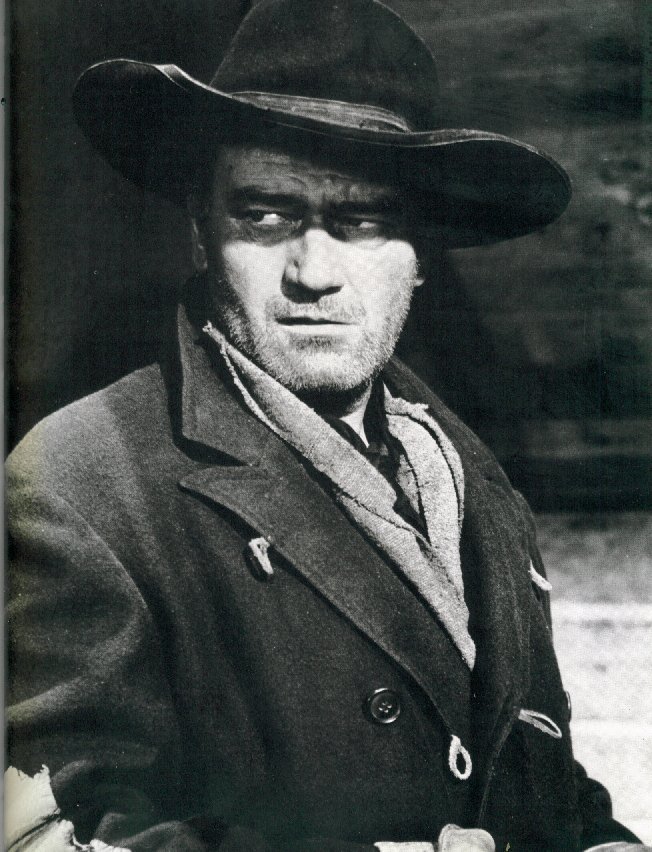
John Ford’s best film (and he made many great ones). It is inarguably John Wayne's finest performance on-screen, while completely working against the image that Marion Morrison built as “John Wayne.”

Oh no. We’re talking about “
The Searchers”—a “western” made during the somnambulant 50’s …and with John Wayne, ferchrissakes! How corny can you get?

Back up, pilgrim.

“The Searchers” has just been re-released (to mark its 50th anniversary) in a
gloriously re-mastered DVD, and has come under critical review for being too corny, too obvious, and more than a little dated. Worse still, it has been branded a “film-school darling” that has skated too long on an undeserved reputation as a masterpiece.

Bullshit.

Like
Pauline Kael’s faulty detective work dissecting “Citizen Kane” and Elvis Mitchell’s naïve un-analysis of “2001,” the work in Slate smacks of a critic either looking for something to write about or make a name for themselves bucking “conventional wisdom.” Having to spend a summer reviewing the third X-Men movie, the fifth “Superman” opus AND an entirely superfluous “Pirates of the Caribbean” sequel is bound to make anyone crabby.

But it shouldn’t lower one’s standards, and there’s enough slip-shod work in the article to indicate that’s the case. At the very least, it’s a terrible gloss-over.

“The Searchers” is a masterpiece—the culmination of decades of film-making experience that John Ford had accumulated since the silent era—while crystallizing Ford’s growing disenchantment with the Myth of the West. In a time when westerns were still basically built around the simplistic formula of “Cowboys vs. Indians,” Ford was starting to speak out more explicitly for the latter sixteen years before such accepted “consciousness-raising” films as “Little Big Man” or “Soldier Blue.” Like any masterpiece, it displays the sum of a body of work and breaks new ground, paving the way for the future.

“The Searchers” tells the story of an obsessive 10 year hunt for a lone family member taken in a violent Comanche raid. It’s led by the worst person possible: the child’s uncle--a hate-obsessed confederate soldier, self-exiled from his family, who still carries his saber on his hip, bitterness in his soul and his heart on his sleeve. Mix in a venomous race-hatred for all non-whites and you have the most flawed anti-hero to appear in movies. Ethan Edwards starts his search to bring his niece back alive, but as the years pass and she matures, he gives her up as one of the Enemy, and sets out to kill her. At the center of the film’s black heart is that most archaic and useless word: miscegenation.

It’s rough stuff. Rougher still are the attitudes of the settlers towards the Indians that border on hysteria. There’s a haunting scene late in the film where Edwards and his fellow traveler (played by future Captain Pike and “Teenage Jesus,”
Jeffrey Hunter) ride into a fort on the Trail of Tears to inspect some white women who have been captured by the Cavalry. “It’s hard to believe they’re white” a sergeant says. “They ain’t white,” spits Edwards, and at the sound of a shriek from one of the women, he turns to look at her. Ford trucks in the camera fast onto Wayne’s face (mirroring the shot he used to introduce Wayne in their first film together, “Stagecoach”) and it’s amazing. Wayne was always blessed with a mug that the camera loved*—it could read every emotion that played across it--and in a performance minus the “hero façade” and that turns on the full after-burners that usually blew his co-stars off the screen, this one quiet moment radiates a combination of hate, disgust…and abject fear. No words need to be said to make the point.

And yet, for all its depths of despair amid bloodshed and the race-hysteria swirling around that most antiquated and completely useless term “miscegenation”—Ford tries to balance it with entertainment. That’s quite the tight-rope walk. But then, it’s not a sermon. It’s a Western. Ford was never so pretentious to be caught lecturing. He’d say if you want to send a message, use the Pony Express. Better to sneak the lessons into the fabric of the story, and distract with shenanigans about wayward lovers, goony old men, and green cavalrymen with pointy swords. One of the incidents involves the unintended marriage of Hunter’s character to a portly Indian maid. It’s the source of raunch comedy in the vein of Ford’s “The Quiet Man”—all roughhouse and bad taste. But when Ford’s good guys “The Cavalry” dessimate a Native village and the luckless character along with it, Hunter is left to ask “What’d they have to killer her for? She never hurt anybody!” The question hangs in the air with indictments all around.

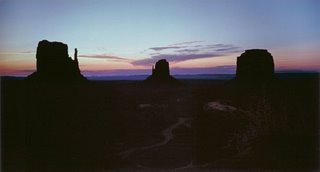
“The Searchers” begins and ends with a black screen. In the beginning, the blackness gives way to the vast magical vista of Monument Valley (which figures in two of my anytime movies. If God lives anywhere on Earth, I think it’s on that vast acreage of land overseen by the Navajo) that to Garry Wills suggests an irising lens, but to these eyes seems more of a proscenium arch. At the end it shuts out Ethan Edwards who is left out of the warmth of a family embrace to wander the desert (Of course, Wayne’s character is going to come in eventually and eat…but Ford chooses to leave Edwards outside). His prejudice does not belong with home and hearth...and society…and Civilization. Yet it is also Ford’s choice to leave the character alive, the wolf always at the door.

It’s as if having made his plea for tolerance, Ford cautions us that it will always exist, somewhere.

Will we ever lose the hate?

“That’ll be the day.”


* Screenwriter Robert Towne has a better term for it, the "camera-love" phrase implying a happy accident that doesn't give enough credit to the actors, their craft and experience. He says that actors like Wayne, Henry Fonda, and Gary Cooper are "ruthlessly efficient" in that they can communicate differing emotions with an economy of expression. The words are particularly apt for Wayne's performance in "The Searchers."


Anytime Movies are movies I can watch anytime, anywhere. If I see a second of it, I can identify it. If it shows up on television, my attention is focused on it until the conclusion. Sometimes it’s the direction, sometimes it’s the writing, sometimes it’s the acting, sometimes it’s just the idea behind it, but these are the movies I can watch again and again and never tire of them. There are ten. This is Number 5.

V: The Searchers


Thursday, August 03, 2006

Say Goodbye to Normandy Park


The contracts are signed. The ink has dried. The financing is clicking into place like tumblers in a lock. The 1031's have passed each other and waved. The recording numbers have just been filed. The keys have been handed over. It's all over but the shouting.

Time to say goodbye to Normandy Park.

We've sold the house (or actually, to be absolutely correct in the eyes of the city, the two condo's) where we've lived for the past seven years. We've moved out, taken our belongings, and left the shell. For weeks, it has not been our home. In fact, it hasn't felt like it since the big furniture was moved out and you couldn't walk in any room without it echoing. I've been going back the last few weeks to take some left-over items and sweep a dust-bunny or two, and, whenever I've taken him, Smokey has refused to go into the house. Oh, he'll gladly go for a walk in the next-door park that he's walked every day since he was a pup. Anything else, he'd just as soon stay in the car. Interesting, the psychology of dogs.

But, me, I have to linger a moment longer. This was the first house I ever bought. This was the first time I was ever a land-lord (though I preferred to use the term "land-baron"), a role and responsibility I took very seriously and grew to enjoy. It was also the first time I've ever been a part of a homeowner's association (and hopefully, the last, as I have the pleasure of resigning from the Board after I finish this). This is the house that we brought Smokey home to. The house Katheryn and I came home to after we got married (which is a story in itself). It's housed visitors and relatives in times of celebration and grief and five families of tenants and kept them safe and warm. And in return, we spent a lot of time and money improving the house and grounds, and making it "ours." We took care of it and it took care of us. Symbiosis.


Now, it's someone else's.

And we get on with the task of improving the cabin, and making it functional. The hot water heater's out. Life goes on. Fu's found a nice big patch of sunlight on the couch to sleep in. Smokey just came in from outside.

He's home.

One Last Look

Tuesday, August 01, 2006

Happy Birthday, Katheryn

Wife-Companion

Running Mate

Comrade in Arms

Fellow Traveler

CFO

Leader of the Pack

Den Mother

Inspiration

Muse

My Buddy


"Once you get past ten, birthdays get a lot less fun."