Wednesday, November 28, 2007

K's back! (November)

A little later than planned. A little earlier than expected. K's* back and we celebrated by taking Smokey (who was so excited to see her he jumped onto the hood of my car!) for a long, long walk along "Two Cliffs" Beach. The tide was high (but not as high as its gonna be--they're expecting records off the Oregon coast!), and Nature has done some re-surfacing work and pushed a lot of the driftwood further North. Still, we walked all the way to the point--a solid two-hour walk with a dog that wanted us to throw his floating chicken every step of the way--then went to "Besta Round Pizza" for a meat-ball sandwich and a spinach/chicken salad split between us. I did some provisioning and K went home to a hot shower. It's good to have her back. She's around until after Christmas, then back to Eugene.

Today's a day of recycling--I take the junk out to the recycle place in CoupeDeVille, and I start chopping more wood for an anticipated series of soggy, frigid days--maybe another couple of rounds will be stored away. Who knows?

Tomorrow, it's brunch with Jean-o, and an afternoon session with The Agents--they have a handful of projects through Christmas, which is good because I was starting to feel a little strapped. In between I might stop at the Fantagraphics Bookstore--they have some early original "Peanuts" strips on display, and I'm always interested in seeing where the touch-ups and paste-overs occurred--I know Schulz would appreciate that. And if the Agents don't happen--I might have to see a guy about a cattlegun.

I've got a ton of reviews to write, from the SLC and three first-runners: one is a film I'm half-hearted about, and the other two were SO good, that I've combined them into a mega-review, with some assistance by Raymond Chandler. Hope it lives up to its potential. And there are a couple just arrived that even K has expressed interest in--she's still waiting for "The Golden Compass" and is half-way through "The Subtle Knife" in anticipation. I'm reading "Atonement" before the film comes out, but the book is currently on "Pause" while Life happens. It'll take two days max. That's my week.
Thanks to everyone who's written in. Keep reading.

* One of the topics at various "LaRonde" get-togethers is that some folks having not SEEN K, suspect that K is really a "K," and doesn't, in fact, exist, ala Corky's "wife" in "Waiting for Guffman." Oh, she's real, alright, as Walaka, and The Gang of Four, and most other folks we've known the past ten years can attest. But (if I can use bird-watching terms) as K's basic nature is migratory, it should be noted that her responsibility is merely to exist, it is the responsibility of the keen observer to be alert to her presence.

Sunday, November 25, 2007

Movie Review - "Beowulf"

Getting Pixelated at the Mead Hall

"Beowulf" tells the age-old story about the hero who rides into town to defeat a inhuman beast, then its mother, and finally, late in life, a fearsome dragon which proves to be his final battle. Robert Zemeckis directs from a screenplay by Neil Gaiman ("Sandman," "Stardust") and Roger Avary ("Pulp Fiction").

First off, the screenplay by Gaiman and Avary takes a few liberties with the old text, making Beowulf something of a blow-hard, the struggle of Beowulf and Grendel's mother a different kind of tussle, and that fateful dragon becomes the issue of that liaison, just as Grendel is the product of an earlier assignation between Grendel's mother and Hrothgar. That ties it all very neatly together, and sets up a nice little "sins of the father" echo.

It also neatly dispels one of the problems I always had with the story (I first read it in a Scholastic Book Club edition) was that Beowulf maims Grendel, tearing off his arm, then marches off to dispatch Grendel's mother. Having done so, he marches back to the Mead Hall bearing the head of Grendel. Grendel? What about Mom? Since he's taking souvenirs, why doesn't he bring back her head? I mean he cut it off, did he lose it somewhere? Struck me as a bit of a disconnect, it did, and I went on with the story vaguely distracted by that point.

So Gaiman and Avary, citing that Beowulf is boastful, supposes that Beowulf didn't kill Grendel's Mom, but was seduced by her instead, thus the only trophy he could bring back, save for a "loathsome" disease, would be Grendel's head, and he just says he killed her. And that child is the dragon that King Beowulf fights to their mutual destruction.* As I said, tidy.

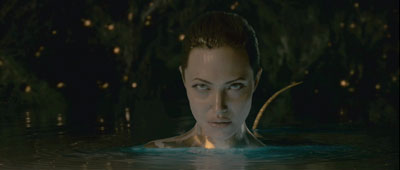
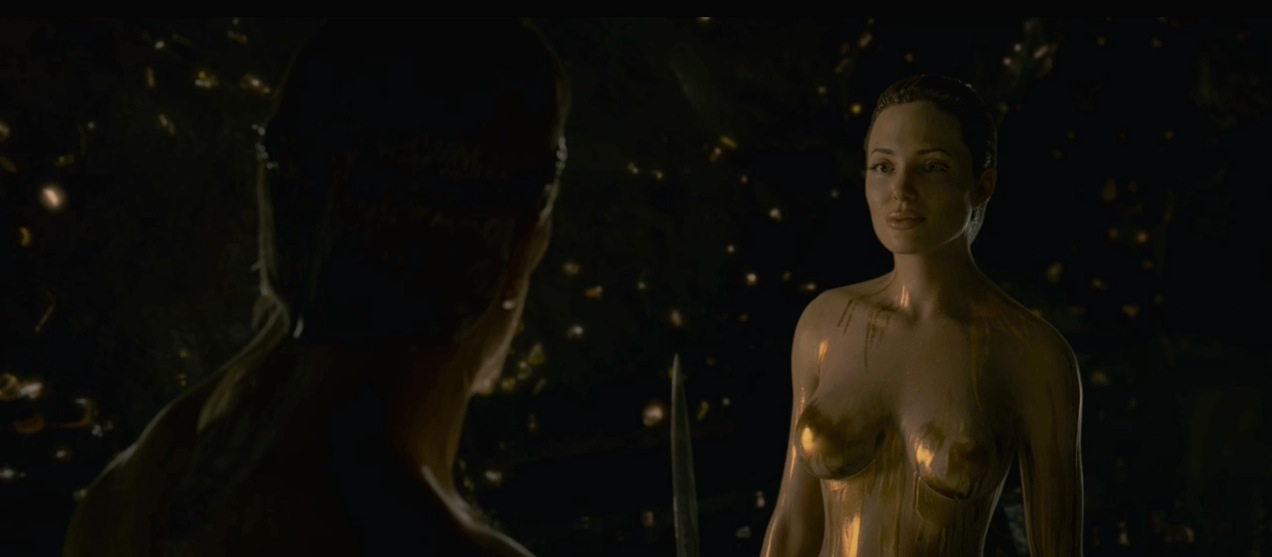
This is Zemeckis' second big motion-capture film after "The Polar Express," the "beloved" children's story made slightly creepy because all the characters look like those artists models, with resemblances of people plastered on them. One wishes to say that it's a "revolution" and all, but I'm still unimpressed, despite the thousand of person-hours involved to produce it. The landscapes and inanimate objects look great, but the people still have a clumsy way of walking and expressing themselves that takes you right out of the moment. The eyes seem all wrong, and the animation of the mouths when talking looks pinched and unconvincing, as if every character has had a few rounds of plastic surgery--the women in this are all unlined and Barbie-doll-ish. The characters played by Hopkins, Malkovich, Wright-Penn and Jolie all resemble the actors, which is also a bit of a distraction--they've done a lot of work to get Jolie "just so," but despite that there are instances where it looks like Jolie morphing into Jennifer Garner. ** But Ray Winstone, and Brendan Gleeson look like totally original characters that make them a bit more accesible. Generally, everything looks wonderful in dim-light scenes, but in the glare of daylight, the illusion falls apart.

A few other things bother, like the fight where Beowulf vows to fight Grendel naked (just to keep things even), and we are presented with object after object getting in the way of proving it. It was a running joke in "Austin Powers" and "The Simpsons Movie," but here, it's done completely straight-faced--which makes it all the more funny. The presentation of Angelina Jolie as Grendel's Mother makes the seductress role a little easier to see, but when she approaches Beowulf in all her "might-as-well-be-nakedness," there is a shot of her feet, which are cloven--but have spiked heels. Claws, yes. But spiked heels? Did Grendel's mother get the image to present herself from "Victoria's Secret?"*** Then, there's the problem that I'm seeing in more CGI movies--the "we're under a tough deadline, so let's make everything move really fast, so we don't have to do a lot of detail work" that shows up in such things as "Spiderman 3" and this film. Propulsive? Yes. Distinguishable? Not a bit. But it's easier to do a complex sequence if your make everything kind of a "smear." Finally, there's Crispin Glover as Grendel--one of those handful of roles you could say that Glover was BORN to play, but even here he's bizarrely strange--his words undecipherable, and his performance turned to "11." Like a lot of things in the film, it may produce unintended fits of giggling.

Also, this may be an animation film, but there is no way that a kid should go to this. There's a lot of gooey, icky violence, disturbing images, and nudge, nudge jokes that will have them in therapy within a week. Also, I didn't see the 3-D presentation of it--a lot of pointy things get stuck in your face in both versions--but I've been told the 3-D effects are, indeed, staggering and probably the most successful 3-D process yet produced.

I know a lot of things will stay with me--particularly the way Ray Winstone says: "Moi Nime is Baya-woof! An' Oi've cahm to kill yo' monstah"

"Beowulf" is a rental, by crom!

* I'd cite some sort of "Spoiler Alert" here, but as it's the oldest manuscript in "British" literature, and was written around 1100 AD, you've had plenty of time to read it by now!!

** A trick not beyond Zemeckis, who in the space-warp segment of "Contact," morphed Jodie Foster's face with Jena Malone's, the actress who played the character as a child.

*** Want to know what's really wierd? You go to the web-site that has the Beowulf translation on it, and there are two google ads: one for "Olde English" and the other for "sexy pics" of Angelina Jolie. One has to wonder whether the film-makers have done more harm than good.
--------------------------------------------------------------------------------------------------
POINK!!!

Smokey and I came back from a walk and hunting-and-gathering (at the Payless Food Store) after dark, so I was glad to have left the porch-light on to guide us from the car to front-door. Half-way there with two bags of groceries, mail and his leash gathered together in an ungainly crush, the porch-light went out. "Well, " I thought, "that means a trip to the hardware store to get a new light tomorrow." Then I looked around. No lights up and down the street (even the full moon was behind some clouds!).

Hmmm.

Cancel that trip to the hardware store.

We lost power about 5:36 PM last night. No idea why. There were no storms, no wind, no snow, or anything else visible that could have caused it--which usually means human error of some kind (I'll bet it had something to do with the hasty work being done on the Keystone-Pt. Townsend ferry dock that's being re-jiggered for foot traffic only--but that's just a guess--all the power on "The Rock" comes from up North, and if anything disturbs it, the whole island goes out. Isn't that con-veeeenient!). But we're prepared out here. By the time my neighbor Jim had his generator puttering away, I had the three candled storm lanterns fired up, the battery one operating, the crank-radio/recharger/light/siren charged up, the flash-lights in plain view, and a fire in the wood-stove. Then I made some phone-calls. Seester. Dog-sitter. FarmerScott.

Then at 7:17pm (ZZZZT!) the power came on. Emergency over. Nothing to see here. Back to your homes. Re-set your blinking clocks.

Still...it was fun while it lasted.

More power to us.

Friday, November 23, 2007

Thanks-giving for the Memory

Friday was a day to do things at home, like sleep in, chop wood (a lot! I got rid of three rounds, chopping them into nice wedge shapes that have been thrown under the tarp to dry off for use later in the Winter), and got around to wrapping the outside pipe, since the temperature has dropped down to below freezing. I can't use one of those handy-dandy foam contraptions ("foam-boobs" one of the elder ladies at the Normandy Park condo used to call them) to just latch onto the nozzle to tighten, so the process is to find one of my socks with holes in them, take a few of the more "thick" pages of the Voters Pamphlet and wrap them around the pipe and cover the wad with the rolled-up sock (Nothing like a sock full of hot air to keep the pipes from freezing). Presto! See you in the Spring.

While I'm swinging the axe (and to keep him happy, and out of the arc of my swing) the dog is chewing on an "O-bone" from the butcher's shop. He likes to gnaw on them 'til they're nice and shiny, while the action does the same for his teeth. His vocabulary has expanded to where the word "0bone" makes his ears perk up, and he snaps to attention.

While I was doing these chores I also managed (for the second time since we moved to "The Rock") to brain myself by stepping on the tongs of a metal rake in the cluttered shed. The handle snaps up and clobbers me, just the way they did in the silent movies. My reaction both times has been to laugh like a hyena, probably because that joke always works for me, but also because it rattles my brain and drops my IQ fifty digits.

The big toe on my right foot feels better. For the past few days it's been swollen and hurting. I don't know why but I surmise that when I stuck my foot into a shoe this week, I might have been stepping into the new home of a spider, who "bit it." But before "biting" IT, he bit my toe. All better today, though it's just made me reflect that I've acquired more scars since living here than I have in my entire life previous. Which brings to mind the old Red Barber quote: "It's not the one with the most toys, wins. God doesn't count the toys. he counts the scars."

That in mind, I should get on Ebay and sell some of these toys.

But all this activity was just an excuse to think about Thanksgiving, which was rough. A little devastating, really. And I've needed time to think things through--to digest from Thanksgiving, not only gastrically, but also mentally.

Things started off well with the Walaka/Otis pumpkin pancake feast. A fine time was had by all, even by Smokey who got a couple good walks in and got to bound around the RD. It was splendid to see everyone and engage. I disengaged about 1300, and headed for My Seester's, where we went to a local dog park and tossed the frisbee for Smokey until he was taking extended "time-out's." Then we headed for Thanksgiving dinner at a local hotel, with Claudi's neighbor Joan, my cousin Rob and his Mom, Aunt Chris. Chris is my Mom's youngest sister. She's 80. And she's had a series of small strokes, and may possibly have Alzheimer's. Anyway, Rob was helping her with her food--making "runs" to the get, helping her negotiate the utensils, stuff like that. I would engage Chris in conversation, and found that she still had the same caustic wit she always had, which I found was the same with my Mom. That basic core-personality of the person hangs on right until the end, so if anybody thinks they're going to get "mellow with age," they're confusing human beings with wine. So, I kept making Chris laugh, went and got her some dessert to let Rob eat, and helped her with that. At the end of the dinner, she looked at me and said--"You're a pretty nice guy." I thanked her, but it felt like a knife in the heart. That's what my Mom used to say to me on my visits long after she'd forgotten who I was. "You're a pretty nice guy." We talked about Rob for awhile, and then I had to leave. I had to "deal."

I went to the men's room and took long deep breaths, splashed cold water on my face, and tried to keep my heart from racing. It was all coming back and I wasn't handling it well. I took a few minutes, gathered myself, and went back. We had a wonderful time.

But I woke up this morning still obsessing, and my plans for heading to the Mainland were scattered to the winds. I had to digest this as much as I had digested the Thanksgiving dinner, and it was going to take time, activity, and time. And activity. And time. But I'm okay now. I've been thinking about my Mom a lot lately, because the "thing" I wrote all those years ago about her and Alzheimer's and reality had been brought up a few times in the past week (more on that later), and that story was comfortably filed away in my thoughts as "The Past."

And here I was being confronted with it again, like an echo, in the form of my Mom's sister saying the same words, meant to compliment, but bringing no comfort.

Despite things like Alzheimer's, and the other afflictions with similar symptoms, you never really can lose The Past. And whether it warms the heart or chills the soul depends on the prejudices and attitudes of the one who keeps it, or is kept by it.

Like a scar.

Just in Time to Celebrate the Birth of the Baby Jesus...*

Happy Black Friday

Every year for the longest time, I had a Christmas Tradition. I would go out and buy the tackiest Christmas ornament I could find--the one that least celebrated the True Meaning of Christmas, in the Schulzian sense. First one I ever bought was an ornament of Shaquille O'Neal hanging off a basketball rim. There have been some great ones--a Harley Davidson motor (with sound!), the killing of the Wicked Witch of the West from "The Wizard of Oz" (it just SAYS "Christmas" doesn't it? "Whattaworld, whattaworld!"), and Star Trek ornaments of "Worf" with a Klingon scimitar (as if to say "Honor the Holidays..or I'll sever an artery!!"), and "7 of 9" in a skin-tight bio-morph cat-suit. I can't even make a joke of that one.

Well, finances keep me from buying it, but I've found the ornament for this year.


Don't you want an Airstream trailer hanging from your tree in all its silver glory? Why, look, it even has the propane tanks on the hitch! The wheels turn and (subsequently, I'll bet) the awning extends. Now, if Mary and Joseph had one of these babies they wouldn't have had to sleep in the barn! This even beats out the "Star Trek II" ornament that has a space battle between Kirk and Khan (with animation and sound!)

* That's a quote from Phil Harper (RIP), who, as one of the most prolific of Seattle voice-actors, took a decidedly irreverent tack when doing commercials. Every ad for Christmas, he would intone with a wildly enthusiastic introduction "Just in Time to celebrate the Birth of the Baby Jesus!..." to be followed by news of 50% off sales, holiday chocolates, jewels, furs, whatever. Phil would inevitably end commercials with "...so go out and buy some of this shit to-day!" I miss that.

And I should mention that as a promotion to ad agencies in town to use his Claus-like voice, he sent out a newsletter that said "Let Phil be your Christmas Ho!"

Thursday, November 22, 2007

Thanksgiving 2007

"Only a Turkey Isn't Thankful!"*

(Like my hand-turkey? Only took me 30 seconds (!!) with the computer! And it's just as good (or BETTER!!) than the ones I made when I was...oh....two.)

So, here is my "Thanks" list from last year. It's still a pretty good record of many of the things I'm grateful for...like:

1. For no longer having to sit at the kid's table

2. For living in the Greatest Nation on Earth...it has such potential. Give it a year...

3. For having a roof over my head (to keep out #7)

4. For my wife...and her infinite patience and grace

5. For my family...always there in good times, but especially in bad, and that includes the Niece and Nephew who have made the area a "haynt."**

6. For my friends who have stayed friends...no matter the distance...no matter the time, and the new folks I've met since last year who have enriched my life and made me appreciate the shock of the New

7. For the Nature that has surrounded me these past few months and made me stop...and consider...even if said Nature can be pesky and danged inconvenient at times

8. For the opportunities that life affords me on a day to day basis

9. For reading this, you stray readers who've made this a regular "haynt"** (even those of you who come here because of a stray link to a Leif Garrett picture, or the Norman Rockwell "Freedom from Want" painting, or even that employee of the State Department who was looking for a picture of Kato from the "Pink Panther" movies (you know who you are, and probably so does "W")--anyway, I have to subscribe to the "Premium" version of "Sitemeter" now...not that I'm complaining

10. For the memories*** (especially the ones still to come)

But I also wish to thank those of you who have helped me out this year, just through kindness when you didn't really have to, or a place to stay when I was on the road, or work when you didn't REALLY have to, or slipping my name to a colleague, or making me feel welcome, or just keeping in touch when I've fallen behind in my correspondence. Everybody is everybody else's Life Support System, and I've never believed that so much as this year.

Let's all be here next time this year.

* Thanks to the Church reader-board I passed for that

** That's a Carolina version of a "haunt"

***Which brings us to this audio blog by my buddy, Jeff Hoyt, courtesy of "Hoytus Interruptus" http://www.hoytus.com/?p=35

Monday, November 19, 2007

Movie Review - "Lions for Lambs"

"Never engage the enemy for too long, or he will adapt to your tactics"


There are three arenas in play, and as the film begins the protagonists are checking their ledgers and statistics: Lt. Col. Falco (Peter Berg) is checking his strategy briefings; Senator Jasper Irving (Tom Cruise) is looking at dropping poll numbers; Professor Steven Malley (Robert Redford) is checking the quarter's attendance; Reporter Janine Roth (Meryl Streep) is looking at her unopened note-book--an empty slate. Thus begins "Lions for Lambs"* a polemic about the current Middle-East War, the entities that package and sell it, and the public that may not like it, but won't do anything to oppose it. All the stories intersect a bit and the movie takes place over a few hours. The script is by Matthew Michael Carnehan, who also wrote "The Kingdom" Its director, Peter Berg, who plays Falco here, said that film was "98% Action, 2% Message." Here, that ratio is reversed, and, man, is it tedious.

First off, there is a heavy veneer of liberal self-satisfaction (though not as much as when conservatives put the hammer down). The senator is a Republican tyro, trying to bolster his party's (and his) poll numbers by setting up a new front in Afghanistan (Senator's can do that? I mean besides Charlie Wilson?) He's given Roth a solid hour (this is supposedly a big deal) to argue his case that this attack (no, really, this one!) will win the war in Afghanistan, the war on terror, the hearts and minds of Afghans (he really says this) and presumably bring the troops back home for Christmas (he doesn't say this, but he might as well have). Cruise was bio-engineered for this role (and you just know this is the part Redford would have taken during his career in the cynical 1960's), an opportunistic-photo-op-ready politico, with flags on the desk, pants-press in the office, and flashing Chiclets in his mouth, while Meryl Streep is all shambling messiness, trying to counter the arguments (is that her job?) that Cruise spins on the head of a pin. Their section is the sort of "greased-pig" argument and obfuscation bull-session that keeps me from watching the "pundit" shows--nothing's less fun or informative than watching two used-policy salesmen, hectoring each other trying to get their feet stuck in the open door of your mind. Finally it gets down to my favorite argument when rats-on-their-hind-legs are cornered--The Multiple Choice Bottom-Liner: "Do you want to win the War on Terror: Yes or No?". ("Well, I don't know, Senator, when did you stop beating your wife?") At one point Streep asks, "When does the new offensive start?" Cruise looks at his (supposed) Rolex. "Ten minutes ago." So much for pre-selling.

And in that ten minutes, the mission is already SNAFU'd, when two grunts are bounced out of a helicopter taking heavy fire, turning the offensive thrust into a rescue mission. Not a good start to winning those hearts and minds.

And by a curious coincidence--or a heavy-handed ploy by the screenwriter--those very two soldiers were both students in Professor Malley's political science class, who, in a school project capped their volunteerism argument by enlisting. Now, Malley uses them to guilt a slacker-student who can't be bothered coming to class because he's "busy with stuff," into considering a more activist stance before the bigger challenges of jobs, mortgages, ball-games, and watching "American Idol" zombies away any chance of him doing any critical thinking for the rest of his life. That's a valid argument to make, whichever side of the aisle you take bribes on. But instead of making the arguments, Malley turns them into three-corner shots that kind of dance around the problem, rather than saying something, oh, like "I would suggest you start coming to class or I will flunk your lazy frat-ass: your call."

The trouble here is that the issues are so immediate that the arguments the film is making were too late four years ago. So, it's a bit like soft-ball preaching to the choir. The arguments are sound, but they have very little relevance to extricating us from the tar-pit of this conflict, and, yes, people are getting chewed up by it, but that's the business of war, and why you try to avoid it, rather than rush in like a damned fool. It's great to be able to say all this with 20-20 hind-smugness, but it's essentially useless. Now tell us something we don't know, and how we can avoid it the next time. "Is he failing you?" a fellow frat asks the student about his meeting. The movie certainly is.

"Lions for Lambs" is a cable-flick.

* The title derives from a phrase from World War I, but, the exact nature of the quote is subject to debate, and its history, like the film, is a bit muddled.

--------------------------------------------------------------------------

Ken Levine is currently on strike, but though he's not writing professionally (as he did on "M*A*S*H," "Cheers," "Frasier," "Wings," --then graduated to shows with more than one word in the title like "Dharma and Greg" and "Everybody Loves Raymond"), he does have a blog, which is sometimes informative and sometimes just damned funny, like his overview for the Holiday Movie Season. Priceless. The link, it is hidden.

Sunday, November 18, 2007

Intermission


video

Saturday, November 17, 2007

Movie Review - "Into the Wild"

Finding oneself and getting lost

There is a pleasure in the pathless wood,
There is a rapture on the lonely shore,
There is society, where none intrudes,
By the deep sea, and music in its roar:
I love not man the less, but Nature more,
From these our interviews, in which I steal
From all I may be, or have been before,
To mingle with the Universe, and feel
What I can ne'er express, yet cannot all conceal.

Lord Byron

The films of Sean Penn's directorial career have all carried the underlying theme of obsession. But until now, he has always shown the dark side of it-- "The Indian Runner," "The Crossing Guard," "The Pledge"--the latter two focussing on revenge, of sorts--the Need to get even, to balance the books, to set the world and Nature right. But with his Oscar-winning role in Clint Eastwood's "Mystic River," he seems to have cauterized that need from his system. His new film, "Into the Wild," is just as obsessive but presents more of a spiritual quest. Nature is already balanced. Now one must become a part of it. Based on Jon Krakauer's book (which is expanded from this article on "Outside Online"), it dogs the footsteps of Christopher McCandless, who upon graduating from college, disappeared on a journey across the country and eventually to Alaska, where he tried to live off the land, and his body was found by moose hunters in an abandoned bus. If he wanted to become one with Nature, he achieved it. But there's no great trick doing that. As so often happens, the destination isn't as important as the journey.

Penn (who also wrote the complex screenplay) presents McCandless' Odyssey as a rite of passage, literally divided into chapters, starting with his shedding of everything tying him to a middle-class life like his parents (played cold and shrill, by, respectively, Willian Hurt and Marcia Gay Harden), and simply disappearing, leaving no trace, and ensuring that he would have at least a couple months head-start before anyone knew he'd left. These chapters serve as flash-backs of a sort (given the opening of the film, the whole thing could be a flash-back) to McCandless' day-to-day life living in the abandoned bus/hunting drop that would unwittingly be his last stand. The narrative is punctuated by McCandless' writings in dreamy, floaty script, and a journal-like view from home from the perspective of his sister (played by Jena Malone). Each chapter begins with an extended montage played over songs by Eddie Vedder (which sounds like it could be horrendous, but Vedder's introspective lowing is the perfect counter-point to the images--one begins to look forward to the transitions). The results are never less than hopeful while never losing sight of the hardships along the way, the lessons learned and the experiences along the way.

Or the people. Along the way in the form of jobs worked, beds crashed, and meals shared, McCandless (who travels by the name of "Alexander Supertamp") encounters reflections of his parents and free spirits who push him to abandon his mental baggage, that, instead of establishing lasting ties, only steels his determination to complete his trek to Alaska. Here the movies shines with wonderful performances by Catherine Keener, Vince Vaughn (who's great), Hal Holbrook (who is heart-breakingly good-he should be recognized for this) and some folks that Penn just found on location (including a guy named Brian Dierker, who runs a ski shop in Flagstaff, Arizona--first movie--endearing performance). And its here that if the movie has a weakness, it is that Everybody Loves Chris, wanting him to settle, and by having that be the sole reaction, one's manipulation-shield is engaged, wondering if Penn is stacking the deck, making his McCandless not merely charismatic, but near-messianic. Counter that with the fact that these people are road-blocks to his purposes, while being necessary way-stops on the journey, and those quibbling mountains become mole-hills.* I suppose one could have done more to balance his character (for example, including the opinions of the native Alaskans who thought him merely "stupid"), but short of showing him rolling a drunk, I'm not sure that such a pruning would be all that worthwhile. His encounters are already showing the roads not taken, it is THIS path that is the subject of the film. Anything else would be a detour.

I didn't want this film to end, frankly. It's truly exciting to see a director use a kaleidoscope of techniques to tell a story that celebrates life.

"Into the Wild" is a full-price ticket.

* I wrote this entire review without mentioning the amazing work of Emile Hirsch as McCandless--the guy's in the ENTIRE movie, and if McCandless is too much of a good thing, it's because Hirsch's performance is so constantly winning, and focussed. You're compelled to keep watching this kid, and fear that his next step will be wrong. It's an involving, remarkable performance. While Penn's work is astonishing, he has the best co-conspirator in Emile Hirsch. His next role? He's playing "Speed" Racer. He looks just like him, but...I mean, c'mon AAAAUGH!

Friday, November 16, 2007

Movie Review - "The Kingdom"

Cries and Whispers

On the American military compound in Rhiyadh, two terrorists command a security vehicle and open up machine gun fire on a family softball game leaving carnage before they are killed. But like the WTC attacks, it's a two-pronged assault, the first wave of terror providing the means for a devastating explosion during the rescue efforts. For four FBI investigators it becomes a personal duty to investigate the scene and find out what happened and who was responsible. They only have five days. They're under constant surveillance by the local police. Their movements are restricted, their presence resented and the attack zone compromised in the clean-up efforts. The only thing they do have is an Exit Strategy, which has been formulated before their arrival, and things have a way of changing. But it's personal, and they have to find a way, doing an impossible task, in an unfamiliar and hostile area, without leaving a trace because it's not exactly sanctioned by the U.S. government. Yeah, good luck with that.

"The Kingdom" is directed by Peter Berg, whose previous film was "Friday Night Lights," a film I greatly admire. Berg shepherded that film over to a fascinating series on NBC, and unlike his previous series "Wonderland," has made it all the way to a second season. He started out as an actor-- was the slightly lump-headed first seduction of Linda Fiorentino in "The Last Seduction," and he starred for several seasons on "Chicago Hope," where he first started directing. Berg is a genuine find--an intelligent director who communicates everything-- gives you all you need to know, keeps things logistically decipherable, and lenses with an oblique eye that takes everything in but doesn't beat you over the head with it. An action-director who gives his audience credit for intelligence and propels the film along, trusting that the audience will keep up.

Berg has a flashy cast for "CSI: Rhiyadh" (scripter Matthew Carnehan describes it as "Imagine a murder investigation on Mars") in Jamie Foxx, Chris Cooper, Jennifer Garner and Jason Bateman (as well as Danny Huston, Frances Fisher, and Jeremy Piven--who basically plays his "Entourage" character working for the State department). Everyone's performance is tamped down, but the fact is they're all stars--well, Bateman is there for comedy relief--and unlike the cast of "Friday Night Lights," they stand out like sore thumbs, which actually serves the film well. But the stand-out performance is by Ashraf Barhom, whose Col. Faris Al Ghazi takes his job of providing protection for the team so seriously that he hampers their efforts at every turn. And given that his job is to stand in for the entire Arab world (almost every other local is a bit of a cypher), he carries off the role with a subtlety that doesn't betray the heavy lifting.


Berg has stated that he didn't want to make a "message" film, saying that the ratio for a film to make a point and make an audience is "98% action, and 2% message." That may be overstating the case, as there's a lot more message in the film hidden between the frames. But...though the film does put a face to the Arab world, though it does reflect the heavy-handed presence of America there, though it may bring into sharp focus the folly of having a formalized military presence in a guerilla situation and the dangers that that presence can provide in escalating the conflict--though it may say all these things that point to the folly of invading Iraq, that 98% action still has the effect of having the audience jingo-cheer on the Americans (even with Arab back-up) in a fire-fight in a hotel building. You have to have your message and the action that belies it. That's troubling. But while one contemplates that, the film moves on and delivers a spoken coda that says that, really, we're all not so different after all.

Boo-yah.

"The Kingdom" is a cheap matinee

Gray-Day-tion

(Before we go any further, JohnBai and Steve don't have to read this...well, nobody HAS to!)

Man!

Has there ever been a day as gray as this one? Dark, dark, dark! Like the sun hadn't even come up! I went out to chop wood early this morning before the rains set in, because I'd used everything up, and I figured I'd be needing it before the sun went down. It's a day of cleaning and staying indoors (unless the clouds part!) and tending to things that need be done. The office is a wreck and an invoice has to be sent out (I think I've invoiced every day this week!). The dishes have stacked up, there's a ton of recycling (I mean that--a TON!) Oh, and writing (taking care of that now).

Expect three more reviews, one of which is kinda blocking right now, but there's a TON (I mean that--a TON!) of movies out today that are screaming to be seen...and I still haven't seen "Gone Baby Gone" and "Before the Devil Knows You're Dead." No time in the sked (or "shed" for you stray Anglo-attendees).

I've been to the Agents twice this week to set up their audio room. It's been moved from a space that was designed to be quiet to one that couldn't be if a project depended on it. But what are ya gonna do? It's going to make putting those "subliminal" accents in a little problematic, but that's the hand that's dealt. It's not my shop.

This weekend, it's some socializing, and K will be "in the area," but I don't know if she's coming back up to the Rock yet before the next leg of her journey to Eugene. She's been in Mehico, "spa-ing" with her Niece which will help in the never-ending battle for a tobacco-free lifestyle. We've been out of communication since she's been down there, but I'll bet dollars-to-regular-priced-doughnuts that's she's doing well in a world without a black cloud around her head.

Speaking of which, have you looked outside lately? Man!

Wednesday, November 14, 2007

Tales from the Red Envelope

"The Pink Panther" (Shawn Levy, 2005) I've always been a big fan of the Blake Edwards' "Panther" films (until they became out-take reels, anyway), so when I heard of a new version with Mike Meyers as Clouseau, I didn't give it much of a chance. When Steve Martin signed on to take the role Peter Sellers made famous (and has been briefly taken over or supplanted by, respectively, Alan Arkin, Ted Wass, and Roberto Benigni) I gave it even less of a chance. The result...is not too terribly bad. Martin doesn't so much copy Seller's Clouseau, as spoof David Suchet's Hercule Poirot. His Clouseau is still informed of ego and little else, and is blithely unaware of what a prat he really is. Martin resists the urge to play it more broadly (which is his weakness), and if he doesn't have Sellers' innate ability to take things in a perversely savage manner, he does manage to keep the comedy up and the timing semi-precise (he's aided immeasurably by a bit too aggressive sound-design). One also has to credit the writers and Levy for matching Blake Edwards' ability to make a joke out of taking a small inconsequential act and turning it into a disaster. There is a terrific Edwards-ian gag involving a large globe (but NOT having Clouseau catch his finger in it as it spins) that builds quite precisely and would fit just as well into a silent film, which is from where the physical comedy of the "Panther" films sprang, and did a prat-fall. There are big changes. No Cato, though the gag is kept. Closeau still has a deadpan assistant (though now it's Jean Reno, whose potential is a bit wasted). And the plot is a combination "Pink Panther" and "A Shot in the Dark," although Beyoncé does not show as much screen-potential as Elke Sommer (that's one of those things you think you'd never write!) Someday Beyoncé may find a vehicle for her talents, but right now she's a bit behind Mariah Carey in the "Diva Most Likely Not To..." category (Somebody's going to have to overcome "The Curse of Diana Ross!"). And nobody can replace Henry Mancini, so Christopher Beck (who scored a lot of "Buffy") doesn't even try to match the sophistication. Michael Giacchino would be a better choice. And Kevin Kline feels a bit...restrained as Chief Inspector Dreyfus, though why no one thought of casting HIM as Clouseau is beyond me.


"Harry Potter and the Goblet of Fire" (Mike Newell, 2005) Year Four at Hogwarts, and Harry must learn that he can not stop death, that at times he must stand alone, trust his friends, and though he may be a natural at magic, it can't keep him from acting like a stupid muggle in front of girls. Oh, and (He Who Must Not Be Named) comes back. That's big. Who's new? Lots of kids (Hogwarts is visited by exchange students from France (girls) and some teutonic country (boys), Miranda Richardson as The Daily Prophet's gossipy-pain-in-the-neck Rita Skeeter, Brendan Gleeson (marvelous) as "Mad Eye" Moody, and Ralph Fiennes, chewing as much CGI scenery as possible as HWMNBN--Fiennes clearly relishes the role. At this stage of development, all the regulars are at the heighth of awkwardness, looking slovenly and disheveled, and just a bit homely. Harry must participate in a prom as well as the Tri-Wizard's Something-Or-Other, and one had best place their bets on Harry on the latter (in the former he's a complete wash-out). Director Mike Newell bustles things along and tries to put eveything in at the cost of giving A Big Important Event For Harry (and the emotional high-point of the film) a little too little background to make us care. The films are getting darker, both in subject matter--but also in lighting, the beginning of the film is nearly indecipherable without one of those divining maps from Part Three, "Harry Potter and the Rather Inocuous Magical Prop" (that was the name of it, wasn't it?).


"Enron: The Smartest Guys in the Room" (Alex Gibney, 2005) This "buy the book" documentary scrupulously tells the unscrupulous story of Enron, the energy-trading company whose fall was so huge it sucked down the accounting firm of Arthur Andersen, as well as the pensions and retirement accounts of its employees. At the eye of the "Big Suck" was a triumvirate of robber-barons with grandiose schemes on how to shuffle energy it didn't have, and what energy it did have was used to "cook the books." Those smartest guys are now infamous--Ken Lay, Jeffrey Skilling and Andy Fastow. They began as all fortunes do--they came up with an idea no one else had. Deficit Financing--don't get rich making a profit, get rich saying you're going to make a profit. And when you don't, offset the loss with dummy corporations set up solely to take the hit. And in this shell-game where money is a concept more than a commodity, the longer you can keep the plates spinning on the sticks, the more successful you might become. You just have to know when the plates begin to fall, then cash in. The film-makers have access to company films, P.R. pieces, and, most damning of all, the ribald voice recordings of the taders on the floor, famously yukking it up about gramma freezing in California. Skilling and Lay built up a cult of personality that gives them access to powerful friends who can manipulate the market to their advantage, delay investigations, and blue-sky security ratings (The speculation is that Lay helped formulate the Bush Energy Policy, which is why Dick Cheney has fought so strenuously to keep the names secret). The hubris becomes so great that soon they think they can sell a sunny day--tape recordings have company officials speculating on selling "weather futures." There is a damning wealth of information provided on the durth of anything approaching ethics and the depths to which the greedy can sink. One wonders if there's something deeper about Enron's company slogan: "Ask why."


"The Score" (Frank Oz, 2001) It's notable for being the last movie Marlon Brando was in, and his presence is probably why DeNiro and Norton and Bassett signed on, because, really, this is no great shakes as a film. It's a simple "heist movie," with some interesting switch-backs along the way, which works as an effective metaphor for a bunch of people generating a paycheck for themselves. But if you expect to see sparks fly between DeNiro and Brando (The Two Don Vito Corleones) the way they did between Pacino and DeNiro in "Heat," you're going to very disappointed. Bassett is completely wasted in the movie as "The Girlfriend," and Norton pulls off one of his "so-good-it's-scary" impersonations, this time as a retarded kid, which borders on the cruel. No, the only sparks are the ones that happened between Brando and director Oz. Brando didn't like the way he was being directed, so he decided he'd play games calling Oz "Miss Piggy" (of course, Oz played her in "The Muppets") It's just another indication of how far Brando was slipping--a perpetual jokester and lover of comedy, he couldn't even be charitable acknowledging Oz's gifts as a performer. "The Score" is not a great indicator of anyone's work (except the cinematographer's), but it's a shame that Brando went out on this one.


"God Grew Tired of Us" (Christopher Dillon Quinn, 2006) An amazing documentary (which won both major Documentary Prizes at
the 2006
Sundance Festival)that has a lot of godfathers* and a long history. "God Grew Tired of Us" tells the story of "The Lost Boys of the Sudan," 27,000 refugees who fled the Sudanese Civil War and made their way by foot to Ethiopia and then to Kenya. 10,000 survived the trip across the desert. After education in a refugee camp, the oldest of the young men get the opportunity from the International Rescue Committee and the to travel to other countries--3800 live in the U.S. The film concentrates on three of them-Panther Bior, John Bul Dau, and Daniel Abol Pach as they adjust to life in America, fight loneliness and isolation, and achieve personal goals of jobs, finding surviving family and forming their own charity and help organization to help their fellow countrymen, in the U.S. and at home. There must have been warehouses of material to choose from because it covers a lot of ground over many years. That the film is so powerful and an inspiration is a testament to all those in front and behind the camera.
* The financiers are NewMarket Films, Silver Nitrate and National Geographic. The film was shepherded by Brad Pitt, Catherine Keener, Dermot Mulroney, Mike Myers and the dispassionate narration provided by Nicole Kidman.

Monday, November 12, 2007

Movie Review - "American Gangster"

"That's What's Wrong with America. You can't Find the Heart of Anything to Stick the Knife In"

"American Gangster" tells the story of Frank Lucas, who, for a time in the 60's and 70's, ran the most successful narcotics operation in Harlem. The film is based on a "New York" magazine article from an interview with the real-life Lucas, so it must be based on fact, right?*

Ridley Scott's played fast and loose with facts before (1492, Black Hawk Down), so one should take the credit "Based on a True Story" with a kilo of salt. But, that aside, how is the movie?

It tells the parallel stories of Lucas' rise in power on the Harlem streets by "cutting out the middle-man" smuggling in raw opium from Thailand, and manufacturing a concoction called "Blue Magic" that had twice the potency, but at half the cost, with the story of the cop who eventually busted him, a down on his luck detective named Richie Roberts who's too honest to be trusted by the New York Police. While Lucas starts to make his version of the American Dream, Roberts continually has his legs knocked out from under him--his wife leaves him, takes his kid, he struggles with classes to better himself (public speaking, law), his partner turns junkie, and implicates him in a murder. The movie drips with irony at every turn, constantly showing the easy path of Crime and the tough road of Law Enforcement, that recalls that epitome of the thesis-"The French Connection."** In a montage of Thanksgiving, Lucas is shown with his entire family at a stereotypical Thanksgiving spread (and in one of the more heavy-handed of Scott's directorial choices frames it like Norman Rockwell's "Freedom from Want" painting, while Roberts, makes a cold sandwich of canned turkey-spread and potato chips over the kitchen sink. But then the director re-ups it by showing junkies shooting up between their toes in grimy bathrooms, and a mother passed out in bed, while her child is screaming in the room. Whatever glamour Lucas may enjoy, Scott is particular about showing the cost in human misery. No one gets off Scott-free.

Sometimes the tables are turned. Lucas occasionally has troubles in the operation, and however much he may espouse core-values of honesty and integrity, the very nature of his business starts to rot his dreams for his family. And the more Roberts investigates, the closer he comes to his target, the more his team of "Untouchables" gel, and his investigation and life begin to come into focus.

Ridley Scott misses as much as he hits. For every good film (The Duellists, Alien, Black Hawk Down, Thelma and Louise), there is a terrible one (Legend, 1492, Someone To Watch Over Me, G.I. Jane, Hannibal, A Good Year), and some that have just enough quality in them (Blade Runner, Gladiator, Matchstick Men) that his directorial brio can compensate for weaknesses and messy scripts. But here, he has a cracker-jack script by Steve Zaillian, no worries about creating "a world" out of whole cloth, and a stunning cast that includes Clarence Williams III (uncredited), Joe Morton, Armand Assante, Josh Brolin, Cuba Gooding, Jr., the magnificent Ruby Dee, Ted Levine, Roger Bart, Carla Gugino, Chiwetel Ojiofor, and top-lined by Russell Crowe, but especially Denzel Washington. When these two heavy-weights get together, their scenes crackle with invention. Everybody does incredibly lived-in work.

And nobody less than the director. This is Ridley Scott's best film in ages. At times the details get a bit murky, but Scott does so to keep a multi-faceted story moving at a brisk pace. And he pulls off some amazing little camera tricks that stun, and some of the most unpretentious action-sequences put to film. Those action sequences are rough stuff--the film begins with the immolation and point-blank gundown of a mob rival--and the junkie sequences are harrowing, so one should be warned. But missing it would be missing a great film.

"American Gangster" is a full-price ticket

* a casual glance at the internet will disprove a lot of myth from fact. Lucas did not work for crime boss "Bumpy" Johnson for 15 years, but five (he's been in prison before), he was not with him when he died, did not marry "Miss Puerto Rico," or own "Small's" nightclub. And that's just the start for Lucas. The real Roberts is a bit miffed that to attract Crowe, they beefed up his part by making him more of a loser. Lucas admits that the film is "about 20% true."

** The names "Eddie Egan" and "Sonny Grosso" are invoked early on, and Crowe's Roberts employs a foot-chase under the "El" that figured so prominently in the movie.

Sunday, November 11, 2007

We Interrupt This Broadcast...

...to be narrow-minded.

The FCC snuck in like thieves in the night the other day to grudgingly hold a "Town Meeting" Friday night at Seattle's Town Hall on the subject of station consolidation.

They're for it.

They want more of it.

That's why they're considering letting the entities that own every radio and television station in town, also own the newspapers as well.

That would make everything neat and tidy, wouldn't it?

But because the broadcast channels and air-waves are a public trust--we own them, they administer them--they had to hold a meeting in various cities to get the public's reaction. We were the last. And because it's such a big deal, the commissioners made sure they gave very little notice or announcement of it. God forbid, that people should show up and actually give their opinions.

But people did...in droves. And one of them was conservative commentator John Carlson.

Here's a report of the meeting and what he said there.

http://blatherwatch.blogs.com/talk_radio/2007/11/john-carlson-sp.html#more

Thanks to Michael Hood and his snarky little broadcast blog "Blatherwatch" for the word.

Saturday, November 10, 2007

"Oh, Wasted 'Sleuth'"


"In Olden Days a Glimpse of Stocking Was Looked On as Something Shocking, now I suppose....Anything Goes"

"Sleuth" started out as a hit play by Anthony Shaffer. It was inevitable that a movie would be made of it, and in 1972, a spit-and-polished version of "Sleuth" hit the screen. Shaffer wrote the screen-play, and it was directed with a rich panache by Joseph L. Mankiewicz (who knew a thing or three about theatricality) and the cast could not be improved--top-lined by Sir Laurence Olivier as mystery writer Andrew Wyke, and Michael Caine as the London hair-dresser Milo Tindle, currently having an affair with Wyke's wife. Mankiewicz's film is devilish fun, a clash between The Old World and The Terminally Hip with the battleground being Wyke's gadget and gee-gaw filled Manor House (designed by Ken Adam). Add to it John Addison's frothy hapsichord score and however dark the film becomes (and Mankiewicz gives it a creepily saw-toothed edge), it is never less than fun to watch, especially seeing Olivier energetically dashing through each scene, precisely mimicking accents and dialects--a brilliant murderous man-child forever playing games and Caine keeping up, trotting warily behind. At the time, that theatricality and staging made everything seem a trifle--a little bon-bon for the rinse-set. But over time, one can't help admiring the energy brought to the fore by Mank and Olivier, defying age and frailty to knock another one out of the park. And Shaffer's play is filled with all sorts of opportunity to...play. It stands as definitive...a champion documentation of the play.

Good Authors too Who Once Knew Better Words, Now Only use Four Letter Words Writing Prose, Anything Goes.

It must have seemed such a good idea to re-do it. With Caine old enough to play the Wyke role, and who else but Jude Law as Tindle, making it "The Battle of the Alfies" (and if you think this is coincidence, a couple of lines makes it obvious it was uppermost in the film-maker's minds). Then, to adapt (at one point Wyke says, cheekily, "You know what the word 'adapt' means, don't you?"), the great Harold Pinter, and to direct, Kenneth Branagh, both men who can mine rich veins out of depleted quarry. And the result? "Sleuth" is still there in skeletal form--it's still Wyke vs. Tindle, but only one line of the original remains*--it's been completely stripped. The fussy old school mysteries Wyke wrote are gone, replaced by "crime novels" that regularly turn up on British telly, exemplified by sweating policemen grilling suspects. Milo's now an actor, who does hair, does the occasional chauffeur job. He plays "killers...sex-maniacs, perverts mostly." Not only is the dialog stripped down to essentials ( and in nice....short little...bursts), so is the attitude. Any veneer of civility from the play has been scraped away, starting in the first moments with the chilly pause before a hand-shake when the two men first meet. No, they start off scrapping and spitting at each other right from "Hello" using all manner of Anglo-Saxon terms for each other, mutual contempt hurled in both directions. Which tends to throw the rest of the play on shaky ground. I suppose the makers didn't think Caine could pull off a stuffy, fusty Brit, and made it two working-class toipes throwing knives between their two sets of blue eyes. It takes the class warfare sub-text completely out of the center of the thing, leaving it all to ring just a bit hollow. The play pretty much runs its course, but the Second Act is considerably shortened, and the Third Act, if you will, is dragged on and on (despite all this, new-"Sleuth" lasts 86 minutes--the first was 2 hr, 18 m-- but seems longer) All this is staged in a hi-tech sterile interior (Wyke had nothing to do with it, he claims which seems...odd). And although there's a lot of bantering and word-play, sometimes annoyingly non-sequitir, it's just NO fun at all. Not a jot. At the end of the original, there is the satisfying finish with two simultaneous wails, along with mocking laughter. Then a curtain comes down. Here, nothing. Silence. Not even the impulse to applaud.

"Sleuth" (1972) is a strong matinee.

"Sleuth" (2007) is a waste of time.

* "The shortest way to a man's heart is humiliation."

Friday, November 09, 2007

Movie Review - "The Assassination Of Jesse James By The Coward Robert Ford"

Poor Jesse had a wife to mourn for his life,
Three children, they were brave;
But the dirty little coward
that shot Mr. Howard*
Has laid Jesse James in his grave.

That's from the old song "The Ballad of Jesse James" which I remember from my youth, forever enshrining James and the "dirty little coward" Robert Ford in my memory. It was written by one Billy Gashade (who took pains to include himself in the lyrics, naturally) soon after the outlaw's death. As with so much in the Jesse James business, it is reflective of the myth of Jesse James rather than the reality. For instance (as the Ford character points out in the movie) Jesse only had two kids. The fact behind the myth was that Jesse James was a vicious little punk--racist, paranoid, just as capable of killing friends as enemies, and women and children in the bargain. And while it's true he did rob from the rich--his target was banks and trains (or Union veterans)--the legend that he gave to the poor only extended to himself and members of his gang. No one who sees Jesse James as a folk-hero, or seeks to profit from that image mentions the mutilations he would perform on his victiims. It kinda gets in the way of the "fun." Yet, folks in Missouri still talk of the history of Jesse James (I once stayed in a hotel that advertised he slept there), and there's even a feud going on about whether Jesse really did die, and there are folks who want to dig him up to check DNA evidence to claim family affiliation. The myth rolls on. The lies that were sold in the pulp-magazines during his life are still at work, and as the line from "The Man Who Shot Liberty Valance" goes: "This is the West, sir. If the Legend becomes Fact, print the Legend." Even if it is a god-damned lie and the guy was a scum-bag.

It is the yin and yang of truth and fiction that suffuses "The Assassination of Jesse James by the Coward Robert Ford," but then it did in reality, too. The conceit of the film (and the book by Ron Hansen on which it is based) is that Robert Ford was a product of a pulp-western inspired hero-worship, that Jesse had his eye on the stories, too, and their mutual attraction and loathing of the truth behind it was the music to the dance of death they engaged in. Robert Ford was a nobody, and, in the film's words "Jesse James stood as tall as a tree." And that set up a love-hate relationship with the unstable hoodlum. "I can't figger it out," says Brad Pitt's Jesse to Casey Affleck's Bob Ford. "Do you wanna be like me, or do you wanne be me?" The fact is Ford doesn't know himself and the answer changes depending on his fortunes...and his fears. But as the cliche goes there's only room for one of them, and if there's no doubt that the strong will prevail, there is some question which one that would be. Maybe it will merely be a case of who is the least weak. Ironically, both will go on to greater fame and infamy.

Andrew Dominick's film meanders between an informative narration** spoken over landscapes beneath time-lapsed speeding clouds, as if Nature is careening to a foregone conclusion, while the figures take their own sweet time getting there. Dominick has a formalism going with those fleeting clouds and shots that are framed by a time-distancing diffusion. But it's very inconsistent, and rendered meaningless--no doubt due to post-production cutting by Producer Ridley Scott and star Pitt to punch up the pace. If it's not all Dominick wanted it to be, at least there remains some terrific performances all-around. Pitt is at his enigmatic best here, an unreadable half-smile on his face in all occassions. Sam Rockwell as Ford's older brother and fellow gang member gives another off-kilter performance that is spot-on. Along the way there are terrific cameos by Sam Shepard, Michael Parks and Ted Levine (and one distracting one by James Carville), but the stand-out is Casey Affleck. Affleck is every insecure, withdrawn kid who talks big, with a defensive smile on his face, and eyes that roll protectively up into his head when challanged. He's a train-wreck waiting to happen. And Jesse James specialized at trains.

If you're of a patient frame of mind, and have a taste for an unromantic West with heavy-handed irony then "The Assassination of Jesse James"is for you. But if not...

"The Assassination of Jesse James by the Coward Robert Ford" is a rental.


* "Thomas Howard" was the alias Jesse James was using at the time of his death.

** The narration has its own problems. One is not too sure of its reliability. For instance, in describing Jesse it states that he had "granulated eye-lids" which caused him to blink excessively, though part of Brad Pitt's performance is a protracted concentration, where he stares but does not blink. Then, the narration goes all flowery on the subject "...caused him to blink as if the world was too big to take in for too long." The film has its own problems with truth and myth.

Wednesday, November 07, 2007

More Tales from the Socialist Literary Collective*

"Call Northside 777"(Henry Hathaway, 1948) There was a brief period in American films where Hollywood embraced the neo-realist school coming out of Italy--where stories were filmed out in the streets, not in the rarified atmosphere of a film-studio (Italy's huge studio, Cinecitta, was being used to house refugees), and it dove-tailed with the gritty world of film noir and crime-thrillers. Elia Kazan made one, even Hitchcock did. But the most well-remembered of them was "Call Northside 777" with James Stewart as blasé "Chicago Times" reporter Jim McLane, who, upon taking an assignment he doesn't want, turns it into a cause celebre and his own obsession to see Justice done.

This was one of the first movies Stewart did after his Air Force service, as he was beginning to challenge and even destroy his callow image at the beginning of his career. Now, with an added maturity he could actually pull off the cynical journalist role he wasn't too convincing as in "The Philadelphia Story" (which won him a "sympathy" Oscar after losing the previous year for "Mr. Smith Goes to Washington" the year before) He returned from the war determined to play characters with a darker edge.

Henry Hathaway directed with a subtle eye, finding interesting deep-focus shots in lackluster surroundings. McLane's first encounter with a scrub-woman washing the stairs of a cathedraled office building carries the visual weight of years of work needed to raise the reward-money to help spring her imprisoned son (Richard Conte). The jailhouse of the visitation scenes IS the jailhouse, and the arrest of Conte's character looks and feels like actual newsreel footage. Finally, you get to go back in time and watch vital clues produced by the old technology of wire-photo transfer. It's another instance where the straight-laced neo-noir style goes a long way in selling the truth of a story, however implausible it might seem.


"The Wages of Fear " (Henri-Georges Clouzot, 1952) Some movies are so good they defy time, place and stay universally fresh, seemingly like they were made yesterday. Clouzot's "The Wages of Fear" is that kind of movie, and I would call it the best film 0f 2007 if it was released today instead of 1952. It tells the story of four vagrants scratching out a living in a South American village existing in the shadow (and under the thumb) of an American oil company. One of the distant oil rigs goes up in flames, and these four are hired to drive two trucks of nitro-glycerin over unforgiving roads to the inferno to snuff it out. Why take on this task? $2,000 per man--enough money to fly out and make a new life. Why these four? They're not union workers, and should they die--the odds are fifty/fifty, hence the two trucks--they have no families who might sue or require compensation.

It's a neat little trap, and that doesn't cover the obstacles that Nature (and uncaring road-workers!) have along the way. All these desperate times call for desperate measures and the efforts taken can be undone in the blink of an eye, or a flash of fire. For the four, the journey strips them down to their real selves, all pretense and masks disappear in the face of impossible challenges that must be overcome, and the looming threat of death riding behind them. The wages of fear may be death, but "The Wages of Fear' is a bleak metaphor for life itself.

All of this is played out over a blasted landscape, the results of the presence of Big Oil, and the journey feels like going back through time as well as space, through the spare white jail-bars of a denuded forest, back to the primordial ooze and finally ending up in Hell. By the end one can't help wonder if the fate of Nature and the nature of Fate are intertwined. Except for one fairly amateurish performance this is a near-perfect movie.


"Tom Jones" (Tony Richardson, 1964) I have been hearing for years and reading in books of the freshness and originality of "Tom Jones," and after seeing it, one wonders what all the fuss was about. Yes, it's fun and frivolous. Yes, it won the Academy award for Best Picture. Finney is marvelous, but one also looks at the techniques used and must admit that it has not aged at all well. One must be careful, though, as a film should be considered as it was of its time. The current discussion (one could hardly call it a controversy) where "The Searchers" is a classic--for the simple reason that its sensibilities are of another time and picture-making makes one wary of arguments like this. I've also had to defend "2001" for being full of cliches--yes 'tis, considering every "space" or sci-fi movie since then has ripped it off--merely because it was of a time and sensibility. To someone growing up on MTV cutting "2001" must look stunningly tame (Be that as it may, I'll bet an MTV movie-goer, would still be affected by "long-take" syndrome, where the longer a film-scene goes on, the more nervous-making it becomes.

They'd never have that problem with "Tom Jones." But after sitting on it a week, dissipating the expectations and prejudices and going in for another viewing, one has found the context: the past is not a pageant. Historical dramas before it, were as stiff as the multi-layered costumes and as formal as a ball-waltz. "Tom Jones" got rid of the tracking camera and the stately walks, and made the 2-dimensional costume-fillers 3-dimensional people, and did so with a markedly ribald sense of humor, and the understanding that what drove them, drives us. Since then, Richard Lester and Ridley Scott (and Merchant/Ivory and everybody else making historical dramas of classic novels) has taken Richardson's path and taken the "hit-the-marks" formalism out, and lensed with a satirical eye to show us the past and how we repeat it. "Tom Jones" bursting on the scene must have felt as relieving as removing a whale-bone corset!


"The Spirit of the Beehive" (Victor Erice, 1973) Victor Erice is the Terrence Malick of Spain (though to be correct it should be the other way around). His films are precise and planned so carefully that he has made three films since 1972's "The Spirit of the Beehive." "Spirit" tells the story of two children; Father is a bee-keeper, Mother is a repressed housewife. The children go to see a matinee of James Whale's "Frankenstein," which deeply affects the youngest, Ana. She wonders why, in a pivotal scene, the monster kills a young child (in the film it's never seen) and if the monster is real. She's told by her older sister that the monster is a spirit who will come at her call--"Hello, I am Ana." This sets in motion a series of events that juxtaposes life and freedom, identity and society, death and repression. This film was made in the last echoes of the Franco regime and the people walk around in a form of zombie-state, their expressions impossible to read. That the Frankenstein monster is seen in this context as a symbol of life and freedom shows what a palpable symbol it remains, and how malleable.


"The House on 92nd Street" (Henry Hathaway, 1945) Another of those neo-realist films, filmed in the locations in which they occurred. But this one goes a step further--except for the lead actors, everybody's a real FBI agent--you can tell, the line readings are merely that, line readings. "Bob, let's get this over to the Cryptanalysis boys to see what they think." "O-kay, Wendell!" And the actors, mostly unknowns except for the always-natural Lloyd Nolan stick out because they're at ease and have better hair-styles. Real surveillance footage of the German Embassy during the war is used in this story of a Quantico-trained double-agent tracking a Nazi plot to discover the secrets of The Manhattan Project (or "Project 97," as its called in the movie--it was made in 1945, after all). It's a stunt-film, a propaganda document, an early film-noir (without the noir stylistics). And the blend of styles almost gives it a documentary feel. Henry Hathaway does some ingenious work making this all work together, at the cost of making the staged segments feel extremely staged in a D-budget sense.


"The Hound of the Baskervilles" (Terence Fisher, 1958) I'll go see any Sherlock Holmes story (as long as it's not a spoof), not so much because the story's are compelling--they're fascinating for the glimpse of salaciousness in Victorian England, but the story-template is rarely altered--but because the portrayal of Holmes is an actor's showcase. Holmes by Doyle is something of a blank slate, so an actor can infuse him with whatever qualities they choose to emphasize: Basil Rathbone, the heroic; Jeremy Brett, the neurotic; and on down the line to the worst--Stewart Granger who was content to make Holmes merely British (we won't get into Hugh Laurie as "House"). So, it's interesting to see the Hammer Studios' "take" on Holmes. Hammer was the British equivalent of Roger Corman's AIP, but with a distinct advantage. They also purloined classics in the public domain, but they had Terence Fisher, with his flawless eye of direction (and cleavage) and a repertory cast that included Peter Cushing and Christopher Lee. Here Cushing plays Holmes and he's obviously devoured the Doyle stories for Holmes quirks, stabbing documents into his mantelshelf and writing notes on his cuffs. His Holmes is energetic and flinty, bordering on rude with a relish of the melodramatic. His skull-like face even recalls Sidney Paget's original drawings. Until Brett came along, Cushing, to this Baker Street Irregular, was the best of the Holmes portrayals. Christopher Lee plays the put-upon Henry Baskerville, and as the actor is quick to point out in a "Special Features" interview, it's one of a handful of romantic leads that he's played in his long, long career. What makes this "Baskervilles" different from the countless others? Holmes is absent for less time, a lurid flash-back acquaints us with the origins of the Baskerville curse, there is a romance (of sorts) and the death by quicksand is given to someone entirely different. It is, though, faithful in spirit, if not in detail.


"The World's Fastest Indian" (Roger Donaldson, 2005) A labor of love for Donaldson, who first did a documentary of the man in 1971, "The World's Fastest Indian" tells the story of New Zealander Burt Munro who fulfilled a dream of testing the 1920 Indian Spirit motorcycle he'd been tinkering with his entire life at the test track on the Bonneville Salt Flats. Everything seems to be against him: he's old, lives in a shack, has a pension and angina, but his basic subsistence-level, his spirit, energy and resourcefulness (and his not inconsiderable charm) are enough to get him to America during "Speed Week" in Utah. Recommended by FarmerScott, K. was a little underwhelmed by the prospect--"I'm not into "engine" movies," she said--but was charmed by it, and so rooting for the man, that any set-back was felt keenly. It helps that Anthony Hopkins plays Munro as a slightly-distracted charmer, who, when he goes off on a story or a philosophy turns away from his audience as if he's addressing the world, but takes things in great genial strides and an attitude that it can all be overcome. It's one of those "Based on a True Story" tales that actually is a true story, as the documentary that Donaldson originally wrote and directed is also provided on the DVD, and the real Munro's words and manner are displayed. It's a truly heart-warming, uplifting tale, made doubly so by its provable authenticity. It is easily Donaldson's best film, and a tragedy that so few people went to see it in a theater. It's always asked, "Why don't they make movies like they used to?" And the answer is--because people don't support them. "The World's Fastest Indian" is one of those that "got away."


"The Innocents" (Jack Clayton, 1960) One of the truly great horror movies ever made, though without a drop of blood in sight. Jack Clayton's film of William Archibald's play (based on Henry James' "The Turn of the Screw"), with a polish by Truman Capote, and a final coat of lacquer by John Mortimer, is a creepily finessed horror story/psychological thriller depending on your point-of-view. Miss Giddens is given her first governessing job by "The Uncle," a cold bon-vivant, who wants her to "handle everything" and "leave me alone." Arriving at the country estate, she finds a world alive with life...and some dead stuff, too. Isolated and buttoned-up (minister's daughter) she starts to suspect that her little charges are more than they seem to be, finally convinced that they are in the thrall of the dead care-takers previously employed. Deborah Kerr treads a fine line between gentility and hysteria, and Michael Redgrave, appearing briefly, is the coldest of rakes. The stars of the film, though, are little Martin Stephens and Pamela Franklin, she, vibrating like a thing possessed (well...) and he, all-stillness and eyes that are fathoms deep. There has rarely been two kids as quietly malevolent as these two. Then, too, are the presences of Peter Wyngarde (Britain's epitome of the degrading satyr) and Clytie Jessop, as the figments of Quint and Jessel, who have gone before. The image of Jessop, standing ethereally among the reeds of a lake still is one of the singularly creepy images in all of cinema for me. Freddie Francis did the outstanding cinematography, and A.G. Ambler and John Cox, who provided the outstanding sounds evocative of things both natural and not. Talk about the road to Hell paved with good intentions...


* Your Public Library

Tuesday, November 06, 2007

When "Pack" Authority Breaks Down

No one tell "The Dog Whisperer," please?


On the Road Again: I'm heading for Portland. K's heading for Bonneville (Washington), then Mehico, then Eugene. Smokey the Hat will be staying at the Dog-Sitter's 'til I get back this week. Splendid times are guaranteed for all.


Coming Attractions: More Tales from the Socialist Literary Collective (lots of 'em!), Some Tales from the Red Envelope, and at least two new reviews--probably more.
-----------------------------------------------------------------------------
Bumper Sticker of the Day: On a sticker with a monkey-head silhouette: "I fling poo"
Song in me Head: "I Shot the Sheriff" (Eric Clapton) --but with the lyrics "I bought Musharraf, but I could not buy de-mo-cra-cy"

Monday, November 05, 2007

It's Cartoon-Time, Kids!!*

"Sunny" Day sent me this and I laughed so hard (and K laughed so hard) that I am compelled to share, despite the fact that I can't embed the damn thing. No, you have to go to all the trouble of clicking on a link.

Rest assured, you are going to a safe site (it's Yahoo!®Video), but this is the only place I've been able to find this cartoon.

It's worth it, though.

------------------------------------------------------------------------------------------------

*Of course, that line comes from every kid's show ever transmitted through a photon tube, but the guy I remember saying it the most was Chris Wedes, aka "J.P. Patches." Today the Mayor of Seattle declared November 5th "J.P. Patches Day," which hardly seems like enough. The man would pull down 2 shows a day and one on the week-end and then go out and open every single grocery store in the Puget Sound region. To read more about the self-proclaimed "Mayor of the City Dump," click on the "City Dump" link over there on the right, and enter the peculiar (and mostly ad-libbed) world of J.P. It's an understatement to say he had an influence on my life and career. Here's a check-list that I still have from J.P.'s show:

Saturday, November 03, 2007

And Now, For Something Completely Different...

Q: If you had an infinite number of marshmallows, how many Lincoln-Logs would it take to reach the moon?

A: No, because ice cream has no bones!

This was first thrown at me in a High School English class by a smart-ass who wasn't following an argument I was making about some novel of some kind. It did exactly what it was meant to do: it stopped me cold, derailed my train of thought and made me shut up for a few seconds while I was dealing with the flow of non-sequitirs.

Now, so many years later, I can use that timeless (and time-twisting) poem:

Turn backward, turn backward,
Oh, time in your flight,
Just thought of the comeback
I needed last night*

...which would be:

1) That the best you can do: babble nonsense at me?

2) If you don't have a valid argument, why don't you shut up and let someone speak who does?

3) What's your point?

4) That was a good line when Groucho Marx said it, but what's it got to do with this?


That's what I should have said...(wish I had a Time Tunnel)

* Just a sneaky way to plug the fact that you need to turn your clocks BACK one hour Sunday morning! A Public Service Message from this station.

Friday, November 02, 2007

Jetsam!!!

We've done Flotsam. Here's Jetsam.

Customer Relations--A Study in Contrasts

The Good Example: Over the weekend while K. was gone, I was taking the near-occasion to walk the dog when we got into my car and discovered that it wouldn't start (I was driving). Well, I tried to compression-start it to no avail, so we (the dog and I) decided to walk down to the beach (he was driving). Anyway, no juice in the car. It could be one of a couple of things: dead battery (not uncommon when the weather turns chilly), or a bad something-or-other, either the ignition, or the distributor. In any case, I was not going to move forward with at least a jump. But I really didn't have anyplace to go, so I let it set. K. was coming home Monday morning. Not a big deal.

K. came back, we hooked up the jumper cables--and "Lookit, Igor!" it came alive, ALIVE!! But the next morning, not so much. So after another boost, I took it in to Les Schwab--known around these parts as the very model of a modern Better Business. I left the house at 10, and I was going to be doing chores in town all day, but let me just start by saying I was on the 11 am ferry. So I left my house at 10. It takes 20 minutes to get to Les Schwab. I was ON the 11 o'clock ferry.

What transpired? I went inside, explained the problem, they gave me dollar options and then went to work. They were done within a half-hour. As I was paying I mentioned to the mechanic, "Now I just hope it's not the generator or distributor acting up.." "Oh, we checked those," he said. "You're good to go."

He CHECKED all that. I was GOOD to GO.

And, indeed, I was. But, I had to tell him my admiration for the Schwab shops by telling him of this story, to which he laughed and just said, "It's what we do..."

And exceptionally well. Next stop:

The Bad Example: My first stop was to get the pads of my eyeglasses fixed. The one pressing against the right side of my nose had cracked and split off, causing my some irritation, so I thought that that was the day to get it fixed. I went to the Group Health "See Center" on the Eastside. They were up on the third floor of the building, so I went into the Office, and was promptly beckoned to a cashier. What was I there for? "I just need to replace the pads on my eye-glasses. You can do it here, or I'll just buy the pads and do it at home." Fine. My name? I told her. I have a common name, so I had to do the standard wait while they find which of the "me's" is actually "me." What's my address? Not there. What's my phone? Not there? Any previous address? Not there. How about my birth-day? Not there, either. This went on for 10 minutes. "Well, I can't find you in our data base, so we'll just have to start a new account. Name?" You've got my name. You've got my phone number, my birthdate, and my last two addresses. I could've applied for a job by now. Do we really have to start a new account? "Well, we need it for payment purposes." I'm going to be paying CASH. "It doesn't matter. We still need a record for..." No, you don't. I don't want to start a new account. I'll go someplace else. "Well, if that's what you want to do..." Thanks, I lied. And I left.

Bad Group Health. Very bad.
----------------------------------------------------------------------

I don't give two hoots about sports (though I did cast an eye towards the World Series results), especially College Football, but this caught my eye. Like I said, I don't like c-football, but I do like chaos, and I understand that when a play is made, it takes equal parts planning and luck, and something like a miracle for a complicated play to be completed.

But, this? This is insane. This is a play being made on the edge of a razor blade for a staggering minute and a half, when at ANY TIME, something could and probably SHOULD have gone wrong. But it's been that kind of crazy year for football.

Here's the last play--Trinity College and Milsap. :02 on the clock. Amazing. In fact, legendary.


-------------------------------------------------------------------
So, what's up with you, anyway?

Well, this year I decided that I wasn't going to buy Hallowe'en candy. We (I) always buy too much, and it just sits around the house calling our name, because for the past five years or so, we've always lived in "the spooky house." The house with very few lights. The house that's difficult to get to. Whatever the reason (Hmmm. Maybe it's the ferocious barking of a certain Hound from Hell*), we don't get a lot of kids for Hallowe'en. None, precisely. So no candy shopping this year.

K. went off to her "Smoking Cessation" class (She's doing EXCELLENT, by the way). Before she went, we discussed the Hallowe'en situation. "Do we have anything to give 'em?" No. I've got some Toll-House cookies baked, but parents will be concerned about razor blades and stuff like that. "Well, I don't know..." I could give 'em some of that nicotine gum you don't like.... I thought that was an inspired plan, but K. said you weren't supposed to give nicotine gum to kids, so that put the ki-bosh on that. I guess we would have to contend with T-P in our trees, if any pint-sized pirates and princesses showed up at our door.

But they didn't. Saved by the lack of a bell. K. came home, I put together dinner and sat down to watch our Hallowe'en movie, "The Innocents," starring the recently late Deborah Kerr. It's a great little hysterical romp of a movie with a sound-design track I've always liked, and some images that have always stuck in my head. But it was made even more spooky, when all of a sudden...the lights went out, and the DVD went dead, and the stereo quit.

Not so much scary as disappointing. The outlets on one wall of our house went dead for some reason. So, we plugged everything into a surge-protector and plugged it into a wall-socket in the bedroom. We resumed the movie, but we kept furtively glancing at the wall-sockets to see if their might be melting or erupting in flame. Anyway, it made for an interesting Hallowe'en!
--------------------------------------------------------------------------
Tying it up in a Nice Thematic Bow

Remember the storm we had October 18th? 50+ MPH winds, and all? I was in Portland. But if you were taking a ferry from The Rock to The Mainland, it might have looked like this:


This is the ferry Cathlamet making its way to the Mainland. I've taken this ferry on rides similar to this, but I've never seen this happen:


Now, that is a big, hurkin' wave splashing up and over (and through) the car-deck, completely drenching, and no doubt re-arranging the cars positioned there. The usual procedure is to put motorcycles on the front lip of the car-deck, so that they can egress first--that is, egress once they've docked. I think this time egression was a bit premature.

Which brings us back to "Jetsam." According to dictionary.com, "Jetsam applies to cargo or equipment thrown overboard from a ship in distress."**

Though I doubt the Cathlamet (or is it the Klickitat--I'm not really sure) is not in REAL distress, it would sure seem like it to someone on board. I'm hoping nothing was thrown overboard, but that is one scary looking "hit." One more reason to someday get off "The Rock."


* Ya know what I'd like to see? A "dripping blood" font. That would be ever-so-handy for Hallowe'en, Horror movie invites, James Bond film festivals, Stigmata conventions....

** And "flotsam" is the floating debris from a wrecked ship. You can have jetsam without flotsam, but you can't have flotsam without jetsam.
-------------------------------------------------------------------------
Bumper-sticker of the day: "Boys Lie"
Song in me head: "Yes It Is" by The Beatles
Oh, and Happy Birthday, Ev'!